
Julian Vasquez Helig gave no statistical rebuttal to my data, therefore his comments are meaningless. Brian Crowell
I am usually up for a challenge. It was a lazy Saturday afternoon and Brian Crowell was up to his usual schtick critiquing Peer Assistance and Review (PAR), a community-level teacher evaluation approach. I previously discussed PAR in the post Can we Evaluate #Teachers Without Using High-Stakes #Testing? He posted the following on my Facebook feed:
Brian Crowell Challenges Head of California Federation of Teachers to Repudiate PAR at CFT Convention March 21, 2015 at 2:37am
My name is Brian Crowell. I have been actively investigating discrimination produced by PAR ( Peer Assistance and Review) for the last 3 years. My data base keeps growing and shows overt discrimination of against Veteran Teachers and Teachers of Color among those referred to PAR in cities throughout Calfornia. I am live blogging from the CFT Convention. I ran into CFT President Joshua Pechault. I told him “you have a problem with PAR”. I said I ‘m Brian Crowell. He said “yes I know who you are, you filed that case with PERB ( Public Employment Relations Board”… I ran down to him the overt cost cutting that districts have used in referring veteran teachers to PAR. I explained to him how management is not barging in good faith with their overt cost cutting through PAR and the racial discrimination that has occurred as a result of teachers of color being pushed into the program. He mostly looked down at his feet as he listened. He acknowledged all of my salient points. In the end he said he would follow the case (a case he was already following) which set the a precedent for academic freedom in the State of California. Bottom line; Pechault is resorting to bureaucratoic measures to avoid dealing with this issue. My union friend delegate tried to get a resolution to the CFT Floor to oppose PAR. It was blocked by the Rules Chair. She will try again tomorrow but CFT openly supports age and racial discrimination with PAR. In closing. I’m a member of NEA and AFT and I can’t get representation for my informal settlement conference. The fight continues…
I have seen some of the “data” Brian referenced. I wasn’t convinced. Let the debate continue. There needs to be an alternative to VAM.
If you have an argument let me see it. Otherwise be quiet.
So analyzing LA Unified PAR data on a Saturday evening is not exactly how I want to spend a Redbox night, but I did anyways because I was curious if Brian is right about PAR. I asked him for his data and he sent LA Unified PAR. Thanks Brian. Unfortunately, he did not have data on all the teachers in the district— he only sent along data from the sample of PAR teachers. There are about 30,000 teachers in LA Unified, and there were about 300 teachers in each year of PAR data.
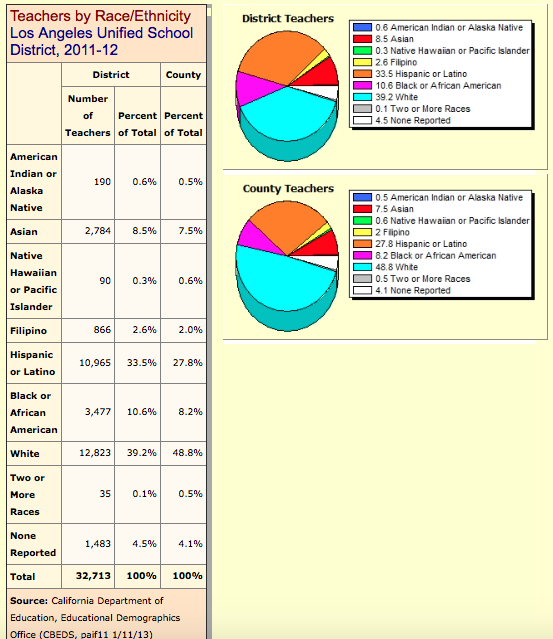
So is PAR discriminatory? On whom might you argue it has a disparate impact? I haven’t put my education stats professor hat on in awhile here at Cloaking Inequity, so it will be good to stretch my legs for just a moment for these analyses. I will focus on 2011-12 because that is the data I have available for comparison purposes for the district population of teachers.
Questions I will address:
- Is there a statistically significant difference in the mean age by race/ethnicity amongst LAUSD PAR teachers?
- Is there a statistically significant difference in the mean pay scale by race/ethnicity amongst LAUSD PAR teachers?
- Are some race/ethnicities disproportionately represented in the LAUSD PAR data?
Is there a statistically significant difference in the mean age by race/ethnicity amongst LAUSD PAR teachers?
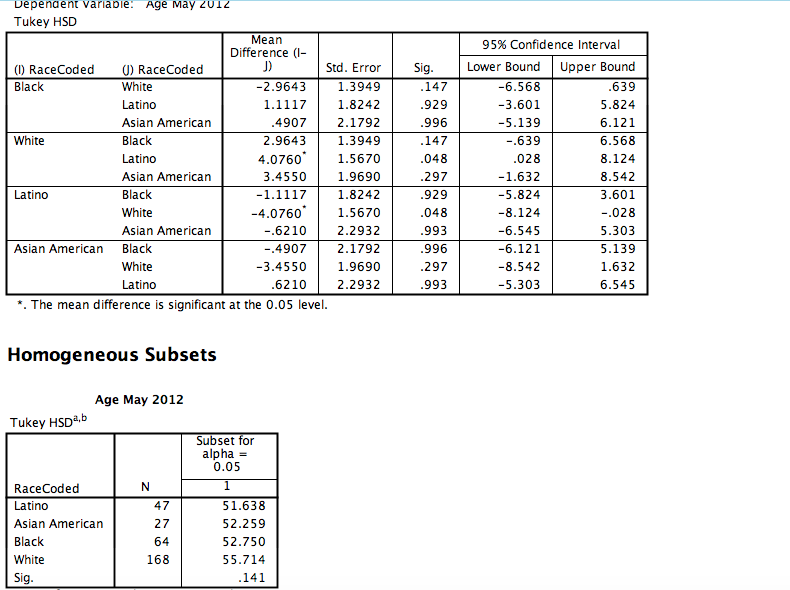
Surprisingly, the ANOVA analyses comparing means demonstrates that White teachers are statistically significantly older in the data. Whites are statistically significantly older than Latinos, but not Blacks or Asians just among the PAR sample. The average age of White teachers is about 55. I don’t know the average age of teachers in LAUSD population, so this is just a “composition” analysis. I can’t calculate relative “composition” or “risk”. Which means that I cannot say from only a PAR sample whether older teachers are being targeted for PAR. You would need data for all teachers in LA Unified for that calculation to answer that question or make suppositions about the possibility. What can be said is that— amongst the PAR sample— Whites are older than other race/ethnicities.
Is there a statistically significant difference in the mean pay scale by race/ethnicity amongst LAUSD PAR teachers?
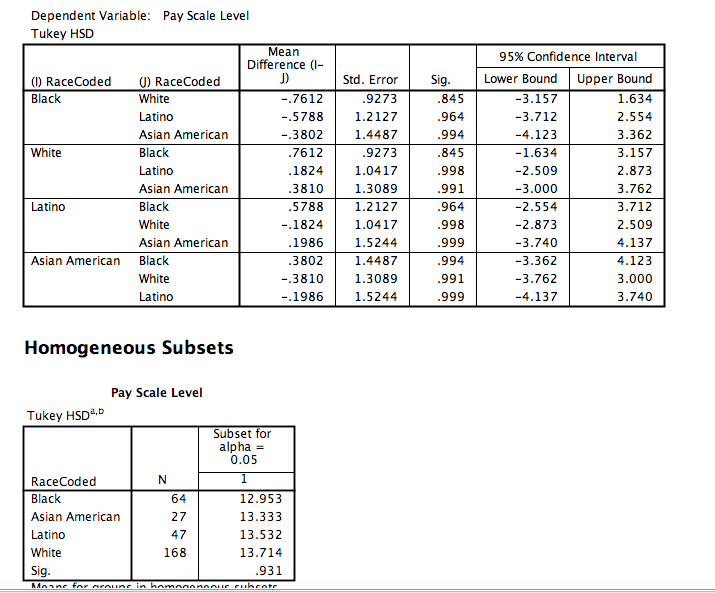
I also conducted an ANOVA to see if there were any mean differences in the pay scales by race/ethnicity for those teachers involved in PAR in LAUSD. The ANOVA shows that there is no mean difference in the sample by race in the pay scales. The average pay scale in PAR is about 13. Again, I cannot say from only a PAR sample whether teachers in higher pay scales are being targeted for PAR, I would need data for all teachers in LA Unified for that calculation and to make suppositions about the possibility.
Are some race/ethnicities disproportionately represented in the LAUSD PAR data?
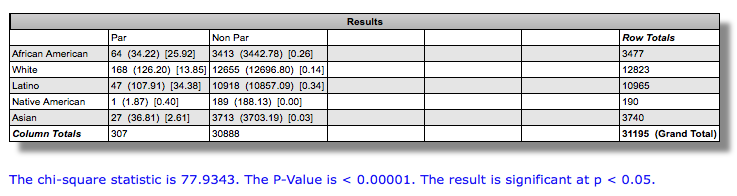
I conducted a Chi-Square analysis of the LAUSD PAR data to answer the disparate impact question. The table of observed and expected frequencies suggests that, in the LAUSD PAR sample, African Americans are over represented by 30 teachers, Whites are over represented by 42 teachers, Latinos are under represented by 60 teachers, Native Americans are under represented by 1 teacher and Asians are under represented in PAR by about 10 teachers. In summary, Whites and Blacks are involved in PAR more than you would expected due to chance— while Latinos, Asians and Native Americans (only slightly= 1 teacher) are under represented.
Mark Naison made the following comment in the thread on this issue:
Ethnic cleansing has occurred in the teaching staffs of urban school districts throughout the country, from DC, to Chicago, to LA. All of those districts have been unionized. Teachers unions have to accept responsibility for the sharp decline in teachers of color on their watch. While PAR may not be the primary explanation for this decline, it has occured in California cities with PAR, in the same or greater proportions than it has in cities outside California without PAR.
Clearly, attracting and keeping teachers of color is an important issue in our society today as our K-12 student population nationwide is now majority minority. I would have been very concerned about PAR if the LAUSD data sent by Brian was in alignment with his very serious accusations. Future research utlizing data from all 30,000 teachers would allow for risk analyses controlling simultaneously for age, pay scales, race/ethnicity and other factors such as school type. These analyses might present findings different than what I have conducted here.
In conclusion, it appears that some have an axe to grind with PAR— but the LAUSD data I analyzed does not sharpen that axe.
Please Facebook Like, Tweet, etc below and/or reblog to share this discussion with others.
Want to know about Cloaking Inequity’s freshly pressed conversations about educational policy? Click the “Follow blog by email” button in the upper left hand corner of this page.
Twitter: @ProfessorJVH
Click here for Vitae.
Interested in joining us in the sunny capitol of California and obtaining your Doctorate in Educational Leadership from California State University Sacramento? Apply by April 1. Go here.





 Cloaking Inequity
Leave a reply to Ruth Wentsel Cancel reply