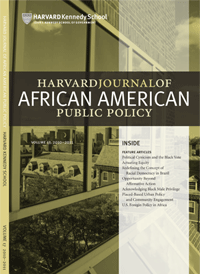
Actuating equity?: Historical and contemporary analyses of African American access to selective higher education from Sweatt to the Top 10% Law

Vasquez Heilig, J., Reddick, R., Hamilton, C. & Dietz, L. (2011). Actuating equity?: Historical and contemporary analyses of African American access to selective higher education from Sweatt to the Top 10% LawHarvard Journal of African American Public Policy27(1), 11-27.

This article examines key events, contexts and policies in the history of selective higher education admissions and enrollment in Texas. The authors find that African American enrollment disparities reduced between 1967 and 2008. The paper also demonstrates that African American enrollment has increased in the Top Ten Percent Plan (TTPP) era relative to earlier time periods. Notably, 70% of African American TTPP students —despite automatic admission— chose not to attend the University of Texas at Austin or Texas A&M, the state’s two public flagships. Considering that the vast majority of African American TTPP students did not attend Texas’ flagship universities, a large persistence and graduation rate gap between flagship and less-selective institutions of higher education has had a disproportionate impact.

Vasquez Heilig, J., Reddick, R., Hamilton, C. & Dietz, L. (2011). Actuating equity?: Historical and contemporary analyses of African American access to selective higher education from Sweatt to the Top 10% Law. Harvard Journal of African American Public Policy, 27(1), 11-27. This article examines key events, contexts and policies in the history of selective higher education admissions and…

9 responses to “Actuating equity?: Historical and contemporary analyses of African American access to selective higher education from Sweatt to the Top 10% Law”

  1. […] Also see his co-authored Actuating equity?: Historical and contemporary analyses of African American access to selective high… […]

    Like

  2. […] of Latinos, African Americans, and English Learners in the midst of the Top 10% plan in the posts Actuating equity?: Historical and contemporary analyses of African American access to selective high… and From Jim Crow to the Top 10% Plan: A historical analysis of Latina/o access to a selective […]

    Like

  3. […] I was a professor at the University of Texas at Austin we published a paper in the Harvard Journal of African American Public Policy that showed that, controlling for ability, students who attended the Texas’ flagship institutions […]

    Like

  4. […] students was aimed at understanding the pipeline of minority students into higher education (See Actuating equity?: Historical and contemporary analyses of African American access to selective high… and From Jim Crow to the Top 10% Plan: A historical analysis of Latina/o access to a selective […]

    Like

  5. […] research institutions (see Vasquez Heilig, J., Reddick, R., Hamilton, C., & Dietz, L. (2011). Actuating equity: Historical and contemporary analyses of African American access to selective highe…. Harvard Journal of African American Public Policy, 17, […]

    Like

  6. […] demographics of students in K-12 (Note: We examined the historical enrollment and segregation of African Americans and Latina/os at UT-Austin in two previous studies). Latina/os are already more than 1/5 of all […]

    Like

  7. […] We examined the historical enrollment of African Americans and Latina/os at UT-Austin in two previous […]

    Like

  8. […] for improvement in higher education? Of course. We discussed graduation rates across the state for African Americans and Latinos in two previous studies. Sure, the graduation rates statewide are low when compared to […]

    Like

  9. […] addressed the historical enrollment of African Americans and Latinos at UT-Austin in recent papers. We believe the historical data contained within these […]

    Like

Leave a comment

Cloaking Inequity is an online platform for justice and liberty-minded readers. I publish reflections, analysis, and commentary on education, democracy, culture, and politics.

Subscribe to stay informed whenever I publish new content. I never send spam, and you can unsubscribe anytime—no strings attached.

Go back

Your message has been sent

Email me at jvh@alumni.stanford.edu