Are charters better on “college readiness” for Latina/os?

After my testimony to the TX Senate Committee on Education on charters yesterday, someone stopped me in the hallway of the capitol and responded to a portion of my testimony by arguing essentially that charters are over-represented in the Latina/o college-readiness (majority of school college-ready) data relative to non-charter public schools. This is an interesting hypothesis that can be quickly tested using a Chi-square statistical analysis.

Research Question: Are charter high schools more likely to have a majority of their Latina/o students “college-ready” than non-charter public high schools. The first run is for all high schools with 50% of Latina/os college-ready in the state of Texas in 2011 (The most recent data I have on my laptop). The second run is for secondary schools in the state of Texas that are majority Latino with 50% of Latina/os college-ready.

In the first run you can see that 343 secondary schools have 50% of the Latina/os college ready in 2011. Of those, 329 are non-charter public schools and 14 charters. That means that 30% of all non-charter high schools in the state of Texas have 50% of the Latina/os college ready while only 20% of charters do so. The Chi-square is not statistically significant at alpha of .05 (Though it almost is at .06 in favor of traditional public schools). So there is no statistical different between charters and non-charter public schools for college readiness (See below).
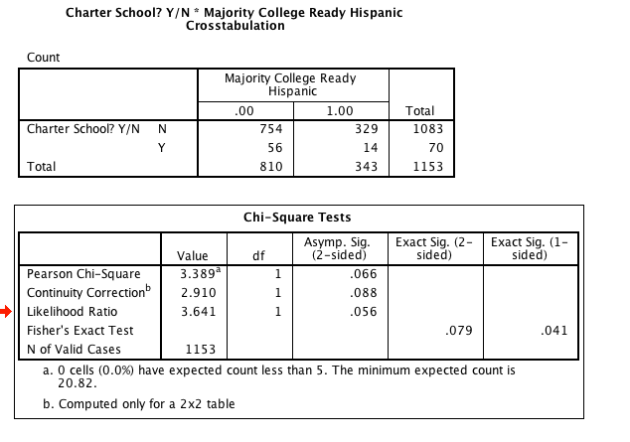
Screen Shot 2013-02-22 at 9.59.55 AM

In this second run on only majority Latina/o secondary schools you can see that 79 schools have 50% of the Latina/os college ready in 2011. Of those, 69 are non-charter public schools and 10 are charters. That means that 16% of all non-charter high schools that are majority Latina/o in the state of Texas have 50% of the Latina/os college ready while 17% of charters do so. The Chi-square is not statistically significant at alpha of .05. So there is no statistical different between charters and non-charter public schools for college readiness (See below).

Screen Shot 2013-02-22 at 10.00.08 AM

Answer: No, charters in Texas do not do a better job of having a majority of their Latina/o student body “college ready.”

Also see original posts on college readiness data for Latina/os and African Americans.

After my testimony to the TX Senate Committee on Education on charters yesterday, someone stopped me in the hallway of the capitol and responded to a portion of my testimony by arguing essentially that charters are over-represented in the Latina/o college-readiness (majority of school college-ready) data relative to non-charter public schools. This is an interesting hypothesis…

6 responses to “Are charters better on “college readiness” for Latina/os?”

  1. […] control and privatization is not a magical wand for increasing students success. Teacher quality, lack of college readiness, and student cropping and many other issues are continually noted by researchers in the literature. […]

    Like

  2. […] my educational policy blog, I showed that the vast majority of schools producing college-ready Latino and African-American students in Texas are actually public magnets and traditional public high […]

    Like

  3. […] discussed yesterday, there is a cadre of politicians that believe we can get something for nothing. That we can do […]

    Like

  4. I disagree with your chart. I have taught in charter school and regular public school. I have seen hispanic student learn better when they can work in smaller groups and learn vocabulary need for a better understanding. We also have students from Sudan and vocabulary is the things that can make or break their success in college.Larger public schools are not able to adjust the class for individual needs like charter schools do.

    Like

  5. Professor Vasquez,
    I don’t know much about statistics, but I do understand that .05% is statistically insignificant. Your analysis is a good “education” for me, and shows that one has to be very careful as many people use statistics without understanding them. It takes an expert to shed light on numbers.

    Like

Leave a comment

Cloaking Inequity is an online platform for justice and liberty-minded readers. I publish reflections, analysis, and commentary on education, democracy, culture, and politics.

Subscribe to stay informed whenever I publish new content. I never send spam, and you can unsubscribe anytime—no strings attached.

Go back

Your message has been sent

Email me at jvh@alumni.stanford.edu