Donald Trump promised during his presidential campaign to spend $20 billion on school choice in his first 100 days. The rumor out of DC is that those funds will come from Title I —if he actually keeps this campaign promise. The fact that Betsy DeVos, a prominent supporter of vouchers for school run by corporations and churches, has been nominated as US Secretary of Education appears to suggest that he will.
Vouchers are being sold by Howard Fuller (who has come out in support of Betsy Devos) and other privatization proponents as civil rights.
https://twitter.com/ProfessorJVH/status/819641169504153600
https://twitter.com/ProfessorJVH/status/819642100195045376
However, what should be know is that vouchers were first created and used for two primary purposes— profit and to discriminate against children of color.
Milton Friedman, a white academic from the University of Chicago, invented the idea of school vouchers in the mid-1950s. He was very clear about his belief that corporations should profit from education and run schools— not the public. In 1997 he wrote “Public Schools: Make Them Private” He argued that vouchers were “a means to make a transition from a government to a market system,” to enable “a private, for-profit industry to develop that will provide a wide variety of learning opportunities and offer effective competition to public schools.” In addition to abolishing the public system of schools, he also believed that vouchers could be used to stack schools by race if folks so chose.

However, vouchers were not and are not being sold to the masses as a massive attempt to privatize or engineer schools, instead vouchers are politically framed as mostly “limited” approaches that would help poor children in cities (!?). Save our Schools New Jersey writes,
Pro-privatization foundations and think tanks market-tested the idea of vouchers as an intervention for high-poverty school districts and found that it was more palatable to voters than a broad-based voucher program that would be open to all children. The nation’s first modern school voucher program was passed into law by the Wisconsin legislature in 1989, targeting students from low income households in the Milwaukee School District. Despite poor academic results and an extremely high rate of turnover, voucher supporters were able to grow this pilot program significantly, once it was enacted, including a particularly large expansion in June 2013, under the leadership of Governor Scott Walker.
As of late-2012, targeted private school voucher programs were in place in the cities of Cleveland, Milwaukee, New Orleans, and Racine; in the District of Columbia, Colorado’s Douglas County, as well as statewide in Arizona, Florida, Georgia, Indiana, Illinois, Iowa, Louisiana, Minnesota, Pennsylvania, Ohio, Oklahoma, Rhode Island, Utah and Virginia. Although vouchers have consistently failed academically, legislatures in Indiana, Louisiana and Wisconsin have expanded their initially targeted programs statewide.
Are vouchers really for low-income and children of color? In 2014, the NC NAACP filed an amicus brief challenging the constitutionality of North Carolina’s voucher program. After Brown v. Board of Education, Southern states decide that they would desegregate with All Deliberate Slowness. One of the ways that they implemented this approach was school vouchers. Vouchers were the confederacy’s response to Brown v. Board (See New Research: Vouchers— schools do the choosing). The NAACP brief was cited in a blog as saying,
This report and the Pearsall Plan were adopted by the General Assembly in 1956. Governor Luther Hudges told the legislators at the opening of the session that “the people of North Carolina expect their General Assembly and their Governor to do everything legally possible to prevent their children from being forced to attend mixed schools against their wishes.” Governor’s Address to the General Assembly, July 23, 1956, 10 Senate Journal.
Neither the Governor nor the all-white legislature disappointed those expectations. The quarter of the state represented by the NC NAACP was ignored. The State established a procedure for local referenda which would permit a school district that was ordered to desegregate to close all its public schools. The State would then provide vouchers to white students in those districts to attend private schools. The rationale behind the statutory change regarding the State Board of Education and non-public schools was out in the open. The ploy of state oversight helped legitimize the use of taxpayer dollars to fund white families’ abandonment of desegregated public schools and to subsidize racially segregated private schools (See Morgan, History of Private School Regulation in North Carolina, p.3). This is the direct and notorious ancestry of school vouchers in North Carolina, and the corrupt foundation upon which the current voucher legislation is built.
What’s shocking is that private school “segregation academies” were in created in states across the South at that time, and they still exist today! In fact, they are even very prominent in African American majority counties.
As the NAACP worked to desegregate North Carolina’s public schools from 1968 to 1972, private school enrollment nearly tripled in the state from approximately 18,000 to over 50,000. Increased enrollment in private schools, furthermore, was often concentrated in areas with high populations of African-American students.
The NAACP found the following:
- Bertie County is 62% African American. Lawrence Academy was founded in Bertie County in 1968. Its student body is 98% white.
- Halifax County is 53% African-American. Halifax Academy and Hobgood Academy were both founded in 1969. Halifax Academy is 98% white; Hobgood Academy is 95% white.
- Hertford County is over 60% African-American, but Northeast Academy, established in 1966, is 99% white.
- Vance County is 49% African-American; Kerr-Vance Academy, established in 1968, is 95% white.
Some of legacy “academies” in North Carolina are still clear about how you can attend their predominately white schools.
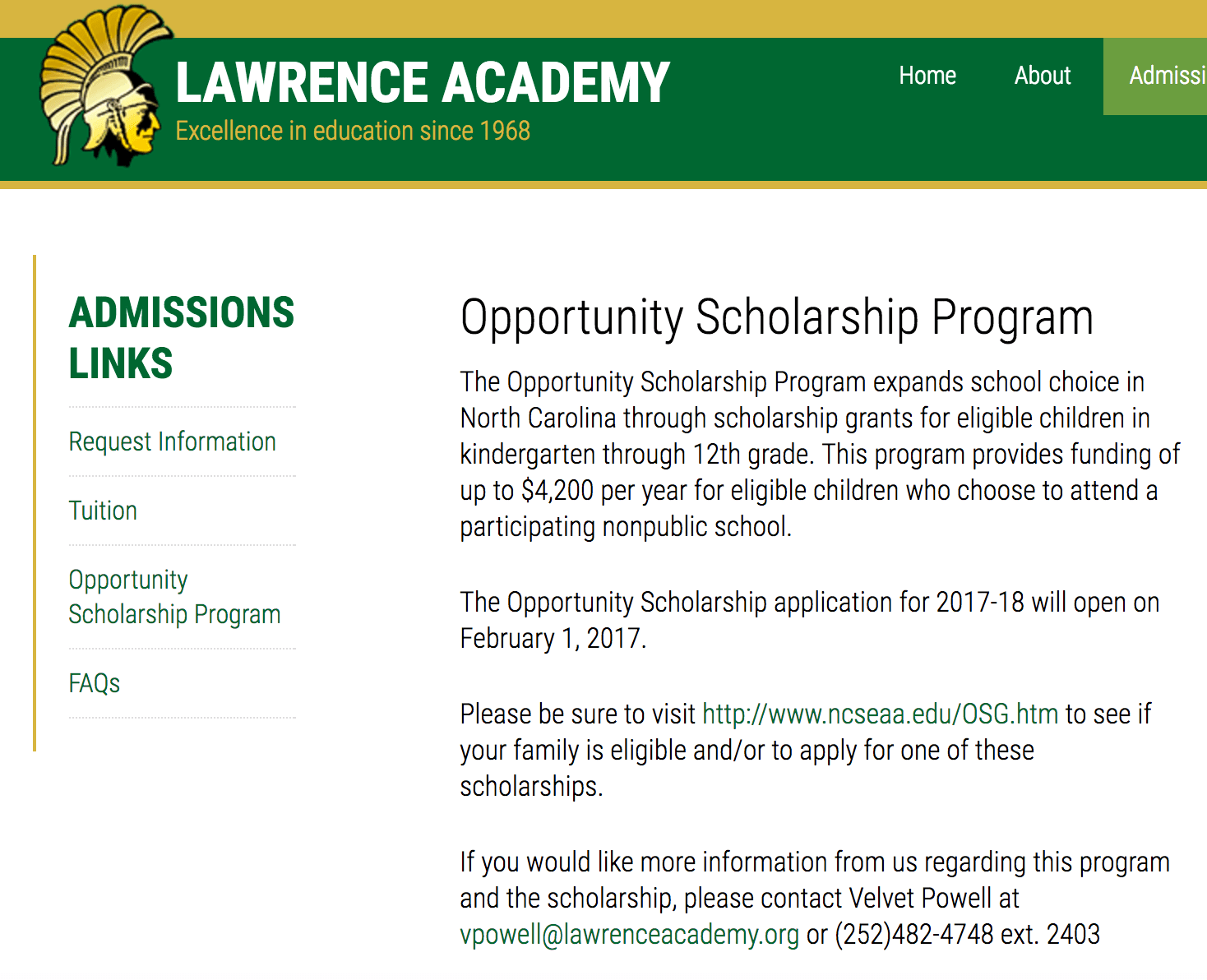
This current screenshot shows that the Lawrence Academy is open for business, and you can use North Carolina’s voucher to attend their segregated school.
The NC NAACP concluded,
A diverse, well-funded public school system is the cornerstone of a successful state,” said Rev. Dr. William J. Barber, II, president of the NC NAACP. “The extremists’ attack on public education is a blatant attempt to further drain our schools of resources. It will not help the great majority of black and other children of color, who will be further isolated and stranded in under-funded public schools.
“The brief points out that the extremists, which have pushed ‘vouchers’ for years, have admitted it tries to get a few minority children and parents as public relations images to disguise the racialist purposes and patterns behind their ploy,” Dr. Barber continued. “The Forward Together Moral Movement will not rest until North Carolina upholds its constitutional and moral responsibilities to ensure every child receives well-funded public education opportunities.
I think it’s also important to the note that the predominance of the peer reviewed research literature (There are always studies funded by neoliberal think tanks and produced by faculty at the University of Arkansas floating around promoting vouchers) demonstrates that vouchers actually have a negative impact on students. Diane Ravitch cites Christopher Lubienski, who is a professor of educational policy, organization, and leadership at the College of Education at the University of Illinois. He has written extensively about markets and schools. His most recent book is “The Public School Advantage: Why Public Schools Outperform Private Schools.”
For years we’ve heard about how the most rigorous studies of voucher programs consistently show significant gains for students — especially urban minority students — and no evidence of harm. While that claim was highly questionable, it was nonetheless a central talking point from voucher advocates intent on proving that vouchers boost academic achievement. The idea that vouchers didn’t hurt, and probably helped, the students trapped in failing urban schools and most in need of options was used to justify calls for the expansion of vouchers from smaller, city-level policies to state-wide programs open to an increasing number of students.
Now, a slew of new studies and reviews — including some conducted by the same voucher advocates that had previously found vouchers “do no harm” — is telling quite a different story. New reviews of existing voucher studies are pointing out that, overall, the impact on the test scores for students using vouchers are sporadic, inconsistent, and generally have “an effect on achievement that is statistically indistinguishable from zero.”
But some new studies on vouchers in Louisiana raise substantial concerns, finding that students using vouchers were significantly injured by using vouchers to attend private schools.
In conclusion, as a person who attended public and private (christian) schools growing up, if you would have asked me 15 years ago my opinion on vouchers, I probably would have written a blog post that was favorable to the approach. However, as I began to engage in the research over the past decade, I have become more critical of school vouchers, their origin, and the real intent of policymakers and other proponents (i.e. Betsy DeVos and Howard Fuller).
Chile is also important. To be honest, I had learned about the Chilean voucher system as a Stanford doctoral student in Martin Carnoy’s courses, but my real awakening happened when I sat on the dissertation of a Chilean graduate student at the University of Texas at Austin. His research on the segregative impacts of vouchers in Chile over the past several decades really opened by eyes to what could happen in the United States if Betsy DeVos and Howard Fuller are successful in their crusade to privatize our education system. Considering the history and ongoing research about schools vouchers, we should be concerned about a system of education controlled by corporations and churches.
To read more about what happens in a system where every child has a voucher click here.
Please Facebook Like, Tweet, etc below and/or reblog to share this discussion with others.
Check out and follow my YouTube channel here.
Want to know about Cloaking Inequity’s freshly pressed conversations about educational policy? Click the “Follow blog by email” button in the upper left hand corner of this page.
Twitter: @ProfessorJVH
Click here for Vitae.



 Cloaking Inequity

Leave a reply to Steve Ruis Cancel reply