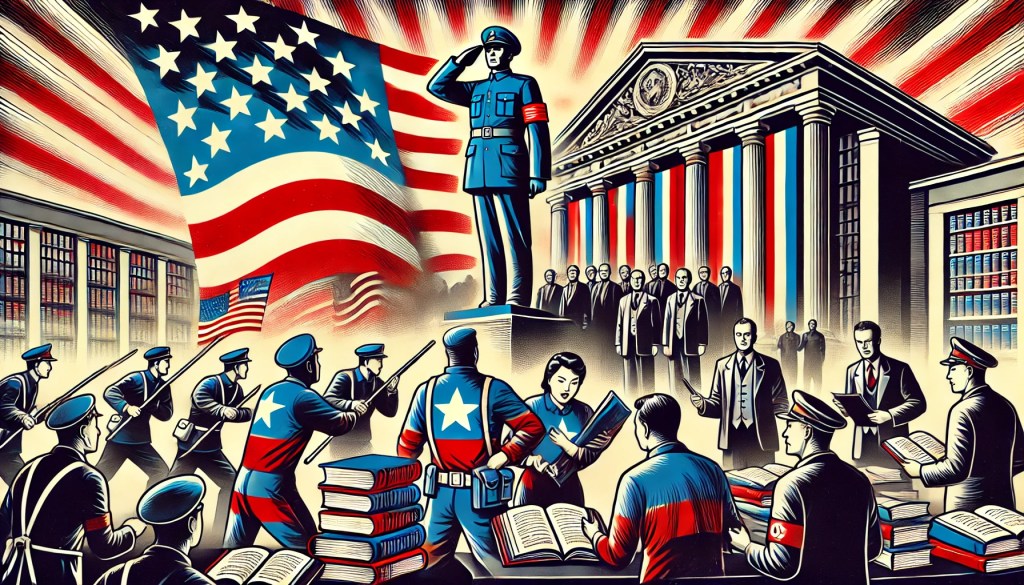
The term “Cultural Revolution” is most closely associated with China’s Proletarian Cultural Revolution (1966–1976) and Iran’s Cultural Revolution (1980–1987)—two radical movements that upended institutions, targeted intellectuals, and reshaped society to fit ideological purity tests. These revolutions led to the purging of educators, the rewriting of history, and the persecution of those who refused to conform.
Now, in 21st-century America, we are witnessing our own version of a Cultural Revolution—a movement not officially declared, yet unmistakable in its impact. Books are being banned, history is being rewritten, universities are being politically purged, and ideological loyalty is being demanded in classrooms and workplaces. While the American movement is unfolding in a different political and cultural context, the tactics bear an unsettling resemblance to those used in China and Iran.
China’s Cultural Revolution: Purging the “Wrong Thinkers”
Mao Zedong launched China’s Cultural Revolution in 1966, mobilizing students and young radicals into the infamous Red Guards to purge the country of what he deemed “Four Olds”—old customs, old culture, old habits, and old ideas. Universities were shut down, professors were publicly humiliated, and intellectuals were beaten or sent to forced labor camps for re-education. Books were burned, historical sites were destroyed, and even traditional Chinese medicine and art were condemned as remnants of bourgeois decadence.
At the heart of Mao’s revolution was the belief that intellectuals and experts were dangerous obstacles to ideological purity. The movement demanded total allegiance to Maoist doctrine, criminalized dissent, and turned the population against itself, encouraging citizens to report and denounce colleagues, teachers, and even family members. The result? A generation terrorized into silence, the loss of academic and artistic freedom, and a culture of fear that stifled innovation and progress for decades.
The American Parallel: Censorship and Political Purges in Education
In today’s United States, we are seeing a disturbing resurgence of ideological purges in education, albeit from different political angles. Books are being banned in dozens of states, from works on race and civil rights to literature about LGBTQ+ experiences. Teachers are being fired or intimidated for teaching so-called “divisive” subjects like systemic racism, gender studies, and the history of oppression.
Legislative efforts such as Florida’s “Stop WOKE Act” and similar bills across the country criminalize discussions of race and gender in classrooms—mirroring the suppression of free thought during Mao’s revolution. Just as Chinese professors were forced to publicly confess their ideological “sins” in struggle sessions, American educators now fear losing their jobs for acknowledging historical truths that some find uncomfortable.
In a move reminiscent of historical Cultural Revolutions, the current U.S. administration has intensified efforts to dismantle Diversity, Equity, and Inclusion (DEI) programs within federal agencies. Federal employees have been directed to report colleagues engaged in DEI initiatives, with warnings of “adverse consequences” for non-compliance. This strategy mirrors past tactics where citizens were encouraged to denounce peers to enforce ideological conformity. Such measures risk fostering a culture of fear and suspicion, undermining workplace cohesion and the foundational principles of diversity and inclusion.
The attack on DEI initiatives in universities and workplaces also echoes the Red Guards’ demand for ideological purity. Universities like Columbia, once bastions of academic freedom, are now dismantling programs and restricting discourse in response to mounting political pressure aimed at erasing uncomfortable truths from the classroom.
Iran’s Cultural Revolution: Theocratic Control Over Education
Following the 1979 Iranian Revolution, the Islamic Republic launched its own Cultural Revolution (1980–1987) to purge Western and secular influences from universities and force academia to conform to strict Islamic ideology.
Thousands of professors were fired, students were expelled, and entire academic departments were dismantled. Books that did not align with Islamic doctrine were removed from libraries, and intellectuals who opposed the government’s new order were imprisoned or executed. Education was restructured to serve the ruling ideology, leaving little room for free inquiry or dissent.
The American Parallel: Politicizing Schools and Higher Education
In the United States today, education is increasingly being reshaped to serve ideological interests rather than intellectual growth. We have seen governors and state legislatures rewrite curriculums to promote a particular nationalist or religious viewpoint, much like Iran’s effort to replace secular education with religious doctrine.
Several states have initiated measures to reshape educational curricula and institutional governance, reflecting a trend toward promoting a particular ideological perspective. Florida has taken a leading role in this movement with Senate Bill 266, which restricts public universities from funding programs related to diversity, equity, and inclusion (DEI) and mandates the removal of certain majors deemed to be based on “unproven, theoretical, or exploratory content.” The law aims to refocus educational content toward a more traditional portrayal of American history and values. Texas has followed a similar path with Senate Bill 37, which proposes sweeping changes to the governance of public colleges and universities, including reorganizing faculty senates, establishing public curriculum review committees, and expanding the authority of university governing boards. These boards would have greater control over faculty hiring, tenure decisions, and administrative appointments, allowing for more direct political influence over higher education leadership.
Alongside curriculum restrictions, states like Florida and Iowa have led the nation in school book bans, with Florida alone removing nearly 4,500 books from school libraries in the 2023-24 school year. Texas has also reported 93 attempted book bans, targeting over 2,300 titles, many of which address LGBTQ+ issues, racial history, and social justice topics. In Florida, the restructuring of university leadership has already resulted in the removal of certain academic programs and the installation of politically aligned administrators, particularly at institutions like New College of Florida, where Governor Ron DeSantis has sought to control the school’s leadership and curriculum. These actions have raised concerns about academic freedom and the increasing influence of political agendas in education, echoing historical instances where governments sought to control knowledge and dictate acceptable discourse.
The Supreme Court’s Role in Expanding Theocracy in the U.S.
In recent years, the U.S. Supreme Court has issued several rulings that blur the traditional separation between church and state, leading to increased federal support for religious institutions, particularly in education. These decisions have significant implications for the rise of theocracy, the role of religion in public life, and the allocation of taxpayer funds.
Federal Funding for Religious Schools
A pivotal case in this context is Carson v. Makin (2022). The Court ruled that if a state provides tuition assistance for private education, it cannot exclude religious schools from such programs solely based on their religious affiliation. Chief Justice John Roberts, writing for the majority, stated that Maine’s exclusion of religious schools from its tuition assistance program violated the Free Exercise Clause of the First Amendment. This decision built upon the Court’s earlier ruling in Espinoza v. Montana Department of Revenue (2020), which similarly held that states cannot disqualify religious schools from public benefits solely because of their religious character.
Religious Practices in Public Institutions
The Supreme Court has also addressed the presence of religious practices within public institutions. In Kennedy v. Bremerton School District (2022), the Court sided with a public high school football coach who was dismissed for praying on the field after games. The Court held that the coach’s prayers were a form of private speech protected by the First Amendment, emphasizing that such religious expressions could not be prohibited by the school district.
These rulings set new precedents, making it easier for public institutions to favor religious beliefs and practices over secular governance, a move that mirrors the rise of theocratic control in Iran’s Cultural Revolution.
The Consequences of Cultural Revolutions: What Comes Next?
Cultural Revolutions do not just suppress knowledge—they stifle progress, silence dissent, and turn societies against themselves. China’s revolution created a lost generation who missed years of education and intellectual development. Iran’s revolution cemented theocratic control over knowledge, setting back scientific and social progress for decades.
If the United States continues down this path, the consequences will be equally dire:
- A Generation of Fearful Educators – Professors and teachers will self-censor rather than risk being fired or harassed for discussing “sensitive” topics.
- The Politicization of Knowledge – Universities will be forced to teach history, science, and social studies through a politically approved lens rather than objective inquiry.
- A Nation in Intellectual Decline – Suppressing free thought and open inquiry weakens a society’s ability to innovate, adapt, and compete globally.
Conclusion: Our Cultural Revolution Is Here
The United States is undergoing its own Cultural Revolution, and while it may not involve the mass executions or labor camps of China and Iran, the suppression of knowledge, forced ideological conformity, and attacks on educators follow a familiar playbook. The effort to rewrite history, silence dissent, and reshape education to fit political agendas has been a hallmark of authoritarian regimes throughout history. What we are witnessing today is not just a debate over policy—it is an existential struggle over the future of intellectual freedom in America.
Throughout history, nations that have compromised academic freedom and the open exchange of ideas have suffered devastating consequences. In the Soviet Union, scientists and scholars who did not align with state ideology were imprisoned or executed, setting back scientific progress for decades. In Nazi Germany, the book burnings of 1933 signaled the beginning of an intellectual and cultural purge that helped fuel a totalitarian regime. And in China’s Cultural Revolution, universities were closed, intellectuals were humiliated and imprisoned, and entire generations were denied a meaningful education, all in the name of ideological purity.
Ronald Reagan, in his famous address to the British Parliament in 1982, warned of the dangers of suppressing free thought and democratic values:
“Freedom is never more than one generation away from extinction. We didn’t pass it to our children in the bloodstream. It must be fought for, protected, and handed on for them to do the same.”
We are at a crossroads. Will we allow political forces to dictate what can and cannot be taught, read, or discussed in our schools and universities? Will we accept a future where teachers fear retribution for speaking truthfully, where books are banned for challenging official narratives, and where students are denied access to a full and honest education?
Or will we stand up for intellectual freedom before it’s too late?
The choice is ours—but history warns us that inaction has dire consequences.


 Cloaking Inequity
Leave a comment