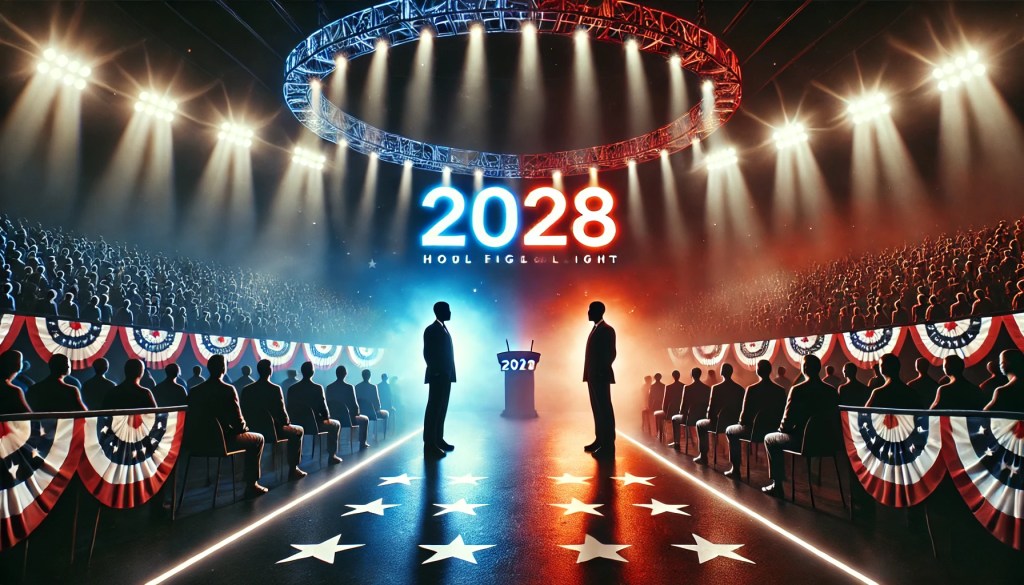
So I was watching Chris Cuomo’s show the other night, and there it was: Steve Bannon, in all seriousness, said that Republicans are working on a way to allow Donald Trump to run for a third term. Bannon called Trump “the greatest political talent in a generation.”
Whether you agree or not, that comment got my wheels turning.
What if, just for a moment, we played out the thought experiment? What if the Constitution was changed and former presidents could run again? What would a Trump vs. Obama showdown in 2028 actually look like?
I’ll admit—it sounds like a made-for-Netflix drama. But let’s roll with it.
Age Check: Who’s the Comeback Kid?
In 2028:
- Donald Trump would be 82 years old
- Barack Obama would be 67 years old
That’s a 15-year age gap. Obama would be in his political prime for a third act, while Trump would be trying to make history as one of the oldest leaders ever elected. Think about it: this would be like Ali coming out of retirement to face a slightly older George Foreman… but on a debate stage.
Age in politics is tricky. We’ve seen Biden, now in his 80s, take on the rigors of the presidency. We’ve seen younger leaders like Justin Trudeau or Emmanuel Macron bring a different energy to the world stage. In a Trump-Obama 2028 showdown, it wouldn’t just be about age; it would be about vision, clarity, stamina, and presence.
And it’s worth noting that Obama, while quieter in recent years, hasn’t faded. His speeches still go viral. His book topped bestseller lists. His foundation is growing. His Netflix partnership is productive. Meanwhile, Trump has stayed relentlessly in the spotlight, continuing rallies, court appearances, and the occasional social media thunderstorm. The contrast is stark.
Rematch Energy: History Has Seen This Before
You don’t need to look far to find legendary rematches that captivated the world. Think about:
- Ali vs. Frazier III — The “Thrilla in Manila” was brutal, emotional, and the culmination of a trilogy where more than just boxing was on the line.
- Lakers vs. Celtics in the 1980s — Magic vs. Bird wasn’t just a basketball rivalry; it was coast vs. coast, charisma vs. grit.
- Serena vs. Venus — A sibling rivalry that elevated tennis and showed how greatness evolves over time.
Political rematches are rarer, but they’ve happened:
- Adams vs. Jefferson battled it out in the early days of the republic.
- Cleveland vs. Harrison saw Grover Cleveland lose, then win it back four years later.
- Even Nixon, after losing to Kennedy in 1960, made a triumphant return eight years later.
Obama vs. Trump would be the ultimate rematch. Not just two presidents. Two brands. Two cultural forces with global name recognition and fiercely loyal bases.
Style Clash: Cool vs. Chaos
If there’s one thing a rematch like this promises, it’s contrast. Obama is cerebral, deliberate, often professorial. Trump is bombastic, unscripted, and thrives on disruption.
Imagine the debates. Obama quoting poets and intellectuals, calmly weaving in policy. Trump lobbing zingers, interrupting, pivoting to grievance, leaning into populism. Their 2016 interactions showed flashes of this dynamic, but in 2028, the stakes and tone would be even higher.
Obama is the polished orator with a talent for connection. Trump is the showman, tuned into the anger and anxieties of his base. The style clash alone would make for a political spectacle unmatched in history.
What the Numbers Might Say
Polling in this fantasy matchup would be a political scientist’s dream. Obama left office with high approval ratings, particularly among younger voters and communities of color. Trump, even amidst multiple investigations, remained the GOP’s central figure with a solid base of support.
But how would the numbers shake out in a real 2028 election?
- Obama could re-energize younger and more diverse voters who may have disengaged.
- Trump would lean heavily on his rural and older base, pushing turnout through fear of the Liberals and loyalty.
- Independents would be the wild card, potentially swayed by the tone, issues, and economic conditions of the moment.
Would it be close? Probably. Would it break turnout records? Almost certainly.
The Spectacle Factor
Picture this: stadium debates, Netflix documentaries, podcasts dissecting every move, SNL skits, op-eds, think pieces, merch drops, protest marches. The country wouldn’t just be watching—it would be emotionally invested. It would feel like the Super Bowl of democracy.
And yes, it would be divisive. That’s baked in. But it would also be clarifying. These two figures represent vastly different visions for America’s past, present, and future.
Would it be exhausting? Probably. Would it dominate global headlines? No doubt.
A Marvelous Thought Experiment
I have to admit, I’ve really enjoyed watching Marvel’s What If…? series. It takes the familiar universe of heroes and events and asks simple, mind-bending questions like, “What if Peggy Carter became Captain America?” or “What if T’Challa was taken instead of Peter Quill?” It’s fun, imaginative, and sometimes surprisingly profound.
But more than just entertainment, the series is a meditation on choice, circumstance, and how small changes can lead to entirely different outcomes. It shows us how timelines diverge—and how history, even fictional history, is shaped by those pivotal forks in the road.
Thinking about a Trump vs. Obama 2028 election through the What If…? lens opens a similar door. What if the rules change? What if we broke with historical precedent? What if two of the most iconic political figures of our time met on the national stage one more time?
It’s a dramatic scenario, sure—but like Marvel’s alternate universes, it forces us to examine our values, our institutions, and the fragility (or resilience) of the systems we take for granted. Sometimes fiction—or near fiction—is the best lens to view reality.
The Rules of the Game: Can It Even Happen?
Now, let’s address the elephant in the room: The 22nd Amendment. Ratified in 1951, it limits presidents to two terms. It was a direct response to FDR being elected four times. Since then, it’s been settled law.
But could it change?
Technically, yes—with a constitutional amendment. But that requires a two-thirds vote in both the House and Senate and ratification by three-fourths of the states. That’s an incredibly high bar.
So when Bannon talks about Trump getting a third term, he’s either floating a wild long shot or testing public reaction. Either way, it’s a signal. And it reflects how some political actors are more than willing to stretch norms if it means holding onto power.
Back to Reality (Sort Of)
Look, it’s unlikely that the Constitution gets changed for a third term. But the fact that people are talking about it—out loud, on national TV—is telling.
Still, the idea of a 2028 Obama–Trump rematch is an irresistible mental exercise. It’s the excitement of sports, pop culture, and politics wrapped into one. And it gets us thinking: who really defines a generation? Who leaves a legacy? And what would we want a future rematch to actually represent?
But let’s be real: if the Constitution does not get changed to allow a third term, and it still happens—well… we all know what that means happened to democracy. And if it doesn’t, that says something, too.
Whether you’re Team Obama, Team Trump, or Team “please no more rematches,” one thing’s for sure: 2028 would be one for the history books.
Let’s hope by then, the next generation is ready to write its own chapter.



 Cloaking Inequity
Leave a comment