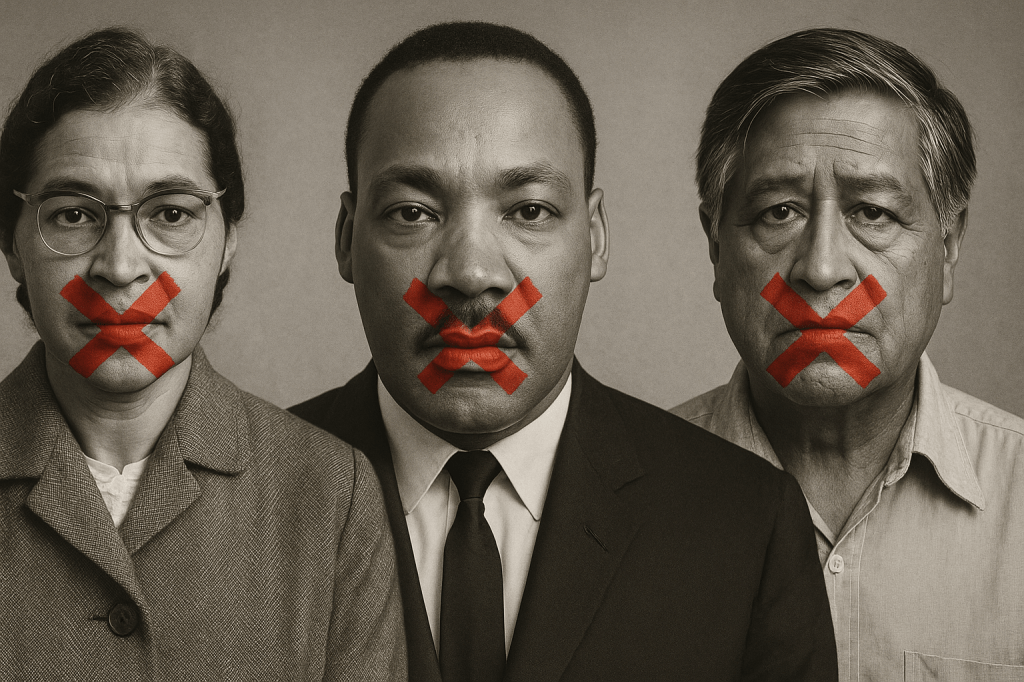
What once referred to innovation in education is now being weaponized to justify attacks on academic freedom, equity, anWhat once referred to innovation in education is now being weaponized to justify attacks on academic freedom, equity, and public trust. Politicians are invoking “disruption” to burn down what they cannot control. University leaders invoke it to appear forward-thinking while often standing still.
But here’s the thing: Not all disruption is created equal.
We are living in an era of competing disruptions. One form seeks to dismantle inclusion, critical thinking, and shared governance. The other seeks to upend centuries of exclusion and rebuild systems to serve all communities—especially those long marginalized.
The question is not whether our institutions are being disrupted. They are.
The real question is: Disrupted for what?
“You must never be fearful about what you are doing when it is right.” — Rosa Parks
Disruption for Inequity: Politically Engineered Regression
A wave of new state laws is transforming higher education—and not for the better.
As The Chronicle of Higher Education recently reported in “New State Laws Target DEI, Struggling Academic Programs, and Tenure,” a coordinated effort by conservative legislatures is rewriting the rules of public education. These policies are not about improvement. They’re about power.
“Riding a wave of conservative activism, several state legislatures have managed to pass laws that will change the college experience.”
These laws have a common goal: to disrupt for inequity. In over a dozen states, we’ve seen:
- The dismantling of DEI (Diversity, Equity, and Inclusion) offices and initiatives.
- The elimination or restriction of tenure.
- Defunding of programs like ethnic and gender studies.
- Censorship of “controversial” speech and curriculum.
- Criminalization of protest and student dissent.
This is not random. It is strategic—and systemic.
It is disruption in the service of exclusion.
And this new normal is being enabled by a specific type of leadership.
The Passive President: Acquiescence in a Suit
Too many university presidents today are unwilling—or unable—to stand up to these political power grabs. They retreat behind vague press releases, defer to hostile legislatures, and privately wring their hands while publicly remaining silent.
Or, just as troubling, they leave one job in a blue state where there are high expectations to advance diversity and justice—and head to a red state where the only expectation is compliance with political whims. In doing so, they trade the hard but necessary work of equity for the safety of political ease and alignment.
This kind of leadership isn’t neutral. It’s acquiescence dressed up as professionalism. It sends a message that power is to be feared, not challenged. That institutional values are negotiable. That equity is expendable.
These leaders are not managing change—they are managing capitulation.
While their bios may boast about navigating “complex political landscapes,” their silence speaks volumes when students are arrested for peaceful protest or when faculty are punished for teaching historical fact with integrity.
This is not courage. It is cowardice posing as pragmatism.
Disruption for Equity: Changemaking, Not Compliance
But disruption doesn’t have to mean destruction. It can mean transformation—if it’s rooted in justice.
Disruption for equity is the kind of bold, community-centered leadership that:
- Protects vulnerable students and faculty from political overreach.
- Champions inclusive pedagogy and equitable admissions.
- Defends tenure as a shield for truth-telling, not a perk of seniority.
- Embraces protest and public pressure as valid tools of democratic accountability.
Disruption for equity asks us to rethink the very architecture of our institutions—to center those historically pushed to the margins, and to challenge the myth that neutrality equals fairness.
“Once social change begins, it cannot be reversed. You cannot un-educate the person who has learned to read. You cannot humiliate the person who feels pride.” — César Chávez
It takes changemakers who recognize that their job is not just to preserve institutions, but to remake them in the image of justice.
It also takes coalition building. Presidents, faculty, students, alumni, trustees, and community partners who share a common purpose: to defend truth, expand opportunity, and affirm the humanity of all who walk their campuses.
Why coalitions? Because they will come to assassinate your character if you don’t have a strong coalition to push back. And you must also be able to let your coalition know when you are under attack. I wrote about that previously in this blog post entitled The New Assassination: Silencing ChangeMakers with Smears
The Chronicle’s Warning: A Shift in the Rules of Engagement
The Chronicle article is a wake-up call. It shows us how far and how fast things have shifted.
“Several of the new state laws now allow political appointees to control hiring, curriculum, and even what is considered ‘controversial’ speech on campus.”
We are watching a quiet coup in higher education. Power is being centralized. Dissent is being criminalized. Academic freedom is being reframed as political subversion.
This is disruption by decree. And it’s coming for us all.
DEI Is About Community Success—And That’s Exactly Why It’s Under Attack
To understand the current attacks on DEI, we must begin by telling the truth: Diversity, equity, and inclusion efforts are not about favoritism. They are about community success.
Despite political distortion, DEI is not an abstract ideology. It is a set of research-based practices designed to foster thriving learning environments, inclusive workplaces, and equitable outcomes.
- DEI is about student success. It ensures that all students—regardless of race, gender identity, ability, or background—have access to advising, mentoring, financial support, and curricula that reflect their lives and histories.
- DEI is about staff success. It promotes equitable hiring, fair evaluations, professional development, and a climate where employees feel respected and heard.
- DEI is about faculty success. It supports inclusive pedagogy, equitable tenure and promotion processes, and policies that protect academic freedom—especially for those from underrepresented backgrounds.
So when politicians launch attacks on DEI, they’re not just targeting an office or a program—they are undermining the success of an entire campus community.
The rhetoric of “reverse discrimination” is a smokescreen. It’s not grounded in fact—it’s designed to hide the real motive: the recognition that students, faculty, and staff will find it harder to succeed in climates stripped of inclusion, affirmation, and accountability.
Let’s be clear: when you take away DEI, you don’t create neutrality—you create a more hostile environment.
As The Chronicle notes:
“The new laws are forcing institutions to rethink or shut down programs meant to help marginalized students succeed. The chilling effect is real.”
The chilling effect is not just on speech—it’s on potential. The attack on DEI is a direct attempt to suppress student retention, employee morale, and academic integrity.
This Is Not About Merit—It’s About Control
The claim that DEI harms merit is not only disingenuous—it’s insulting.
DEI does not replace excellence—it expands it. It recognizes that talent exists in every community, but opportunity does not. It demands systems that correct for exclusion, not through handouts, but through accountability, access, and support.
These attacks are not about fairness—they’re about fear.
Fear that inclusive excellence will shift who holds power. Fear that equity will expose outdated hierarchies. Fear that justice will shine light on truths too long buried.
Let’s stop accepting the premise that DEI is the problem.
The real problem is the intentional sabotage of community success.
The Two Faces of Disruption
So let’s lay it bare:
| Disruption for Inequity | Disruption for Equity |
|---|---|
| Top-down and coercive | Bottom-up and collaborative |
| Driven by political agendas | Driven by justice and inclusion |
| Silences dissent | Welcomes dialogue |
| Defunds diverse programs | Expands access and support |
| Prioritizes image and compliance | Prioritizes truth and community |
| Demands neutrality | Requires courage |
The kind of leader you need for each is radically different.
For inequity: You need a caretaker, a manager, someone willing to trade integrity for access.
For equity: You need a changemaker—someone bold, visionary, and unafraid.
Call to Action: Disrupt for Justice, Not Compliance
If disruption is inevitable, then let us fight for disruption that builds.
Let us fight for:
- A disruption that centers student, staff and faculty voice.
- A disruption that defends knowledge over political expediency.
- A disruption that is led by values, not political polls.
- A disruption that recognizes our institutions are only as strong as the most marginalized among us.
DEI is not the problem. It is the solution being dismantled by those who fear what a more equitable future looks like.
The question is not: Can we afford to defend DEI?
The question is:
Can we afford not to?
And as we make this choice—between silence and courage, between complicity and disruption for justice—let us be guided by the words of Dr. Martin Luther King Jr., who warned us:
“We will have to repent in this generation not merely for the hateful words and actions of the bad people but for the appalling silence of the good people.”
Disrupt wisely. Disrupt boldly. Disrupt for equity. Please share and like this post.




 Cloaking Inequity
Leave a comment