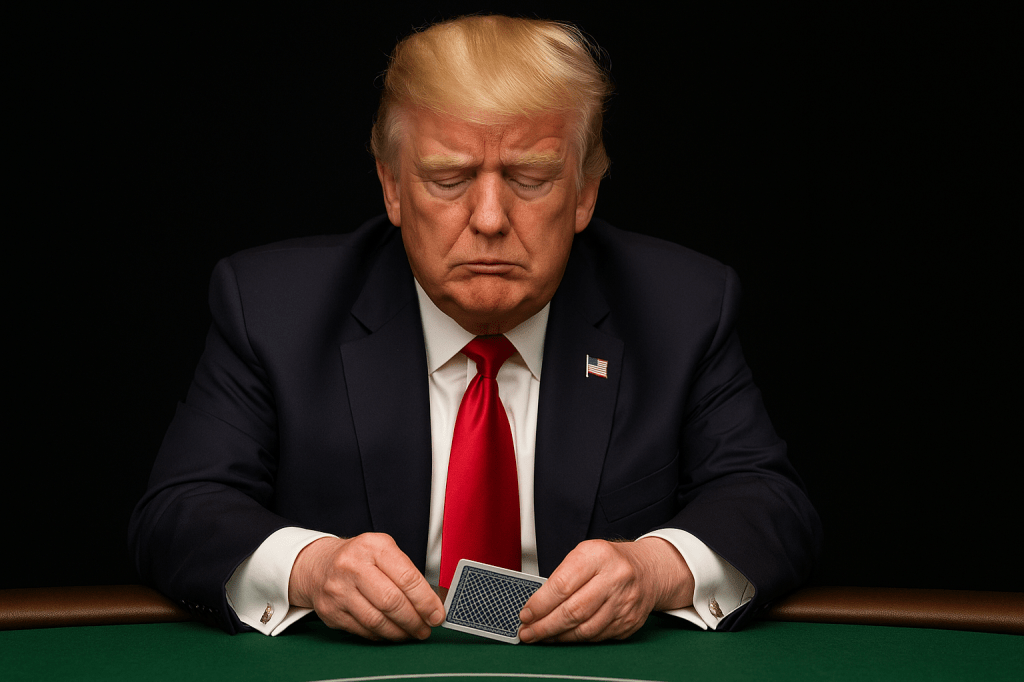
It’s a familiar story by now. The bluster. The threats. The intimidation. And then—when someone finally stands their ground—Donald Trump folds or weakly deflects responsibility to get out of the line of fire.
From the boardroom to the Oval Office, the former president has built a brand on spectacle. But time and again, when confronted with legal pressure, public resistance, or coordinated defiance, Trump retreats. The emperor has no spine.
This reality is not a partisan talking point—it’s a political pattern. And it holds valuable lessons for higher education.
Folding Under Pressure: A Pattern of Deflection
Take Trump’s recent interview comments on one of the most foundational questions for any American president: the Constitution. When asked whether he believed it was his responsibility to uphold the Constitution—particularly in the context of controversial programs like Abrego’s immigration enforcement coordination with El Salvador—Trump dodged. “I don’t know if that’s really my responsibility,” he shrugged, quickly deferring the question to unnamed lawyers.
This isn’t a slip of the tongue. It’s a habit. One that reveals just how hollow the strongman posturing really is.
When pressed about an AI-generated image of himself dressed as the Pope—posted directly to his Truth Social account—Trump again feigned ignorance. “I don’t know where that came from,” he claimed, distancing himself from his own platform’s propaganda. One minute he’s retweeting violent memes and retouching Time magazine covers. The next, he’s supposedly unaware of the most absurd and audacious content being amplified in his name. When the consequences become real, he folds—or deflects, hoping the blame lands elsewhere.
Even Harvard, that perennial lightning rod of liberalism, saw this game unfold firsthand. When the Trump administration sent the university a constitutionally dubious letter demanding ideological compliance, Harvard publicly pushed back. The result? The administration sheepishly claimed the letter had been “sent in error.” The implication was clear: Trump’s team blinked. Their threats are often hastily drafted and rarely defensible.
And then there’s the state of Maine. A few months ago, Governor Janet Mills responded to Trump’s ultimatum over federal nutrition funding with four fearless words: See you in court. Trump’s USDA had threatened to withhold school meal funding from Maine because the state protected the rights of transgender student-athletes. But Mills didn’t flinch—and now, she’s won. The USDA dropped its lawsuit. More than 170,000 children will continue to receive school meals, regardless of gender identity or political pressure from Washington.
These episodes may seem disconnected. But together, they sketch a portrait of a man—and a movement—who caves when challenged. A figure who thrives only when institutions comply silently. And that’s precisely why higher education must not.
A Moment of Moral Choice
Higher education is under siege. From Florida to Texas to Iowa and beyond, colleges and universities face mounting attacks on academic freedom, diversity initiatives, free expression, and shared governance. Faculty are being silenced, students surveilled, curriculum censored. And behind much of this backlash lies Trump himself—or at least the political machine he enabled and continues to helm.
This is no longer just about culture wars. It’s about constitutional ones.
Yet far too many university leaders are meeting this moment with caution when what it demands is courage. They issue carefully worded statements. They convene task forces. They hope the storm will pass.
But hope is not a strategy. Silence is not neutrality. And history will not be kind to those who stood down when they should have stood up.
Because here’s the thing: Trump always folds. Or, when caught, he tries to slide away through weak deflections—shuffling responsibility off to others, hiding behind lawyers, or claiming ignorance. When educators, advocates, and policymakers apply organized, principled pressure, they win. It happened in Maine. It’s happening at Harvard. It will happen when governors, school boards, and civil rights organizations refused to comply with unconstitutional demands.
It can happen across higher education—if we choose it.
Higher Education’s Hidden Power
The American university is not defenseless. In fact, it holds immense cultural, political, and legal power—if only it would use it.
Universities house First Amendment scholars who can challenge unconstitutional gag orders. They employ lawyers who can litigate when DEI offices are dismantled or ethnic studies banned. They shape public discourse, control large endowments, and influence state economies. And, critically, they educate future voters, leaders, and movements.
Yet these same institutions are being cowed into compliance by partisan agendas that fear nothing more than truth, scholarship, and democratic debate.
This is why the New York Times recently issued a rare editorial call to arms, urging the formation of a “grand coalition” to resist “authoritarianism.” It’s not just about internal policy—it’s about democracy itself.
We should take that warning seriously. But we must also see it as an opportunity. Because when universities defend themselves—and their students, staff, and missions—they win.
Five Ways to Make Trump Fold Again
So what does that resistance look like? What would it mean for higher education to call Trump’s bluff, to put pressure where it hurts?
Here are five practical actions colleges and universities can take now:
1. Sue Early, Sue Often
Like Governor Mills, don’t wait for rights to be violated—challenge unlawful policies preemptively. File for injunctive relief when free speech is chilled, DEI offices are targeted, or student rights are infringed. Courts still matter. So does precedent.
2. Join or Lead Multistate Legal Actions
Too often, universities act as isolated actors. But they can and should organize legal resistance at scale—through state university systems, consortia, and national higher education associations. Lawsuits backed by coalitions send a stronger message. We’ve seen this in recent coordinated legal responses led by organizations like the American Educational Research Association (AERA), the Association of Public and Land-grant Universities (APLU), and others. When higher education acts together, it doesn’t just defend—it reshapes the legal and political terrain.
3. Cut Through the Noise with Moral Clarity
Don’t hide behind bureaucratic language. Be as bold in defense of your faculty and students as Trump is in his attacks. Issue statements that name what’s happening: censorship, racism, authoritarian overreach—not just “policy changes.”
4. Refuse Compliance with Politicized Audits
If your institution is targeted for political reasons—such as for promoting anti-racism or LGBTQ+ inclusion—don’t roll over. Demand due process, challenge the legitimacy of the audit, and publicize the overreach.
5. Activate the Academic Community
Faculty senates. Student governments. Alumni networks. Governing boards. All of these bodies have voices, and they need to be heard. Trumpism thrives in silence. Mobilize everyone, not just top administrators.
More Than Symbolic
Teacher Appreciation Week is here. Across the country, we’re seeing thank-you notes, donuts in break rooms, and tributes to educators on social media. But appreciation without action is just branding.
It’s the same with higher education.
Universities love to tout diversity, inclusion, and academic excellence on their websites and brochures. But how many are fighting to protect those values in courtrooms, statehouses, or public discourse?
How many are willing to confront the political bullies head-on?
If they do, they’ll likely find what Janet Mills did: the bully folds. And the kids win.
Final Thought: Pressure Is a Privilege
The lesson here isn’t just that Trump folds. It’s that pressure works.
Universities aren’t powerless. They are essential infrastructure for truth in an era of #alternativefacts. But they need to stop playing defense and start setting terms.
This moment calls for coordinated courage, not crisis PR. It calls for chancellors and presidents to join the “grand coalition” with unions, civil rights groups, legal scholars, and students who refuse to be pawns in a political game.
Because when higher education acts together, it does more than protect itself. It protects democracy.
So let’s stop waiting for permission.
Let’s push back—so he folds, or runs.






 Cloaking Inequity
Leave a reply to gruntinthetrenches Cancel reply