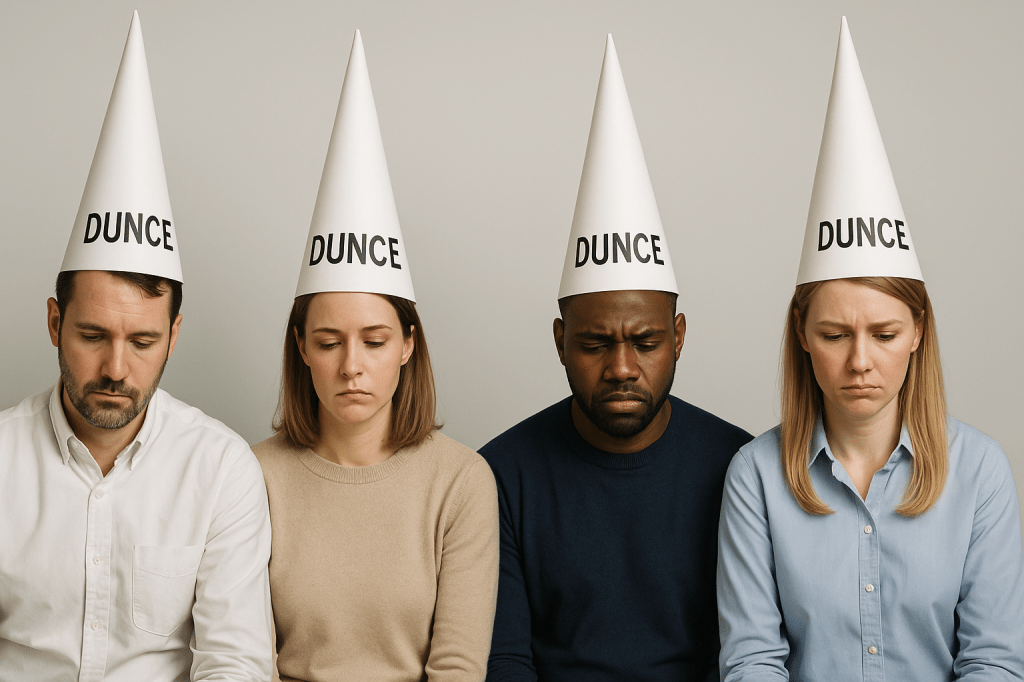
There is a quiet crisis unfolding before us—a deliberate dumbing down of Americans. This erosion is not happening by accident. It is being engineered through a combination of political manipulation, digital disinformation, and technocratic shortcuts that devalue human intelligence, critical thinking, and democratic citizenship.
Let’s be clear: this isn’t just an education issue—it’s a democracy issue.
1. AI Without HI Is a Shortcut to Ignorance
We live in an age where artificial intelligence (AI) is doing more of our writing, thinking, and learning for us. But here’s the danger: AI without HI—Human Intelligence—is dangerous.
AI tools can be helpful in enhancing productivity, but they cannot substitute for a solid foundation of knowledge. Without that foundation, humans will lose their ability to evaluate, contextualize, and question what they’re being shown. Critical thinking is not optional. It is essential. But in our obsession with efficiency and automation, we must avoid erasing the process of thinking altogether. Students now lean on generative AI not just for help but for substitution. We are not teaching with tools. We can’t let tools think for us.
What we need is a generation of students who can use AI wisely, not depend on it blindly. That means grounding learners in the fundamentals of literacy, logic, ethics, and independent thought. Without those anchors, AI becomes not a tool for liberation, but a crutch that disables rather than empowers.
2. Reel-Based Misinformation
Go to any social media platform and you’ll see it: the 30-second reel has replaced the textbook. Short-form video content, much of it emotionally charged and algorithmically boosted, is now a primary source of information for millions of students and adults alike.
Many people don’t even Google to fact check anymore. They believe what they see on Instagram or TikTok reels, often without fact-checking or context. Why search when a stranger with confidence and good lighting tells you what to believe?
This is not education. It’s indoctrination by interface.
These snippets often provide half-truths, misinformation, or outright propaganda—all delivered in a package optimized for attention, not understanding. The result? A culture increasingly shaped by impressions and opinions instead of evidence, and by memes instead of meaningful dialogue.
This trend is especially dangerous in education, where nuance matters. Students are less likely to question what they see if they never learn how to question in the first place.
3. The Tyranny of the Test
Standardized testing has long dictated what counts as “real knowledge” in our schools. But the damage is deeper than just curriculum narrowing. The test-based paradigm teaches students that:
- There is only one right answer.
- You are punished for exploring alternatives.
- Critical thinking and creativity are liabilities.
This mindset bleeds into our politics and our media. We are being trained to believe that truth is singular and that dissent is ignorance. That compliance is the goal.
The test has become a metaphor for American intellectual life: choose the approved answer or be marked wrong. This is not how democracies function. It’s how authoritarian systems condition obedience.
Moreover, standardized testing has consistently reproduced inequality. It privileges certain cultural and economic backgrounds while penalizing linguistic and cognitive diversity. We are not measuring intelligence. We are measuring access—to resources, tutors, familiarity with test-taking tricks.
4. Distrust of Experts and Authoritative Knowledge
Across the political landscape, we are being told to listen only to the “official” and “good” sources—media outlets that echo the talking points of a strongman that is in charge. Everyone else is labeled as a liar, a radical, or a leftist conspiracy theorist.
This climate breeds fear, submission—and, perhaps most corrosively, cynicism. We see it in the rise of whataboutism: the lazy assertion that everyone is equally guilty, so no one is truly accountable. Consider the meme circulating of Donald Trump dressed as the Pope. Whether intended as satire, trolling, or a reflection of inflated self-image, it captures the absurdity of today’s political spectacle. The first reaction many have is: Is this real? Where’s the original post?
Yes, Donald Trump posting a pope photo of himself on his social media account is a real thing.
In this new era of digital distortion, it’s practically a coin flip—there’s a 50/50 chance the image is authentic or artificially manipulated. That uncertainty itself is a symptom of the deeper crisis. The result? Mass confusion. Public disengagement. And the rise of political manipulation. When the public stops believing in facts altogether, it becomes easy for authoritarians to replace reality with fiction.
In classrooms, this shows up as students unable to discern credible sources, unwilling to engage in civic debate, and unable to tolerate discomfort—a key condition of real learning. Which leads to adults who are unable to discern credible sources.
5. Polarized Media Manipulation (Culture as Warning)
We, of course, can’t forget the novel 1984—and now, we’re seeing its warnings echoed across today’s popular culture. Two recent streaming shows highlight just how deeply this crisis of polarization and manipulation has seeped into our collective consciousness.
In The Madness (Netflix), the story begins as a murder mystery. But beneath the surface, it delivers a chilling revelation: Americans are being fed highly curated, polarized information streams—engineered to provoke conflict. The left and the right are shown radically different versions of reality. When they inevitably clash, it doesn’t arise organically—it’s by design.
Who profits from that chaos? The billionaire elites who shape and control both narratives.
Similarly, HBO’s 2073 presents itself as a futuristic sci-fi epic, but it functions as a dispatch from the future. It warns that our increasingly authoritarian present is quietly laying the groundwork for a dystopian tomorrow.
These shows aren’t just entertainment. They’re foreshadowing. They remind us that our media and education systems are no longer cultivating the capacity for critical thinking or collective understanding. Instead, people are being programmed to react, to distrust, and to divide.
6. Strongmen and Manufactured Emergencies
Authoritarian leaders always frame their power grabs as responses to emergencies. Look at recent executive orders: many are grounded not in reality, but in imaginary “emergencies” used to justify expanded power under the law.
Whether it’s immigration framed as a national threat or an ethnic studies class branded as subversive, the goal is the same: manufacture urgency to suppress resistance.
These tactics mirror historical patterns. Create fear. Declare a state of exception. Seize control. And when people or institutions push back, question their patriotism, capacity, or punish them with state power such as arrest, departation, or IRS retaliation.
From banning books to limiting what teachers can say in classrooms, the current wave of censorship and centralization isn’t about protecting children or public institutions. It’s about remaking education into a tool for political control.
7. Historical Erasure Through Curriculum Bans
Many Americans shrug off these trends because they don’t feel the immediate consequences. But education policy is like climate change: the damage is cumulative and often invisible until it is too late.
When we ban ethnic studies, when we gut Black studies, when we erase LGBTQ+ history, we are not just sanitizing the past. We are sabotaging the future.
As the saying goes: those who do not know their history are doomed to repeat it.
The long-term consequences are already here—in declining civic engagement, increasing intolerance, and a generation of students more fluent in memes than in historical memory. Ignorance does not remain passive. It metastasizes into injustice.
8. Public Apathy and Delayed Consequences
A final factor: apathy. Many people assume that if nothing has exploded yet, then nothing is wrong.
But the consequences of educational decay are slow-moving and systemic. Today’s policies shape tomorrow’s mindsets. And by the time we feel the full weight of this intellectual erosion, it will be difficult to reverse course.
We must understand that what feels like harmless policy tweaks today—banning a book here, defunding a program there—is laying the groundwork for cultural amnesia and civic paralysis.
A Way Forward: Resist the Dumbing Down
We need a national recommitment to education that values:
- Critical thinking over conformity.
- Historical context over cultural erasure.
- Human intelligence over solely artificial substitutes.
- Democracy over obedience.
We need leaders who understand that teaching complexity is not dangerous—it is democratic.
And we need communities who will reject the dopamine drip of disinformation and fight for schools and universities that educate, not indoctrinate.
This means fighting for curriculum that addresses real-world issues. It means protecting educators and leaders who speak the truth, even when it’s politically inconvenient. It means investing in teacher preparation that prioritizes justice, empathy, and intellectual rigor.
We are standing at a crossroads. Down one path lies a nation unable to distinguish truth from propaganda. Down the other is a citizenry capable of thought, empathy, and action.
Let’s choose the courage to think—before it’s too late.



 Cloaking Inequity
Leave a comment