I want to have one of the difficult and not often discussed conversations.
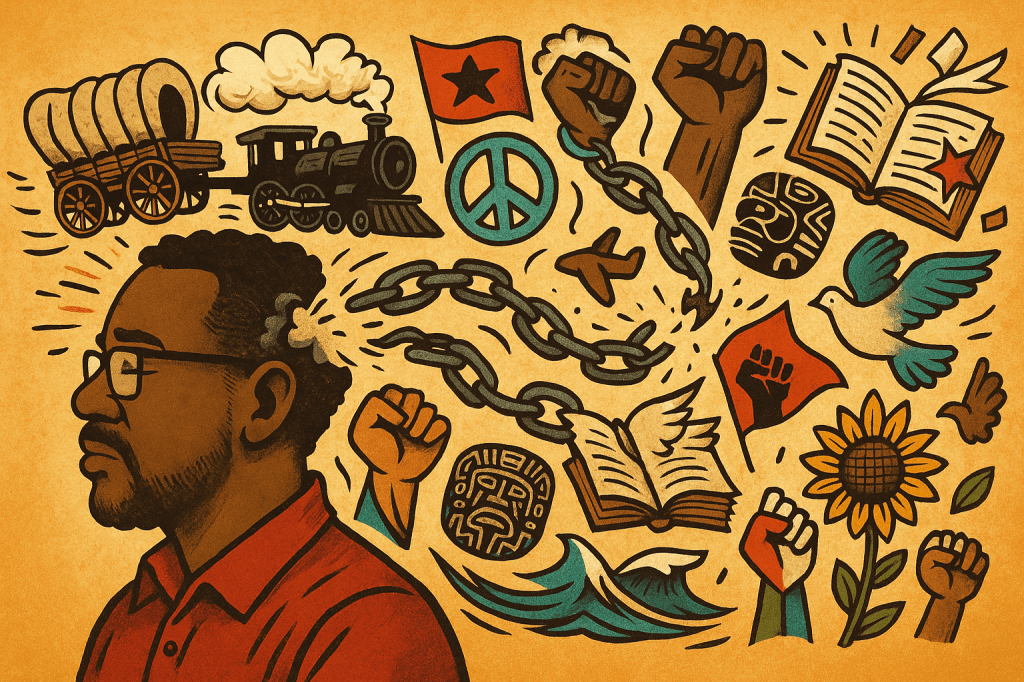
Recently, I was talking with a group of students about the challenges we face within the Latino community based on national origin. The discussion was honest, raw, and necessary. I shared how some Latinx communities in the U.S. replicate the same divisions that exist in Latin America—where being Cuban can be privileged over being Venezuelan, or being Colombian can be seen as more aspirational than being Salvadoran. As we engaged in the conversation, I felt both heartbreak and clarity. And I told them something I’ve said to myself and others many times: we must decolonize our minds.
Because it’s not just external systems we’re fighting—it’s the inherited narratives that live inside us. The ones that whisper that Indigenous means inferior. That light skin signals intelligence. That the closer you are to European heritage, the more respectable or desirable you are. These stories did not come from us. They were fed to us, generation after generation, through conquest, colonialism, slavery, and cultural erasure. And too often, we’ve swallowed them whole.
Decolonizing the mind means asking hard questions. Who taught us to discriminate against our own people? Who benefits from our divisions? Why do we sometimes distrust the leaders who look most like us? It means confronting the anti-Blackness, the anti-Indigeneity, the classism, the casteism, the xenophobia—not just in society, but in ourselves and our communities.
I told the students that we cannot build liberatory spaces in education—or anywhere—until we do that work. The work of justice doesn’t start with legislation or institutions. It starts with how we see each other. It starts with practice and how we see ourselves. If we continue to carry the colonizer’s gaze, even while fighting for freedom, then we are merely rearranging the furniture in a burning house.
We must unlearn the narratives that say power belongs to some, but not others. That say leadership must look a certain way. That say only certain accents are professional, only certain hairstyles are appropriate, only certain names are respectable.
If we want equity, we have to excavate. We have to interrogate what we’ve been taught to value and what we’ve been conditioned to reject. This isn’t theoretical—it’s personal. It’s emotional. And it’s urgent.
And here’s another truth I shared with them: in many of our communities, we share ancestors—sometimes even more closely than we realize. The Mayan student and the Afro-Latinx student, the Puerto Rican and the Dominican—our DNA, our stories, our liberation are intertwined. But centuries of divide-and-conquer have trained us to see difference where there is connection, to view proximity to whiteness as the only currency of safety or success.
These dynamics are real. They are not abstract academic theory. They impact how we lead, how we make policy, how we teach—and how we show up for one another.
Jewish friends have talked to me about the deep pain of rising anti-Semitism—but also about the uncomfortable silence around anti-Palestinian racism. Black colleagues have spoken candidly about how colorism shapes our communities: who gets affirmed, who is considered “safe” in white spaces, who is treated as articulate, and who is given opportunities to lead. Native educators have shared stories of exclusion within their own communities—based on tribal enrollment politics, family lineage, or phenotype. South Asian friends have revealed the persistence of caste discrimination even on U.S. campuses and in Silicon Valley boardrooms. Too often, the internalized hierarchies of the old world are simply imported into the new one.
And I remember one of my favorite Facebook groups—home to more than 10,000 Latinos—suddenly shutting down in the days after the murder of George Floyd. Why? The administrator said he simply couldn’t handle the flood of anti-Black comments flooding the threads. That moment haunted me. Not because it was surprising—but because it was so painfully familiar.
If we cannot stand with one another in times of crisis, how can we claim to stand for justice?
We need to understand what these moments mean. They’re not just isolated failures of our individual character. They are reflections of long-standing structures—built into colonized education systems, reinforced by globalized prejudice, and perpetuated in our own homes and communities. If we want to be serious about equity, we have to start with a hard truth:
Oppression doesn’t only come from “out there.” It can live within us.
Racialized supremacy doesn’t just dominate. It divides. It convinces us that some of us are a little closer to safety and success than others—and that keeping that proximity means distancing ourselves from those who might “drag us down.” This isn’t just a story of institutions. It’s a story of internalized colonialism. And it shows up everywhere.
In Leadership
Nowhere is the contradiction of intra-community bias more visible than in leadership. Especially in education.
Leaders from historically marginalized communities often carry a double burden: confronting systemic racism while also navigating prejudice from within their own groups. I’ve seen Black leaders challenged not by white colleagues, but by lighter-skinned Black peers who question their “fit.” I’ve heard about Indigenous educators invalidated by others in their own communities because of their enrollment status or blood quantum. I’ve watched Latinx leaders wrestle with a version of impostor syndrome not only because of white supremacy, but because other Latinos questioned their legitimacy based on immigration story, language fluency, or how “American” they are perceived to be.
This is especially prevalent in the DEI space. A single leader of color is hired into a hostile or performative institution, and when intra-community bias emerges—whether it’s colorism, casteism, or lateral oppression—it isolates them even more. They become the token, expected to represent everyone, but accepted by few.
But we also need to confront a harder truth: sometimes, those DEI leaders perpetuate the same harm they were hired to dismantle. I have seen DEI leaders literally ignore the communities they were supposed to serve. Skip meetings with affinity groups. Refuse to engage with students or faculty organizing for justice. I have witnessed DEI offices actively work against community efforts—shutting down a pow-wow organized by the Native and Indigenous community and deflecting criticism by playing into the politics of respectability.
Sometimes, the very people who fought their way into the institution spend their time protecting it hostility toward marginalized communities—not transforming it. That is not solidarity. That is gatekeeping.
Let me be clear: these jobs are incredibly difficult. People in DEI roles are often underfunded, under-supported, and placed in impossible political positions. They are expected to heal wounds they did not cause. But that reality cannot excuse active harm. It cannot excuse ignoring the voices of students and colleagues who are already systemically silenced. When you take on a leadership role, especially in equity, you don’t get to opt out of the discomfort. You don’t get to choose which communities deserve dignity.
Leadership development programs must go beyond the surface. It’s not enough to teach people to “navigate the institution.” We must prepare leaders to confront bias both outside and inside their own communities. That includes developing cultural humility, an understanding of intersectionality, and a commitment to justice that goes beyond appearances.
We must also stop romanticizing resilience. Systemic change cannot rest on the shoulders of individual survival. Institutions must create ecosystems of accountability—equity audits that examine who gets mentored and promoted, affinity groups that are resourced not tokenized, and grievance processes that take intra-community harm seriously.
Leadership isn’t just about having a seat at the table. It’s about being accountable for who gets focus, who gets heard, and who gets left out.
In Practice
For many students, the first time they encounter prejudice isn’t from outside their community—it’s from within— in a classroom. A teacher, trying to be affirming, praises the “eloquence” of a light-skinned student but never says the same about their darker-skinned peer. A social studies unit covers Latino heritage but only highlights Spanish conquistadors and Argentine poets—not Garifuna leaders, Indigenous activists, or Afro-Brazilian intellectuals. A student from Syria or Palestine is penalized for “disruptive behavior” after expressing grief about their homeland. A South Asian student from a marginalized caste watches as the curriculum celebrates Gandhi, while their family history of caste violence is rendered invisible. These scenarios are symptoms of a larger failure: our refusal to fully reckon with the diversity within diversity.
Culturally responsive teaching, when done well, can begin to address this. But too often, it only scratches the surface—focused on festivals, food, or flags, rather than power, proximity, and prejudice. Real cultural responsiveness requires more than just honoring a heritage month or reading a novel in a language other than English. It means building a classroom culture where students can bring their full selves—including their trauma, their intersectional identities, and their intra-community experiences.
And this starts with teachers. Too many teacher preparation programs are still centered on outdated, monolithic racial frameworks. They don’t address colorism, phenotype bias, caste oppression, or ethnic stratification. They don’t train educators to recognize how intra-group hierarchies play out between students. They don’t equip them to challenge those dynamics when they arise.
Imagine a classroom where a Dominican student and a Haitian student are in conflict. Or where a Mayan student is teased for “sounding funny” when speaking Spanish. Or where an Indigenous student is told they “don’t look Native.” What should a culturally competent educator do? If their training hasn’t addressed internalized oppression, they may ignore it—or worse, reinforce it.
These are not hypotheticals. They happen. And when left unaddressed, they send students a clear message: Even here, among your own, you are less than.
We also need to talk about curriculum. Who gets included—and who gets excluded—matters. A U.S. history course that teaches about Black civil rights leaders but omits Native and Indigenous activists tells students there’s only one primary version of social change. A Latinx literature syllabus that never includes Central American, Afro-Caribbean, or Indigenous voices is not neutral. It’s a choice. One that replicates existing power dynamics.
I’ve also seen this play out in language access. A school might proudly offer Spanish-language interpretation, but ignore the fact that many Indigenous Latinx students speak Mixtec, K’iche’, or Zapotec. So their parents are left out, silenced by a well-intentioned but monocultural approach to inclusion.
If we want to build educational spaces where students feel seen, we must decolonize our minds. That’s what I told the students I spoke with recently. Decolonizing means recognizing that even those of us from marginalized communities have internalized the values of the colonizer. We have learned to rank ourselves. We have learned who is “less than” and who is “almost white.” And unless we name that learning, we cannot unlearn it.
Unlearning begins in practice—in what we teach, how we teach, and what we allow to happen in our classrooms. It’s in whether a teacher corrects a student using “broken English,” or affirms their multilingualism. Whether a counselor pushes a Central American student into ESL because of their last name, or takes the time to understand their actual academic needs. Whether a curriculum honors the full scope of Native American history—or reduces it to a chapter about the Trail of Tears.
Justice in practice is about the details. Because that’s where the harm lives. And that’s where the healing can begin.
Why This Matters Now
We are living through a time of fierce backlash. DEI programs are being dismantled. Books are being banned. Words like “equity” and “justice” are being twisted into threats. In states across the country, elected officials are trying to erase the very history and truth that so many of us have fought to make visible.
And here’s the hard part: they’re gaining ground.
But here’s the even harder truth: some of our silence and division make it easier for them.
When we fail to confront intra-community bias, we weaken our coalitions. We give oxygen to the lie that justice is only for some. We create cracks in our solidarity that can be weaponized and exploited. As Audre Lorde taught us, “The master’s tools will never dismantle the master’s house.” But what happens when we begin to use the master’s tools against one another?
We get infighting. We get performative diversity without power. We get communities of color who repeat racial supremacist logics to gatekeep their own. We get DEI leaders who—rather than uplift—ignore or suppress the very people they were hired to serve.
I have experienced this firsthand in recent civil rights work where using high-stake testing has been highlighted as the primary solution to improving public education (again)— a retro idea that was thoroughly debunked during the No Child Left Behind era.
Institutions cannot claim to be inclusive when their representatives actively work against community efforts. That is not oversight. That is harm. And it must be called out.
But calling out is only the beginning. What we need is a calling in—a recommitment to real solidarity.
That means being willing to ask: Whose stories are missing? Whose pain have we minimized? Whose freedom have we delayed in the name of comfort or cohesion?
And we must be willing to go further.
We must decolonize our minds. It’s us too. We carry colonized thinking. We inherit hierarchies. We absorb proximity to whiteness as power, to masculinity as legitimacy. And sometimes we wear those legacies like armor—without realizing they’re also chains.
Unlearning is hard. But it is not impossible. And it is necessary.
We must teach our students—by example—that liberation means more than inclusion. It means transformation. Of systems, yes. But also of ourselves.
We don’t have to maintain it.
We can choose something else. Something better.
We can choose to confront anti-Blackness in Latinx communities. We can choose to speak the truth about caste in South Asian spaces. We can choose to honor Indigenous identity in all its forms—not just the ones that look like Hollywood told us they should. We can stand with our Palestinian students and our Jewish colleagues at the same time—refusing to accept that empathy must be either/or.
We can say: colorism is real, and we will name it. Lateral oppression is real, and we will confront it. Sexism in our communities is real, and we will not excuse it.
And we can do that not because we are broken, but because we are whole enough to heal.
The struggle for justice has never been about perfection. It’s about practice. And today, that practice demands that we look inward as fiercely as we look outward. That we clean our own house, even while defending it from attack. That we love our people enough to tell the truth—and to listen when others do.
Let this be a commitment: to do better, to be better, together.
Because the promise of public education is not just to reflect the world as it is—but to prepare us for the world as it should be.
And that world begins with us.


 Cloaking Inequity
Leave a comment