In recent months, student protests across the United States have occurred in response to the humanitarian crisis in Gaza. On campuses from coast to coast, young people—Jewish, Muslim, Christian, atheist, and everything in between—have taken to quads, libraries, and administration buildings to demand that \
their universities speak out against the ongoing violence, divest from weapons manufacturers, and uphold basic human rights.
These actions have not gone unnoticed. Nor have they been met with the kind of democratic respect one would expect in a nation purportedly built on free speech and civil disobedience. Instead, they are being surveilled, slandered, and—most disturbingly—targeted by a little-known but deeply insidious initiative: Project Esther.
What is Project Esther?
Project Esther is not the work of or funded by the Israeli government (as far as we know). It is not even led primarily by Jewish organizations. Rather, it’s a behind-the-scenes campaign orchestrated by far-right Christian nationalists, many connected to the Heritage Foundation—the same group leading the charge on Project 2025, which outlines a radical right-wing plan to dismantle the federal government as we know it.
In leaked documents and investigative reporting by CNN, New York Times and others, Project Esther has been described as a coordinated effort to surveil, discredit, and discipline pro-Palestinian student activists. Tactics include funding opposition research, pressuring university leaders, threatening donors, and using artificial intelligence to monitor protests in real-time. The goal? To equate peaceful protest with terrorism, to smear students as foreign operatives, and to squash resistance in its cradle.
Let’s be clear: this is not a legitimate effort to address antisemitism. This is a political plot—one rooted not in Jewish safety, but in Christian dominionism.
Smearing Dissent as Terrorism
Consider this, I am aware of that a high-ranking university vice president of research recently accused student protestors of being “paid by the Muslim Brotherhood.” No evidence. No nuance. Just a dangerous, dehumanizing claim that casts students as foreign threats rather than moral actors.
Why would a university administrator make such a wild accusation? Perhaps the VP was influenced by, or even party to, Project Esther’s broader campaign. If this plan is circulating behind closed doors—as the reporting suggests—it raises serious ethical and legal concerns. How many university leaders have been briefed by these operatives? How many are parroting their language under the guise of safety?
The irony is grotesque. A movement claiming to protect Jewish students is co-opting their suffering to advance a Christian nationalist agenda. The same Heritage Foundation that wants to dismantle the Department of Education, ban critical race theory, criminalize LGBTQ+ people, and impose Christian theocracy is now positioning itself as the defender of Jewish life. Let that sink in.
As Joy Reid recently put it: “Even traditional pro Israel groups have avoided participating in this plan because it deliberately ignores right wing antisemitism and Naziism, focusing solely on pro Palestine protests and advocacy.”
The Broader Playbook: From Project 2025 to Project Esther
To understand the implications of Project Esther, one must see it as a sibling of Project 2025.
Both plans are blueprints for a dystopian future. Project 2025 seeks to purge civil servants, abolish protections for vulnerable communities, and concentrate power in the executive branch. Project Esther seeks to suppress campus speech, silence dissent, and criminalize resistance to U.S. foreign policy.
Both are animated by the same goal: to build a Christian ethnostate.
Their targets aren’t just protestors. They include universities, newsrooms, and tech platforms. Any institution that shapes public opinion is fair game. The result is a McCarthyite climate where peaceful protest is equated with terrorism, where truth is undermined by manufactured moral panic, and where the right to dissent is treated as a threat to the state.
Protest Is Not the Problem
Of course, we must name the truth: some protestors have crossed the line. There have been instances of antisemitic speech. There have been confrontations, disruptions, and actions that warrant investigation. We should not minimize these.
But let us not be manipulated.
Dr. Martin Luther King Jr. warned us that “nothing in the world is more dangerous than sincere ignorance and conscientious stupidity.” He also taught that “a riot is the language of the unheard.” Most campus protests have been peaceful, principled, and pluralistic. They have included Jews, Palestinians, and people of every background, united by a shared moral conscience.
To criminalize them wholesale is not only dishonest—it is dangerous.
As Gandhi once said, “The day the power of love overrules the love of power, the world will know peace.” These students are animated by love—love for humanity, for justice, for peace. They are trying to stop a war, not start one.
Cesar Chavez echoed this when he said: “Once social change begins, it cannot be reversed… You cannot uneducate the person who has learned to read. You cannot humiliate the person who feels pride.”
Project Esther seeks to uneducate and humiliate. It seeks to chill speech, erase solidarity, and dismantle the civic power of the young.
The Stakes for Higher Education
Higher education has always been a battleground for ideas. But it must not become a battlefield for repression.
University leaders have a moral responsibility to resist these authoritarian campaigns. That means refusing to be pawns in Project Esther’s playbook. That means defending students’ right to protest. That means addressing actual harm without falling for ideological traps.
If we allow outside operatives to dictate who is allowed to speak, organize, and advocate on our campuses, then the university itself ceases to be a place of learning. It becomes a tool of the state. And if history teaches us anything, it’s that when the university becomes an arm of authoritarian power, the whole society suffers.
Conclusion: This Is Bigger Than Gaza
The war in Gaza may be the spark, but the fire now threatens the very foundations of democracy. What began as student protest against global injustice is being met with an authoritarian backlash far beyond any single issue. We are witnessing a coordinated effort—under banners like Project Esther—to surveil, silence, and punish dissent. And the tools being used are not unfamiliar: blacklists, outside agitator narratives, accusations of disloyalty, and the cynical hijacking of religious history.
Let’s be clear: this isn’t just about foreign policy. It’s about whether we allow religious extremism, political operatives, and corporate ideologues to reshape our schools into instruments of fear and conformity. It’s about whether peaceful protest can still exist without fear of character assassination, institutional retaliation, or being labeled a national security threat.
As Dr. King taught us, “The arc of the moral universe is long, but it bends toward justice.” But arcs do not bend on their own—they are bent by people who speak out, who organize, and who resist. Peacefully. Powerfully. Persistently. Just as Gandhi showed the world that truth (satyagraha) is mightier than the sword, and César Chávez reminded us that “once social change begins, it cannot be reversed,” today’s student protestors are carrying forward a moral legacy older than any policy memo or political campaign.
If you are a student protestor, know that your presence matters. You are not alone. You are part of a global tradition of justice-seeking. And while some among you may have acted outside the bounds of peaceful protest—and those incidents deserve accountability—do not let that justify the collective demonization of thousands who are peacefully raising their voices.
To university leaders: Your duty is not to political pressure, wealthy donors, or partisan agitators. It is to your students, to truth, and to the academy. Silence in this moment is not neutrality—it is complicity.
To every citizen watching this unfold: Project Esther is not just a plan. It’s a test. Of your values. Of your voice. Of your vigilance.
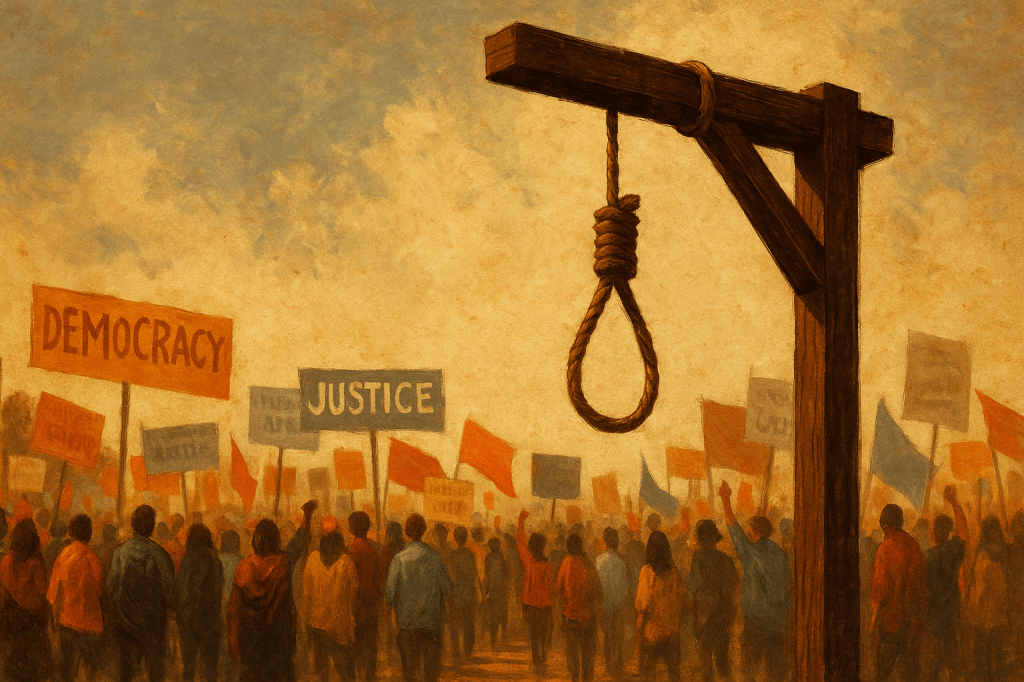
In the Book of Esther, Haman built a gallows to silence dissent. But in the end, it was he who was hoisted by his own hatred. Today, those gallows are being rebuilt—not with wood and rope, but with surveillance systems, repressive policies, and narrative warfare. It is no coincidence that we witnessed an actual gallows erected on the Capitol lawn on January 6, a chilling symbol of how far extremist ideologies are willing to go.
In the face of these real and rising threats, we must respond with unshakable resolve, radical truth, and the kind of democratic courage that refuses to yield to fear. Let us ensure that those who construct the machinery of repression are met by a people who remember, resist, and rise.
Let us not look back one day and say: We should have done more.
Let’s do more now.




 Cloaking Inequity
Leave a comment