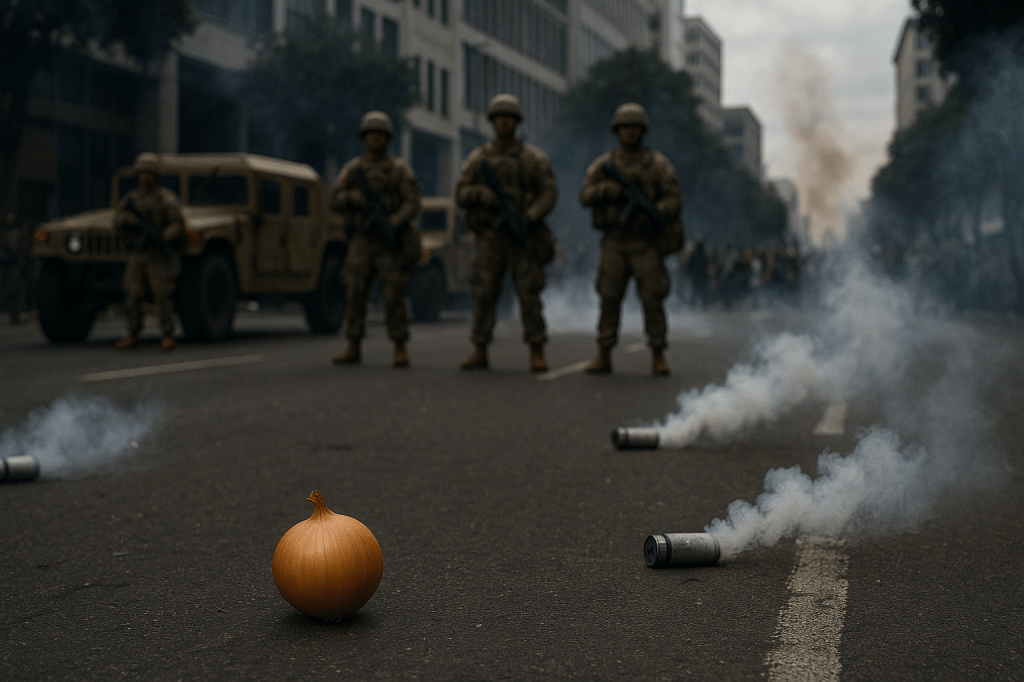
They show up during floods. They show up during wildfires. And if you’re really lucky, they show up when you’re holding a cardboard sign asking not to be tear-gassed. Yes, we’re talking about the National Guard—Trump’s most predictable tantrum accessory since Sharpie edits on hurricane maps.
The National Guard is once again making headlines by standing stone-faced and heavily armed in the streets of Los Angeles, after President Trump deployed them against the explicit wishes of California Governor Gavin Newsom. Trump justified the move by invoking a dusty post-revolutionary law from the legal equivalent of a colonial rummage sale, declaring the protests a “rebellion”—which, in Trumpian dialect, loosely translates to “they disagreed with me.”
Governor Newsom responded by filing a federal lawsuit, calling the deployment “a serious breach of state sovereignty,” just before reportedly being threatened with arrest for obstruction of martial law vibes. Newsom, last seen attempting to finish a sentence before being overridden by federal authority, remained defiant. The White House, meanwhile, described the lawsuit, the threat of arrest, and the National Guard deployment as “a totally normal weekend in a country full of liberty and freedom.”
But Trump’s creative reading of federal authority wasn’t the only escalation. Pete Hegseth, Trump loyalist, former Army officer, and often Fox News military reenactor, suggested live on national television that perhaps it was time to bring in the Marines. Not for foreign war. Not for international conflict. But for American protestors in Los Angeles. According to Hegseth, armed protest suppression requires not just camouflage but combat-level lethality. It was a suggestion so authoritarian, even the statue of Pinochet reportedly blinked.
The National Guard has a long and storied history of answering peaceful assembly with maximum damage. In 1914, during the Ludlow Massacre, the Colorado National Guard helped suppress a coal miner strike by opening fire on families and burning their tent village. In 1932, World War I veterans in Washington D.C. asking for early payment of their service bonuses were met with tanks and tear gas courtesy of the District Guard and General Douglas MacArthur, because nothing says “thank you for your service” like forcibly clearing a Hooverville.
Then came 1970. Kent State University students protested the Vietnam War and were met with real bullets from the Ohio National Guard. Four students died, nine more were wounded. Just ten days later, at Jackson State in Mississippi, two Black students were killed when police and National Guard troops fired over 150 rounds into a dormitory. The event received almost no national coverage, possibly because the victims were Black, and America had already used up its quota of outrage that month.
The Elaine Massacre of 1919 marked another chapter in National Guard history, when Black sharecroppers in Arkansas attempting to organize for fair wages were met with white mobs and state Guard troops. Between 100 and 200 people were killed. The Guard’s official explanation was that order had been restored, a phrase that apparently means “we stood around while armed white men did what they wanted.”
This weekend’s deployments follow the same script—just with higher tech gear. The National Guard is supposed to respond to real emergencies: floods, wildfires, and the occasional Oscar Mayer Wienermobile lodged diagonally across a Walmart parking lot while distributing hot dogs for what may or may not be a coup. (Isn’t that what the Trump parade tanks are for?)
But more often, they’re wheeled out when the government decides that dissent has gone out of style. Technically, the Guard operates under dual state and federal control. Lately, though, “dual” seems to mean “whoever is orange and dreams of being a dictator.”
But this week’s twist—suggesting the Marines be deployed—is a whole new genre of American overreaction. The Marines are not trained for crowd control. They’re trained for amphibious assault. They’re designed to storm beachheads, not block streets in Santa Monica. When asked whether it was legal to use the Marines against protestors, most constitutional scholars simply laughed, cried, and then updated their Canadian visa applications.
Of course, this kind of response only makes sense if the goal is not public safety but performance and escalation. The protests in Los Angeles that were largely peaceful and constitutionally protected, were declared a rebellion not because they were violent, but because they were loud, visible, and critical. In other words, dangerous in the only way that matters to authoritarian leadership: they refused to be silent.
If history teaches us anything, it’s that when Americans demand justice, the state responds by dusting off the nearest camouflage. The names may change—Ludlow, Kent State, Jackson State, Elaine, Watts—but the pattern does not. Protest, deploy, accelerate, death, deny, repeat.
Years from now, students might learn about these deployments—if the future Department of Patriotic Curriculum allows it. They’ll ask why the Marines were even considered. They’ll wonder why peaceful protest was met with military force. They’ll study the photographs, the footage, the fear. And the textbooks might offer this explanation: “In the early 21st century, Trump confused disagreement with rebellion, and deployed troops accordingly.”
Will the National Guard kill anyone this time? Trump’s message to protesters is clear: “You have the right to remain silent—especially once martial law shows up.


 Cloaking Inequity
Leave a comment