The opening question at our Schott Foundation governing board meeting stopped me in my tracks.
It didn’t come from a superintendent or a consultant. It came from Kyle Serrette, a national education strategist with the NEA and someone who’s spent decades pushing for equity-centered systems change. He asked:
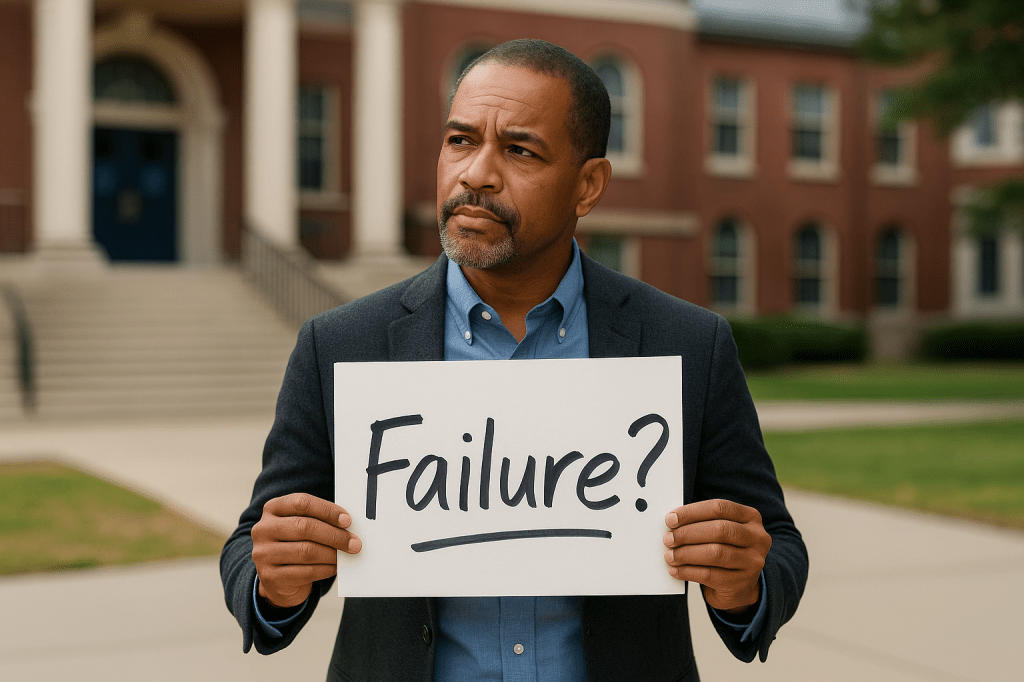
“What have you failed at?”
Let that sit with you for a minute.
We talk a lot about student outcomes, budget priorities, even “innovation” in education. But we rarely—almost never—ask leaders to reflect on their relationship with failure. Not personal failure. Not scandal. But professional risk in service of public good.
And yet in places like Silicon Valley, failure is the engine of progress. Not because it feels good—but because it teaches. You fail fast so you can iterate better. You break things to rebuild them stronger. You don’t fear failure. You fear stagnation.
So why is education so allergic to failure—especially the kind that could lead to transformation?
This post is an invitation to reframe failure, not as a threat to our professional identity, but as a catalyst for justice and progress. It’s also a call to courage, because unlike tech companies, our “product” is human. The stakes are higher.
The Silicon Valley Playbook: Failing Forward
Let’s be clear: I’m no fan of the way Silicon Valley has exported surveillance capitalism or privatized public problems. But there’s one piece of their philosophy worth borrowing—fail fast, fail forward.
In the tech world, failure is expected. It’s embedded in the lifecycle of development. You launch a beta. You collect feedback. You iterate. You pivot. You scrap. You relaunch. And through that process, you get closer to a solution that works.
This approach doesn’t glorify failure. It simply normalizes it as part of the process.
What if we did that more in education?
For example, what if we expected our first attempt at a new, research-based discipline policy to flop a little, because it’s not about perfection—it’s about adaptation?
What if we stopped punishing school leaders for every imperfect implementation and started rewarding iterative leadership?
What if we looked at pilot programs not as verdicts but as prototypes?
That’s not recklessness. That’s what Silicon Valley would call agile thinking—testing bold ideas in small ways before scaling them.
And yet in education, we do the opposite. We punish experimentation. We fear headlines. We chase perfection on the first try. And we sometimes cling to ineffective status quo because it’s “safe.”
The Fear of Public Failure
Let’s be honest: failing in education isn’t like failing in tech. In tech, a product fails and the investor shrugs. In education, a policy fails and the community revolts. The media pounces. The superintendent’s job is on the line.
There’s also a political double standard. Some leaders with power and privilege are allowed to fail upward. But when leaders of color misstep, the margin of grace disappears. Suddenly, the narrative shifts from “bold innovator” to “unfit leader.”
That’s why Kyle Serrette’s question matters so much. Because the real issue isn’t failure. It’s fear. Fear of the political cost. Fear of public scrutiny. Fear of being abandoned by your board, your staff, or your union.
But fear is a lousy compass for leadership.
Learning Organizations vs. Legacy Institutions
Silicon Valley is filled with “learning organizations”—places that reward curiosity, analysis, and evolution. Public education, by contrast, is often trapped in the mindset of legacy institutions—places that reward loyalty to tradition, hierarchical decision-making, and compliance.
Here’s how you can tell the difference:
| Learning Organization | Legacy Institution |
|---|---|
| Fails fast, iterates | Avoids risk, defends status quo |
| Values data + feedback | Prioritizes optics and protocol |
| Encourages experimentation | Punishes deviation from norm |
| Invests in reflection | Moves from crisis to crisis |
| Protects brave leadership | Sacrifices bold leaders to politics |
So what would it look like to shift your school, your district, your board—into a learning organization?
It starts with leadership that’s willing to model failure as growth. Not failure in silence. Not failure spun into PR. But failure named with humility and curiosity.
Innovation Without Exploitation: Who Bears the Risk?
Here’s the tension we don’t name enough in education: how do we create space for innovation and risk-taking without using students—especially our most vulnerable— and educator as collateral damage?
Because not all failure is equal.
That Arizona charter operator who believed students could succeed in a classroom with 50 computers and no teachers? That wasn’t innovation. That was reckless failure. That was treating human lives like a hypothesis. That was ideology dressed as disruption without a peer-reviewed research foundation.
We must distinguish between reckless and responsible failure:
Reckless failure happens when:
- The idea is ideologically driven, not evidence-based.
- There’s no safety net or mitigation plan.
- Marginalized students are treated as disposable.
- There is more concern for media spin than for real impact.
- The adults walk away unscathed, while children bear the cost.
Responsible failure is:
- Grounded in research, data, and community feedback.
- Piloted at small scale with clear metrics.
- Centered on reflection, course-correction, and transparency.
- Guided by humility, equity, and deep ethical responsibility.
The difference isn’t in the failure itself—it’s in who is involved in designing and implementing the innovation and what we do after.
So let’s ask a better question than just, “How do we fail?”
Let’s ask: How do we learn, innovate, and evolve without hurting students and educators?
That requires:
- Start designing with students and families, not just for them.
- Starting and implementing small and local (think pilot programs engaged with community).
- Measuring joy, trust, and belonging—not just test scores.
- Creating safety nets and opt-outs for students, so no one is trapped in a failed innovation.
Because yes, we must try new approaches. But we must also center care in every iteration.
Toward a Culture of Courage
That brings us back to Kyle’s question. What are you willing to fail at? If we want to build schools and systems that serve all students—particularly those long denied opportunity—we must cultivate cultures of courage. Because justice work demands some risk. And if you’ve never risked anything, you’re not leading transformation—you’re managing comfort. Are you willing to fail at the optics game, in order to play the long game? That means:
- Giving grace to those who try something bold and miss the mark.
- Rewarding transparency over spin.
- Prioritizing long-term equity over short-term optics.
- Creating safe spaces for educators to learn and grow with community.
In Silicon Valley, failing is expected. In education, it can become acceptable—when piloted in pursuit of best practice, grounded in reflection, and accompanied by accountability.
Because the only real failure? Is failing to lead.
Final Word
Let’s reclaim failure. Let’s reframe it not as a flaw—but as a function of finding progress. Let’s stop pretending that equity can be engineered in perfect conditions with guaranteed outcomes. The work of justice is messy. It’s iterative. It requires us to be bold enough to try, humble enough to learn, and brave enough to try again. Thank you, Kyle Serrette, for the question we all need to ask ourselves.
So I’ll end where we began with an addendum:
What are you willing to fail at—in order to succeed for students?
Choose something.
Then go try.
Please share.





 Cloaking Inequity
Leave a comment