
What if I told you that the next front in America’s war on student success isn’t a classroom—but a tax form?
This week, Bloomberg broke the story: the U.S. Treasury Department is weighing a proposal to strip tax-exempt status from colleges and universities that “favor any racial group” in admissions, scholarships, student services, or even the use of campus facilities. According to sources within the Treasury’s Office of Tax Policy, the plan is being drafted as an IRS revenue procedure. That means it could take effect without a single vote from Congress—executive fiat disguised as tax guidance.
As they usually do, they’ve floated their latest crazy idea to see how much pushback they’re going to get.
If implemented, this policy would financially devastate colleges that dare to support students of color. It would gut student success programming under the false pretense of “colorblindness.” And it would weaponize the tax code to enforce ideological compliance—punishing institutions that believe education should be inclusive, truthful, and empowering for all students.
This isn’t just a bureaucratic change. This is Project 2025 made real. It’s part of a broader, orchestrated effort by Donald Trump and his allies to reshape education into an obedience machine—one that no longer challenges power with freedom of speech, supports equitable student success, or reflects the diversity of thought in the nation it serves.
From DEI to Data: This Is About Student Success
Let’s be clear: the programs being targeted aren’t radical. They’re not fringe. And they’re certainly not about exclusion. What these initiatives actually represent is a nationwide innovation and data-driven movement to support student success—particularly for groups that have been historically underserved.
We’ve all seen the data. Students from underrepresented backgrounds—Black, Latino, Indigenous, low-income, first-generation, veterans and more—face systemic barriers to retention and graduation. That’s not political ideology; it’s a measurable reality. Equity programs are designed to close those gaps, not widen them. They don’t take opportunities away from anyone—they build opportunities for those who’ve too often been left out.
These programs offer tutoring, mentoring, financial aid, wellness resources, and campus community spaces. They serve as bridges for students navigating institutions that weren’t originally built for them. And yes, they’re often race-conscious—not because they discriminate, but because they aim to correct the legacy of less resources that still shapes my historically marginlized student experiences today.
So when Trump’s Treasury proposes to revoke the tax-exempt status of colleges that run these programs, they’re not eliminating bias. They’re eliminating support. They’re not punishing discrimination—they’re punishing students.
What the Proposal Really Does
The Treasury’s draft proposal would redefine tax-exempt eligibility for private, nonprofit colleges and universities. Under the new rules, any consideration of race, color, ethnicity, or national origin in programming could be grounds for losing 501(c)(3) status. That includes:
- Admissions policies
- Scholarships and financial aid
- Academic programs and cultural centers
- Use of facilities or services
The scope is breathtaking. This change would place over 1,500 institutions—including every Ivy League school, nearly all major public universities, HBCUs, HSIs, and Tribal Colleges—in the crosshairs.
Without tax-exempt status, these institutions would:
- Lose access to tax-deductible donations
- Become ineligible to issue tax-free bonds
- Be forced to pay property and income taxes on educational operations
- Face immediate and potentially devastating financial shortfalls
It wouldn’t just chill student support programs—it would erode the very foundations of student success. Initiatives that help close opportunity gaps, improve retention, and foster a sense of belonging would close. The result? More students slipping through the cracks, and a deliberate failure to fulfill higher education’s mission to serve and uplift all learners.
Is This the Precedent Republicans Want?
Let’s pause and ask a serious question: Is this the precedent conservatives truly want to set?
If the federal government begins using the IRS to punish colleges for offering race-conscious scholarships or running cultural centers, what stops the next Democratic administration from doing the reverse according to their ideology?
Will a future president target schools that don’t have ethnic studies or gender studies programs?
Will they revoke tax exemptions for universities that fail to recognize labor unions or collectively bargain, or that have boards composed entirely of wealthy white men?
Will they penalize religious colleges for excluding LGBTQ+ students or teaching theology instead of evolution?
Do we really want to establish a new normal in which federal tax policy is used as a political weapon—a tit-for-tat tool of cultural and ideological punishment?
This is not conservatism. It’s authoritarianism wrapped in procedure. It’s the beginning of an escalating tax war on education that will hurt everyone—students, faculty, alumni, employers, and communities for years to come.
The Broader Playbook: Project 2025 Comes to Life
Make no mistake: this is not an isolated proposal. It is part of a broader pattern of aggressive, anti-intellectual governance that seeks to divide a nation.
- The Supreme Court has already struck down affirmative action in college admissions.
- Republican governors and legislators have banned DEI offices and initiatives across red states.
- Conservative groups have launched undercover surveillance operations against campus administrators and professors.
- Institutions like Harvard and Columbia are under political siege for how they’ve responded to student activism and Middle East politics.
- Now, the IRS is being drawn into the fray—not to ensure fairness, but to punish institutions that value student success.
This is the MAGA movement’s endgame for higher education: strip it of complexity, flatten it ideologically, and remake it in the image of an authoritarian state.
It is an unprecedented attack on the autonomy of colleges and universities. And it is being carried out with chilling efficiency—under the radar, through bureaucratic means, and without the need for public debate.
If You’ve Ever Asked “How Did It Happen?”—This Is It
People often wonder how authoritarianism takes root in democracies. How did it happen in Hungary? In Chile? In Germany? The answer is rarely a single moment. It’s a drip-drip of normalization. A steady erosion of norms, laws, and safeguards. A process of wearing down the public’s resistance and gradually replacing democratic principles with autocratic practices.
This is that moment for America.
When you see a federal agency threatening the very existence of colleges because they support student success, you are witnessing the slow, silent conversion of policy into power grabs.
And as always, education is one of the first targets of an authoritarian. Why? Because it teaches people to ask questions. Because it creates spaces for dissent. Because it helps students imagine a world that is more just than the one they inherited.
That is what the Trump movement fears most: a future it cannot control.
We Know How to Fight Back
But here’s the good news: we’ve done this before in our nation. We’ve fought limits on freedom of speech. We’ve marched to oppose wars. We’ve opposed limits on academic freedom. We’ve resisted curriculum whitewashing. And we’ve defended the rights of every student to belong, to be seen, and to succeed. None of our civil rights were handed to us. They were demanded. They were defended. And yes, they were died for.
We will not let those sacrifices be erased by a tax code revision.
This is not the time to wait and see. It is the time to:
- Demand transparency and accountability from the IRS and Treasury.
- Pressure Congress to hold hearings and investigate the motivations behind this proposed change.
- Support educational institutions that are on the front lines of this fight.
- Mobilize students, alumni, faculty, and communities in social media to push back—hard.
Don’t Be Fooled: This Is About Control, Not Compliance
The proposed IRS rules are being framed as a matter of fairness—as if recognizing race in student success programming is somehow discriminatory.
But what they’re really demanding is race-blind compliance in a unequal K-12 system that continues to serve students inequitably.
You cannot pretend disparities don’t exist and then punish anyone who tries to fix them.
You cannot dismantle equity programs and then claim surprise when student success rates fall.
You cannot call this neutrality when it is, in fact, a calculated attempt to suppress student success and preserve the status quo.
This isn’t about compliance with the law. It’s about controlling the future and causing failure.
What Kind of Country Do We Want?
This is the question at the heart of this moment.
Do we want a country where education reflects our shared history, or one where it is controlled by whichever political party is in office?
Do we want to support student success across all communities, or only for those who were always welcome and whose retention and graduation rates reflect that?
Do we want the federal government to protect equal opportunity, or to punish it?
And are we really willing to allow the tax code to become the newest tool for enforcing racial and ideological conformity?
We can still choose a different path. We can reject fear. We can reject silence. We can reject this war on education.
Because the truth is, they are not just coming for student success. They are coming for democracy itself.
And the only way to stop them is to stand up—together, clearly, and now.
Let’s Finish the Work
We cannot build a better education system by erasing the needs of our students. We cannot build a better democracy by punishing institutions that reflect its values. And we cannot let another generation inherit a country where truth is dangerous and student success is taxable. So let’s defend the colleges. Let’s defend the students. Let’s defend the right to learn, to question, to grow, and to belong. Let’s finish what our ancestors started— and not back down.


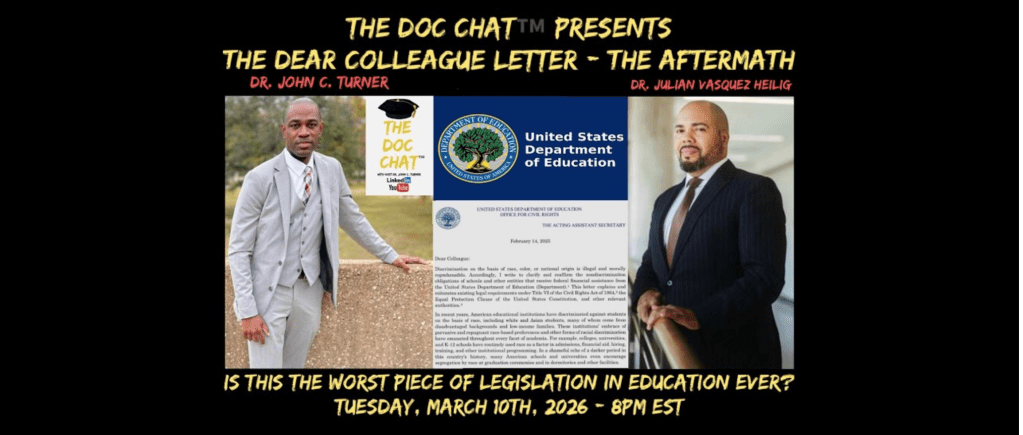


 Cloaking Inequity
Leave a comment