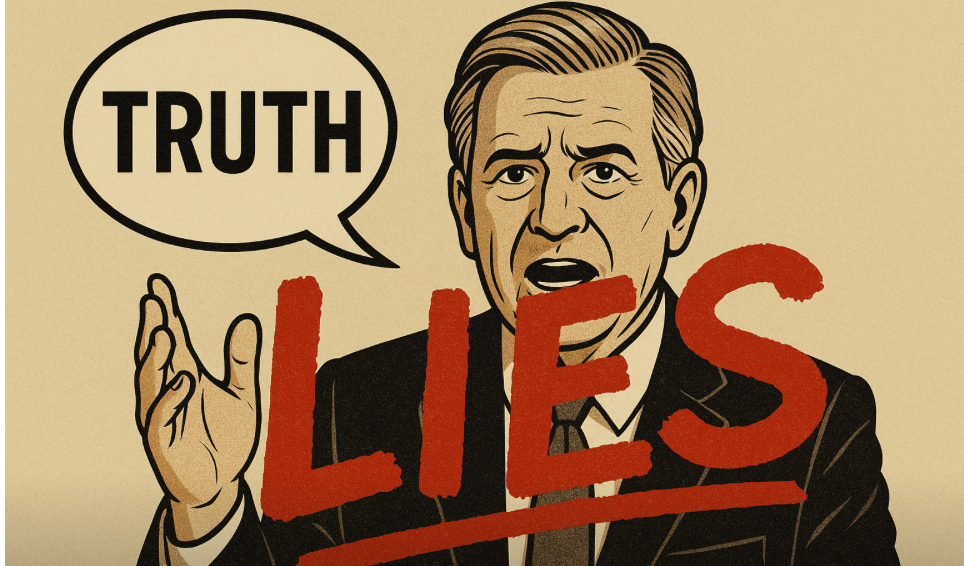
We’ve come to recognize gaslighting in politics with unsettling clarity. It’s the classic authoritarian sleight of hand: say one thing while doing another, accuse your critics of the very abuses you commit, and weaponize language to invert reality itself. Donald Trump has elevated this to a political doctrine—claiming to be the champion of free speech while attacking universities, labeling peaceful protestors as violent while excusing actual insurrections, and arguing before the Supreme Court that immunity from prosecution is essential for “presidential effectiveness,” when the real goal is shielding himself from accountability for crimes against democracy.
What makes this form of manipulation so dangerous is its effectiveness. Gaslighting is not about convincing everyone—it’s about creating just enough doubt, distortion, and distraction that truth becomes hard to pin down. If people can’t agree on what’s real, they can’t organize, resist, or hold power accountable. It creates a fog of confusion, in which authoritarian actors can operate freely under the guise of legitimacy. Political gaslighting works best when cloaked in the language of principle—even as the actions behind the curtain betray those very principles.
This tactic didn’t end at the White House. It has filtered into every corner of public life—including education. Politicians, donors, and administrators have all learned how to use rhetorical sleight-of-hand to shield unpopular decisions, justify unjust actions, and obscure the true motives behind their policies. The result is a national education landscape increasingly shaped by deception disguised as leadership, and authoritarianism dressed up in the language of student success.
The Unexamined Territory: Gaslighting in Education
While we’ve scrutinized gaslighting in politics, its presence in education remains far less examined—but no less dangerous. Educational gaslighting operates through the same dual tools of distraction and deception. Say a policy is about student safety, but it’s actually about silencing protest. Claim a change is for academic excellence, but it’s really about appeasing donors. Tell faculty they’re being included, while decisions have already been made behind closed doors. These are the bread and butter of gaslighting in educational institutions.
We see this manipulation play out in university boardrooms, state legislatures, and even in faculty governance meetings. Often, the people most committed to justice and equity are told they’re being “divisive,” while those undermining those very values hide behind calls for neutrality or “viewpoint diversity.” It’s a strategy of pretending to listen, of deploying vague promises and buzzwords while real power operates elsewhere—unseen and unaccountable. And because universities are assumed to be bastions of reason and fairness, these tactics are harder to detect and even harder to challenge.
Unlike political gaslighting, which often plays out in public spectacles, educational gaslighting is quieter—more insidious. It comes cloaked in institutional language, in glossy strategic plans, in DEI statements and public commitments that never quite materialize into action. It feeds off the trust that students, faculty, and communities place in schools, universities, and educators. But when that trust is violated, it doesn’t just undermine specific initiatives—it corrodes the very foundation of educational credibility.
The Antisemitism Fig Leaf
Consider the recent political interventions into universities like Harvard, Columbia, and others. These crackdowns are often framed as responses to antisemitism on campus. Certainly, antisemitism is real and harmful, and any credible report of it should be taken seriously. But that’s not what’s really happening here. The concern being weaponized isn’t about student safety—it’s about silencing certain types of political speech, particularly support for Palestinian human rights, anti-colonial perspectives, or broader critiques of U.S. foreign policy.
What we’re seeing instead is a strategic misuse of antisemitism as cover for a broader ideological campaign. Internal memos, donor letters, and policy speeches often reveal that the real issue isn’t safety—it’s compliance. Universities are being punished for allowing faculty to speak critically of Israel, for offering ethnic studies courses, or for supporting student groups who raise awareness about injustice. In this framing, any deviation from the political status quo becomes dangerous—and therefore punishable.
By conflating criticism of the war politics of a nation-state with hatred of a people, and by using that conflation as the basis for structural crackdowns, these attacks hollow out the meaning of antisemitism while simultaneously suppressing academic freedom. The use of this fig leaf is not only disingenuous—it’s deeply harmful. It instrumentalizes and hijacks an identity to advance a political agenda that is fundamentally about silencing progressive thought and dismantling the equity infrastructure that marginalized communities have fought decades to build.
Manufactured Justifications for Dismantling Equity
Universities are increasingly using vague, politically safe excuses to justify regressive actions. When DEI offices are shuttered, the reasoning often revolves around vague claims that they “didn’t work” or “didn’t serve all students.” But investigations and internal records often reveal that these decisions had little to do with outcomes or metrics—and everything to do with donor pressure, board threats, or political expediency. The public narrative is crafted for consumption, while the real motives remain buried in private strategy sessions.
We’ve seen this clearly in the closures of DEI offices in 2024 and 2025. Some institutions used antisemitism as a pretext, even when the offices had nothing to do with the alleged incidents. Others pointed to a handful of student complaints cited in media outlets like The New York Times—even though rigorous, long-term data show that DEI programs improve belonging, retention, and outcomes for all students. But in a world ruled by gaslighting, one anecdote can outweigh a mountain of evidence if it serves the right political narrative.
The result is that equity work is not just devalued—it’s actively demonized. DEI is framed not as a tool for student success but as a partisan liability. Institutions don’t admit they’re caving to political pressure; instead, they pretend it was a performance issue all along. But the reality is clear: DEI programs are being dismantled not because they failed, but because they worked—and made the wrong people uncomfortable.
Weaponizing Bad Faith and Cherry-Picked Narratives
Gaslighting thrives on selective storytelling. Leaders cherry-pick data, overemphasize outliers, and create narratives that justify what they’ve already decided to do. Take the example of the New York Times piece that questioned the effectiveness of DEI programs by interviewing a small number of students. This anecdotal, unrepresentative evidence was then weaponized to dismantle programs built over years with community input, research backing, and demonstrable outcomes.
This bad faith approach isn’t accidental—it’s calculated. It allows university leaders to appear responsive without being responsible. They claim to be “listening to students” while ignoring the majority who support these programs. They pretend to be data-driven while deliberately overlooking their own institutional research. The goal isn’t improvement—it’s erasure, cloaked in the language of reform.
By elevating isolated critiques and ignoring broader truths, educational leaders create a false consensus that justifies harmful decisions. It’s the same tactic used by politicians who cite one cherry-picked statistic to justify draconian policies. In both cases, the goal is not honest evaluation—it’s narrative control.
Fake Negotiations and Suppressed Student Voices
During the 2024–2025 Gaza solidarity encampments, many universities appeared to be engaging in dialogue with student protesters. At face value, this seemed to reflect the best of democratic education—negotiation, shared governance, and a willingness to hear diverse voices. But as time passed, it became clear that many of these so-called “negotiations” were nothing more than a stalling tactic. Administrators made vague commitments, promised future conversations, and released joint statements only to quietly reverse or ignore them later.
These were not genuine attempts to meet students halfway—they were strategic efforts to defuse protest without conceding any real power. The primary goal wasn’t justice or understanding; it was optics. Get the tents down. Clear the quads before graduation weekend. Avoid donor backlash. The encampments threatened institutional image, and the quickest way to neutralize them was to simulate engagement, not practice it. Time and again, students found themselves misled, with promises broken and demands dismissed as soon as media attention faded.
This kind of administrative gaslighting has long-term consequences. It undermines trust in institutional leadership, devalues student voice, and turns campus engagement into a cynical performance. When young people are repeatedly taught that their voices will only be heard as a PR maneuver—and then ignored—it breeds apathy, disillusionment, or worse: a deep mistrust of the very idea of democracy within education.
The Illusion of Empathy from Institutional Power
Education leaders have become adept at using the language of inclusion to mask exclusionary behavior. When challenged about inequity in hiring or resource allocation, they say, “We’re listening.” When confronted with evidence of systemic bias, they announce yet another task force. When protests erupt, they offer “both sides” events or speaker panels instead of policy changes. This isn’t engagement—it’s evasion dressed up as virtue.
The illusion of empathy is a powerful shield. It deflects critique by appearing to validate it while making no actual changes. It allows leaders to protect institutional power without appearing authoritarian. They avoid difficult conversations under the guise of neutrality. They speak of “balance” and “dialogue” but never actually confront the roots of injustice. This performance of care becomes a way to not care—at least not enough to risk power, reputation, or money.
At the end of the day, this faux inclusivity causes real harm. It communicates to students and faculty—especially those from marginalized communities—that their pain and concerns are only acknowledged when convenient. It erodes the moral authority of institutions that claim to champion justice. And it teaches the next generation that power doesn’t need to be honest to be effective, only polished enough to withstand scrutiny.
The Cost of Gaslighting: Trust and Truth
Gaslighting may shield institutional leaders in the short term, but it comes at a profound cost. It fractures trust between students and administrators, faculty and presidents, and communities and the institutions that claim to serve them. When people feel manipulated—when they know the truth but are told a different version—they lose faith not only in leadership, but in the legitimacy of the institution itself. This erosion of trust is what fuels resignations, votes of no confidence, and early retirements—a collective response to the fundamental betrayal of the promise that leaders will do what they say they will do.
This erosion of trust is more than a reputational issue. It undermines the educational mission. Students no longer see their institutions as places of learning and justice, but as bureaucracies that prioritize liability over learning. Faculty begin to ignore and distrust administrators or disengage from governance. Community partners distance themselves from institutions that claim to be allies but act as adversaries. The long-term damage is not just political—it is intellectual and cultural.
Worst of all, gaslighting makes accountability nearly impossible. If no one can name what’s really happening, then no one can be held responsible. If language becomes so slippery that “diversity” means dismantling DEI, or “safety” means suppressing protest, then how can anyone challenge injustice in good faith? Truth itself becomes a moving target—and education loses its most sacred currency: integrity.
Equity Abandoned in the Face of Pressure
There’s a painful irony in watching universities that have spent years touting their equity commitments abandon them the moment political pressure mounts. These same institutions have released statements after racial reckonings, declared support for Black Lives Matter, and claimed to be incubators of change. But when influential donors, right-wing media, or state legislatures raise their eyebrows, those commitments evaporate like fog under scrutiny.
In 2024 and 2025, we saw this hypocrisy in full display. DEI programs that were once central to campus identity were suddenly “nonessential.” Faculty who had been praised for community engagement were now accused of politicizing the classroom. Student groups once invited to speak at university events were placed under surveillance or disciplinary review. The pivot was not just strategic—it was cowardly.
And the signal this sends is devastating. It tells communities of color, LGBTQ+ students, first-generation learners, and others who depend on these structures for belonging and success: your presence is conditional. You’re welcome until someone important objects. You’re celebrated until you make power uncomfortable. It’s not just DEI programs being dismantled—it’s the very notion of belonging itself.
Let’s Call It What It Is
At some point, we have to stop pretending this is just politics or policy. It’s gaslighting—plain and simple. When leaders say one thing and do another, when they dress up repression as reform, when they weaponize empathy while operating in bad faith—that’s not strategy. That’s dishonesty. And it’s not leadership. It’s betrayal.
Leaders cannot lead without clarity, honesty, and trust. These are not optional virtues; they are foundational to the mission of organizations. If we allow buzzwords to replace truth, and bad faith to replace real dialogue, then we are helping destroy the very purpose of democracy. We are complicit in the erosion of public trust and the collapse of our nation.
We should not accept bad faith as the price of doing business. We must resist the normalization of gaslighting, name it when it occurs, and refuse to let it shape our nation. Because the consequences are bigger than any single institution. When gaslighting becomes standard practice, America is not a force for good—and is instead a theater of control.


 Cloaking Inequity
Leave a comment