Happy Juneteenth! In the 1960s, brave Americans—many young, many Black, many poor—put their bodies on the line to claim a seat at the table of democracy. They fought for rights long denied: the right to vote without barriers, to protest without fear, to attend school without segregation, to worship without restriction, and to speak truth to power. Those rights were not given—they were won. They were bled for. They were buried for. But today, under Trumpism and its imitators, we are witnessing something darkly ironic, chillingly strategic, and morally grotesque: the very tools the Civil Rights Movement secured are being used to dismantle the movement’s legacy. This is not just backlash—it’s a coordinated rollback. Let’s call it what it is: The De-Civil Rights Movement.
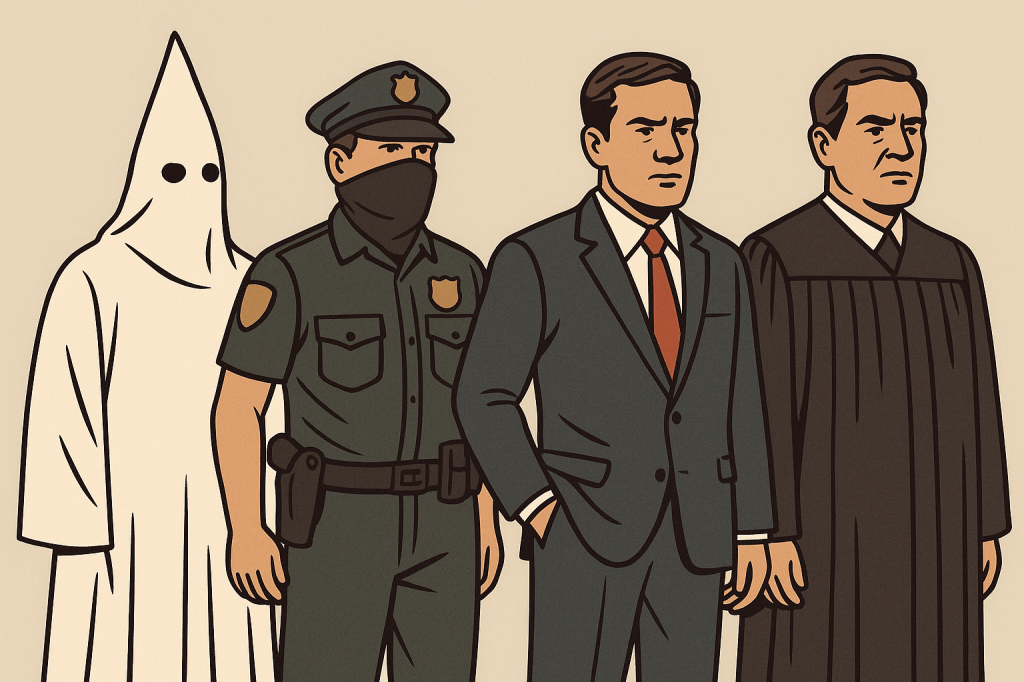
Unlike the overt dogs-and-hoses brutality of Bull Connor, the De-Civil Rights Movement doesn’t always wear an ICE badge or carry a baton. It hides in Supreme Court rulings, statehouse budgets, university boardrooms, and the mouths of tv and podcast pundits shouting “free speech” while demanding silence from everyone who resists. It rebrands itself with patriotic language—“America First,” “parental rights,” “religious liberty”—while pushing policies that exclude, surveil, and erase. It insists it’s defending the Constitution, all while undermining its most vital amendments. The movement doesn’t march in white hoods and sheets; it marches in uniforms, face gaiters, suits, and judicial robes. But make no mistake: the goal is the same as it was in 1963 Alabama—keep power where it’s always been, and punish those who dare challenge that order.
What makes this moment especially dangerous is its inversion. Trump and his allies are not attacking civil rights from the outside—they’re claiming them from within. They’re using our victories—the hard-won legal precedents, constitutional interpretations, and moral language of equality—to justify oppression. Imagine using the Voting Rights Act to suppress votes. Imagine using the Civil Rights Act to claim “reverse racism.” Imagine calling the use of tear gas on peaceful protestors “protecting liberty.” This isn’t a bad dream—it’s the daily reality of American politics in the Trump era. Here are ten ways this De-Civil Rights Movement is using the tools of the Civil Rights Movement against us.
1. Free Speech to Silence Dissent
The Civil Rights Movement made the First Amendment real. In Greensboro sit-ins and on the steps of the Lincoln Memorial, activists forced the country to reckon with whose speech mattered. Today, Trumpism wields the First Amendment as a cudgel to protect the speech of “very fine” white supremacists while criminalizing protestors who demand accountability. In dozens of states, protest laws have been rewritten to impose steep penalties on those who march in the streets, occupy campus lawns, or challenge police violence. At the University of Michigan, undercover investigators infiltrated Gaza solidarity encampments and followed students in their private lives, echoing the surveillance tactics once used against MLK and the Black Panthers.
Meanwhile, voices calling for justice are labeled “disruptive,” “divisive,” or “un-American.” Governors like Ron DeSantis and Greg Abbott claim to be defending speech—but only if it’s speech that aligns with their ideology. Book bans are justified in the name of “protecting children.” DEI programs are dismantled under the claim that they “indoctrinate” students. But when police kill unarmed Americans, when students call for divestment from apartheid loving countries, or when scholars demand honest history, silence is the only answer tolerated. In this new era, free speech is no longer free—it’s politically granted, strategically weaponized, brutally enforced, and indoctrinated.
2. Religious Freedom to Enshrine Discrimination
Religious freedom was once a refuge for the oppressed. Black churches were epicenters of the Civil Rights Movement—organizing rallies, voter registration drives, and community resistance. Today, Trumpism has twisted religious freedom into a license to discriminate. Under the banner of faith, bakeries can refuse to serve LGBTQ+ couples, universities can sidestep Title IX protections, and employers can deny reproductive healthcare. This isn’t religious liberty—it’s religious domination. It replaces pluralism with theocratic privilege.
The Trump administration championed policies that prioritized one religion—Christianity—over all others, while simultaneously treating Muslims as threats and immigrants as criminals—let’s be clear the Bible is 100% supportive of immigrants and treating them with care. In practice, this means a new Muslim ban and Ten Commandments in schools. It means pastors preaching right-wing politics about hating your neighbors from the pulpit (I’ve walked out of sermons when this happens) and LGBTQ+ students are forced into silence on campus by banning their clubs and much more. It means states like Oklahoma and Florida citing religious liberty to introduce charter schools that discriminate openly—paid for with your tax dollars. The wall between church and state wasn’t just breached. It’s being rebuilt with barbed wire—and the bill is being sent to the very communities civil rights was meant to protect.
3. State’s Rights to Undermine Federal Protections
We’ve heard this tune before. “State’s rights” was the rallying cry of segregationists during Jim Crow. It’s back. Trump-era Republicans use state sovereignty as a weapon against federal protections they find inconvenient: environmental justice, LGBTQ+ rights, immigrant sanctuary laws, and of course, education equity. The irony? These same leaders scream “federal overreach” while cashing federal checks and but also support denying disaster aid when hurricanes hit blue states’ coasts. Deploying the national guard without consulting a governor. So what they mean is clear: states should only have power when it reinforces the status quo.
The rollback of federal protections for transgender students and reproductive rights under Trump were just the beginning. Now, states like Texas and Florida are actively nullifying federal civil rights guidance in education, voting access, and anti-discrimination. With Project 2025 being implemented—the right-wing blueprint to gut federal agencies and override local resistance—the playbook is explicit: civil rights are a nuisance to be dissolved. When the confederate states that once resisted integration are now leading the charge to ban Black history, it’s not coincidence. It’s heritage.
4. The Courts to Legally Re-Segregate Society
The courts once opened school doors and outlawed poll taxes. Now, under Trump’s judicial appointments, they are closing those same doors. In 2023, the Supreme Court struck down affirmative action in higher education. The majority opinion cited “colorblindness” as a virtue. But anyone who’s studied race in America knows: pretending not to see race is how you allow racism to thrive. These rulings don’t restore equality—they cement privilege.
Trump’s judicial legacy—over 200 federal judges and three Supreme Court justices—has shifted the bench sharply rightward. From rolling back voting rights to blocking protections for immigrants and gutting reproductive autonomy, these judges are poised to unwind the Civil Rights Act one decision at a time. In many cases, they do so in the name of civil rights—claiming that programs designed to help marginalized groups are now discriminatory. This is legal gaslighting: you’re not being discriminated against in society, you’re being too loud. You’re not being erased, you’re asking for too much. You’re not being targeted—we just don’t see color anymore in the courtroom never mind what’s happening everywhere else.
5. The Civil Rights Act Twisted to Protect Privilege
One of the cruelest ironies of the De-Civil Rights Movement is the use of the Civil Rights Act of 1964 to dismantle the very programs it made possible. In lawsuit after lawsuit, white plaintiffs claim that any attempt to increase representation or address systemic racism is, in itself, racist. The Trump-aligned legal movement treats equity as a threat and whiteness as a vulnerable status. They call it “reverse discrimination.” But reversing racism requires power—and the power structure remains largely unchanged, as evidenced by the overwhelmingly white backgrounds of the wealthy, corporate executives, board members, education leaders and policymakers who still shape American life.
This inversion was at the heart of Students for Fair Admissions v. Harvard, the case that gutted affirmative action. But similar logic is being applied to DEI programs in workplaces, scholarships for underrepresented students, and even Black history curricula. They’re not just denying the impact of racism—they’re calling the remedy racist. And when civil rights law is used to protect dominant groups from feeling discomfort instead of marginalized groups from real harm, the law itself becomes a tool of oppression.
6. Law and Order to Justify Surveillance and Force
We’ve been here before. In the 1960s, “law and order” was code for controlling Black and other historically marginalized bodies. Today, it’s a slogan on campaign hats, flags, and the rationale for militarized crackdowns. Trump’s response to the George Floyd protests was not compassion—it was tanks, tear gas, and threats of military intervention. His call to “dominate the streets” echoed the same logic that justified COINTELPRO: dissent must be destroyed, not understood. Not surprisingly, sending troops to California has brought us back to the same reality TV chaos that Trump escalated in his previous term.
And it’s not just physical force. It’s surveillance. The rise of undercover operations on college campuses—like the one at UNC Asheville that cost a DEI leader her job—harkens back to the darkest moments of the FBI’s war on civil rights leaders. What’s new is the tech: AI scans, social media monitoring, body cams used not to protect the public but to gather evidence against it. These are the same institutions that once spied on Malcolm, Martin, and SNCC. They’ve just updated the software.
7. Voting Rights Laws to Purge Voters
The Voting Rights Act of 1965 was one of the Civil Rights Movement’s greatest achievements. But in 2013, the Supreme Court gutted it in Shelby v. Holder. Since then, the floodgates have opened. Under Trump, the DOJ stood idle as states purged voter rolls, closed polling places in Black and Brown communities, and imposed ID laws with surgical precision. The aim was never fraud prevention—it was voter suppression.
Trumpism has accelerated this trend. In 2020, Trump tried to overturn the election results by targeting Black voters in cities like Detroit, Atlanta, and Philadelphia. In 2026, expect even more barriers. More attempts to limit ballot access, early voting, and more weaponized gerrymandering. These aren’t minor adjustments—they’re the same tactics that once required federal intervention. Only now, equality-oriented referees have left the court.
8. The American Flag as a Symbol of Suppression
During the Civil Rights Movement, the American flag was carried by marchers to demand the nation live up to its promises. Today, the flag has been reclaimed by those seeking to suppress. It flies not just over statehouses, but over militias, insurrections, and school board meetings where diversity is denounced. The flag is no longer a symbol of unity—it’s been monopolized as a badge of belonging to a single version of America. Athletes kneeling for justice are called traitors. Citizens who fly the Stars and Stripes alongside Black Lives Matter signs are harassed. And then there’s the Blue Line American flag—once a tribute to fallen officers, now often flown as a symbol of intimidation, division, and resistance to racial justice. What began as mourning has been rebranded into menace, hoisted at insurrections and waved in the faces of peaceful protesters. Trump-style nationalism doesn’t share symbols—it seizes them. It wraps oppression in red, white, and blue, and dares you to question its meaning. In doing so, it tries to convince the world that justice is unpatriotic—and that erasure is the American tradition.
9. Education Access to Control History
Brown v. Board was about access. Now it’s about control. Trump and his imitators aren’t content to defund public education—they want to rewrite it. From banning AP African American Studies to silencing discussions of gender, they are working to erase the truth from classrooms. The civil rights gains in curriculum and representation are being whitewashed under the guise of “protecting children.” But whose children? The same children who are taught about the Boston Tea Party are denied the truth about Tulsa. The same children taught “freedom isn’t free” are denied books about everyone who fought for it. This is not education—it’s indoctrination by omission and distortion. It’s a new form of segregation—segregation of knowledge, truth, justice, and critical thought.
10. Civil Liberties to Shield the Powerful
Finally, we arrive at perhaps the cruelest twist: the language of civil liberties—privacy, due process, and equal protection—now being used to shield those with the most power. Billionaires and corporations invoke “free speech” to pour billions into elections and shape policies in their favor. Businesses cry “cancel culture” when held accountable for aligning with campaigns to undermine equity and justice. Meanwhile, those most in need of civil liberties are being systematically denied them. Under Trump, immigrant children—some as young as three years old—are forced to appear alone in court, expected to serve as their own legal representatives after the administration stripped them of access to counsel. Due process reduced to a cruel performance, with toddlers asked by judges if they understood the charges against them. Parents arrested and deported while their children sit crying on sidewalks or caged in detention centers. Barbers shipped off to dangerous prisons in El Salvador or redirected under “safe third country” agreements to nations they had never even set foot in. The same “safe third” countries that were made financial offers or blackmailed with total immigration bans if they didn’t agree to accept deportees.
The Constitution wasn’t written to protect kings. It was set forth—through blood and law—to protect the people from tyranny. But Trumpism has turned that shield into armor for the elite. And until we name it, challenge it, and resist it with the same courage that once marched across Edmund Pettus Bridge, the De-Civil Rights Movement will continue to grow.
This is not a drill. This is not a debate. This is a reversal.
We are living through the most aggressive attempt to roll back civil rights since Reconstruction. We don’t need new laws—we need to protect the old ones. We don’t need better slogans—we need better memory.
And here’s what we must remember: everything the Civil Rights Movement won was once illegal, unpopular, and violently opposed in this country. The right to vote was met with poll taxes, literacy tests, and police dogs. The right to desegregate schools brought angry mobs to Little Rock and bombs to Black churches in Birmingham. The right to sit at a lunch counter or ride a bus without humiliation was answered with beatings, arrests, and lynchings. The right to marry across racial lines, to walk without fear, to organize, to strike, to protest—each was challenged by billy clubs, burning crosses, and bullets.
None of these rights were given. They were demanded. They were defended. And they were died for.
Now, the same forces that once fought progress with violence are fighting it again—with legislation, budget cuts, courtroom rulings, and the polished rhetoric of “colorblindness.” What we fight for today—truth, equity, justice—will be slandered, surveilled, and sabotaged.
But if history has taught us anything, it’s that we’ve done this before. We know how to fight back. We know how to win.
So let’s rise—unafraid, unwavering, and united. Let’s defend the Civil Rights Movement and finish what our ancestors started.
Please share.


 Cloaking Inequity
Leave a comment