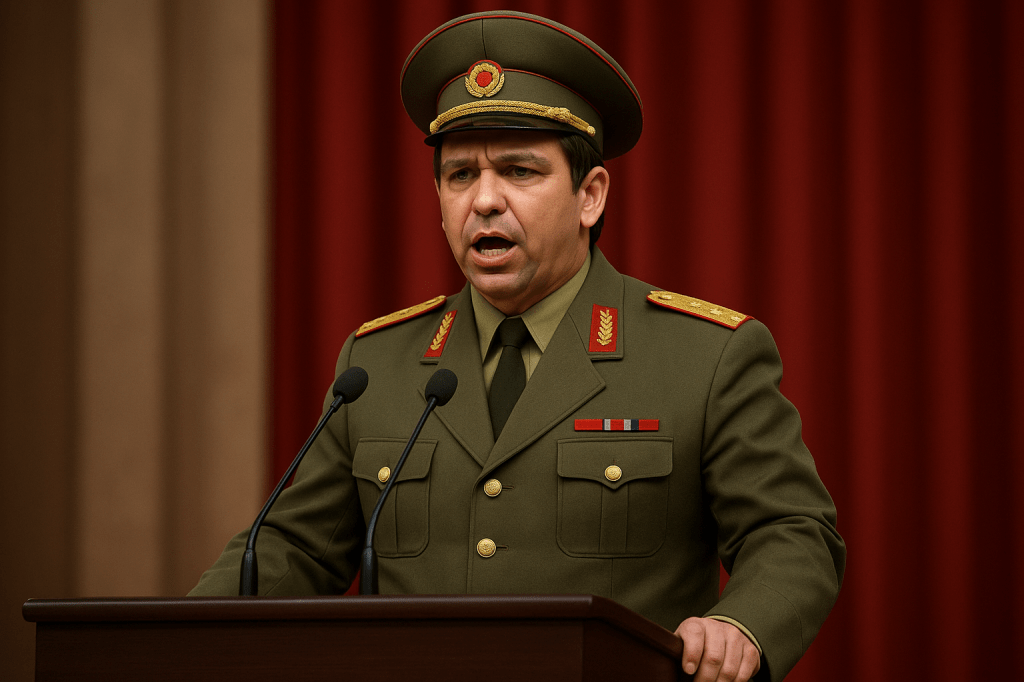
Turkey, Hungary, China, Russia, Egypt—and Florida. The names of these places might evoke different geographies, languages, and histories, but in one crucial area they increasingly speak the same language: authoritarian control over universities. In each, political power has been used to reshape higher education into a compliant tool of state ideology. Once autonomous institutions—grounded in scholarship, debate, and truth-seeking—are now being reengineered to fall in line. And Florida, with alarming speed, is excitedly following their script.
Let’s start with the international cases, because they offer us a chilling glimpse of what’s at stake.
In Turkey, President Erdoğa responded to the failed 2016 coup by abolishing democratic processes for choosing university leaders. Rectors—once elected by faculty—were now appointed by presidential decree. The appointment of Melih Bulu, an Erdoğan loyalist with no ties to Boğaziçi University, ignited massive student and faculty protests. Police detained students. Faculty were purged. One of Turkey’s most esteemed institutions was gutted and “neutralized.”
In Hungary, Prime Minister Viktor Orbán’s government handed control of universities to “public trust foundations” stacked with party allies. At the University of Theatre and Film Arts (SZFE), administrators and professors resigned en masse in protest. But it was no use. Academic autonomy was replaced with a political board that now dictates hiring, curriculum, and campus values in line with the ruling Fidesz party.
In China, authoritarianism is embedded in the university system itself. Communist Party Secretaries, not presidents, are the ultimate authorities at every institution. Under Xi Jinping, these party officials enforce ideological conformity. Xi Jinping Thought is now mandatory reading. Research that challenges government narratives is censored. Surveillance and student informants are normalized.
Russia too has turned universities into an ideological tool of the state. The Kremlin has installed loyal rectors who toe the government line. Institutions like the Higher School of Economics have fired critical faculty, banned protests, and normalized political repression. Academic inquiry is now subject to the whims of Putin’s political priorities.
In Egypt, university leaders are handpicked by the security state. Professors and deans must pass government vetting, and students risk imprisonment for activism. Cairo University, once a beacon of Arab intellectualism, now operates under the thumb of security forces.
And now, we come to Florida.
According to a June 2025 report from the Associated Press, the Florida Board of Governors has confirmed three more political allies of Republican Governor Ron DeSantis to serve as university presidents. Two are former Republican lawmakers. One is a lobbyist. These appointments are not aberrations—they are the latest in a calculated series of political moves. With these latest selections, five of Florida’s 12 public universities are now led by former GOP lawmakers or lobbyists. That’s nearly half of all public universities in the state.
This trend follows a disturbing pattern: earlier this year, the Board rejected the nomination of Santa Ono to lead the University of Florida due to his past support for diversity, equity, and inclusion (DEI) initiatives. His scholarly record didn’t matter. What mattered was that he had committed the unforgivable sin—at least to the current political regime—of having at one time implemented equity innovation.
Supporters of the DeSantis-aligned appointees argue that these politically connected leaders can better secure funding and “navigate a rapidly shifting legal landscape.” But critics—correctly—see these appointments as proof that alignment with Governor DeSantis’ right wing education agenda has become a prerequisite for academic leadership.
And what do these appointments come with? According to AP:
Multiyear contracts six-figure salaries. Plush on-campus residences. A selection process cloaked in secrecy, described by Florida’s own Republican House Speaker as a “spoil system for a select few.”
Let’s not sugarcoat what this is. This is the politicization of university leadership and graft all rolled into one. This is the conversion of public education into a partisan battleground. This is Florida mirroring the tactics of authoritarian regimes, using the office of the university president to enforce ideology and crush opposition.
Just as Erdoğan, Orbán, Xi, Putin, and el-Sisi installed loyalists in universities to suppress resistance and promote doctrine, DeSantis and the Florida Board of Governors are repurposing the presidency of public universities as a reward for political obedience.
This is not reform. This is capture.
And the consequences will long outlast DeSantis’ time in office. University presidents can have impact for decades. They shape faculty hiring, program funding, curriculum review, tenure decisions, and free speech policy. By stacking the top with political operatives, Florida is ensuring that even if DeSantis is gone from Tallahassee, his ideological grip on Florida’s universities will persist.
This is what authoritarian overreach in higher education looks like in 2025. It’s happening in plain sight. And it’s already drawing applause from extremist circles who see this as a model for red-state governance.
The role of a university president has always been complex—part fundraiser, part visionary, part diplomat. But above all, the president must be a guardian of academic freedom. If presidents are selected solely on their political alignment, that freedom dies a slow and deliberate death.
Let us be clear: this is not just a Florida issue. Florida is the test lab. The prototype. The signal flare.
If this strategy proves successful—if governors and boards can transform public universities into ideological echo chambers—we will see this playbook exported to every state where political control is valued more than intellectual integrity.
We are standing at a crossroads.
Do we allow politicians to seize our institutions of higher learning and twist them into tools of authoritarianism that we’ve seen in case after case around the world? Or do we stand with students, faculty, and citizens who believe that universities must remain independent, truth-seeking, and accountable to the public—not political parties?


 Cloaking Inequity
Leave a comment