How do you know what information to trust?
It’s a deceptively simple question. And lately, it’s one I hear more and more—especially from Right Wing-leaning friends and family who claim that “you can’t trust any of it anymore.” They talk about fake news, media manipulation, and digital censorship. They doubt the Census, question school data, and dismiss mainstream research. And then, in the same breath, they cite conspiracy theories from Instagram reels and influencers with no expertise, no credentials, and no accountability.
It would be almost humor if it weren’t so dangerous.
The irony, of course, is that the people saying “you can’t trust anything” have in fact made very clear choices about what they do trust. It’s not that they’ve given up on information—it’s that they’ve replaced legitimate, triangulated, evidence-based sources with curated propaganda and performative outrage. They trust selective narratives from influencers over journalistic ethics and peer-reviewed research. They believe tweets more than trained experts. And it’s not a coincidence. This is exactly how authoritarian information strategy works.
The Authoritarian Playbook: Confuse, Distract, Control
Authoritarians don’t just lie. They aim to destroy the very idea of truth. The goal is not to convince you of one reality—it’s to convince you that no reality can be trusted. When nothing feels reliable, when every fact has a counter-fact and every expert a counter-expert, people stop looking for truth and start clinging to whoever seems most confident, most aggressive, most entertaining. This is the fog in which authoritarians thrive.
We’ve seen it across the globe. In Russia, Vladimir Putin has long perfected the tactic of flooding the media with contradictory narratives—so much so that ordinary citizens simply give up trying to figure out what’s real. In Turkey, President Erdoğan cracked down on journalists, jailed academics, and dismissed thousands of educators in the name of “national security,” creating a single, government-controlled version of reality. In Hungary, Viktor Orbán reshaped the press, restructured universities, and systematically undermined independent research to ensure that state-sponsored ideology ruled over empirical evidence.
Now, the United States is seeing the same heavy fog roll in.
Under Trump, we’re witnessing a systematic campaign to pause, block, or manipulate access to public information. From halting the Department of Education’s civil rights data collection to gutting transparency rules around charter school funding, from pausing environmental impact studies to undermining the Census Bureau, the pattern is clear: facts are dangerous to authoritarians because facts can be used to hold power accountable.
Doubt Is the Weapon—Disinformation Is the Strategy
Right Wing America doesn’t need everyone to believe the same thing. It only needs them to believe that nothing outside the movement is reliable. Friends and family members say digital information can’t be trusted—and yet they trust anonymous memes more than peer-reviewed science from experts. They won’t believe federal crime statistics or educational attainment data, but they believe an edited TikTok clip claiming all universities and colleges are Marxist indoctrination camps. The irony isn’t apparent to them because the distrust itself has become the point. The truth has been “obliterated.”
And this isn’t just about politics—it’s about the foundation of every major democratic institution. When you dismantle the credibility of information systems, you weaken schools, public health, voting, law enforcement, and every other area that relies on accurate, shared data. You also erode the ability of citizens to solve real problems together, because you’ve poisoned the common ground.
This is why educational data is in trouble. It’s why good research is under siege. It’s why public institutions are being gamed or dismantled by people who shout about transparency while hiding the receipts.
Triangulation and Trust: How Real Research Works
So how do we know what information to trust?
In academic and professional research, we rely on a principle called triangulation—the process of cross-verifying findings through multiple sources, methods, and perspectives. If a study finds a racial disparity in discipline rates, for example, we check it against other research that include school-level administrative data, interview findings, and national datasets. We look at trends over time. We compare to peer institutions. We publish the methods. We show the math and can usually make the data available for re-analysis.
Trusted data is not just one source—it’s multiple sources that point to the same conclusion. It’s transparent methods. It’s review by independent peers. It’s acknowledgment of bias and limitations. Knowledge production doesn’t hide uncertainty—it contextualizes it. That’s the difference between evidence and ideology.
But today, triangulation is under attack. Research is cherry-picked. Experts are labeled as “elitist” or “woke” if their findings challenge political narratives. And journalists who once translated this data for the public are now branded enemies for doing their jobs.
If the Data Doesn’t Fit, Destroy the Data
What happens when governments or movements don’t like what the data shows? Increasingly, they try to erase the data altogether. Some states have blocked access to gender and race breakdowns in reporting. Others have purged library catalogs of race-conscious content. The goal is not better data—it’s less data. The logic is simple: if you can’t erase the problem, erase the measurement. We’re seeing it in attempts to defund university sociology and ethnic studies departments that produce peer reviewed research. And we’re seeing it in the weaponization of terms like “CRT” and “DEI” to justify censorship and dismantling of data systems.
The message is clear: some people don’t want information that makes them uncomfortable. And they’ll take control and burn down the data and research infrastructure if that’s what it takes to stay comfortable and ignorant.
Education in the Age of Disinformation
This brings us to the heart of the matter: education doesn’t just happen in schools. It happens in every decision we make about what—and who—to trust. When education is targeted by disinformation, when teachers are afraid to talk about history, when research is distorted or buried, our democracy takes a hit. Not just ideologically—but structurally.
We cannot support an economy or system of health on junk science, manipulated narratives, and fear-based ignorance. We cannot ban vaccines or close opportunity gaps or increase graduation rates or improve mental health outcomes if we’re not allowed to name the problems clearly. And we cannot teach young people to think critically if we, as adults, are living in denial.
Seductive Types of Delivery
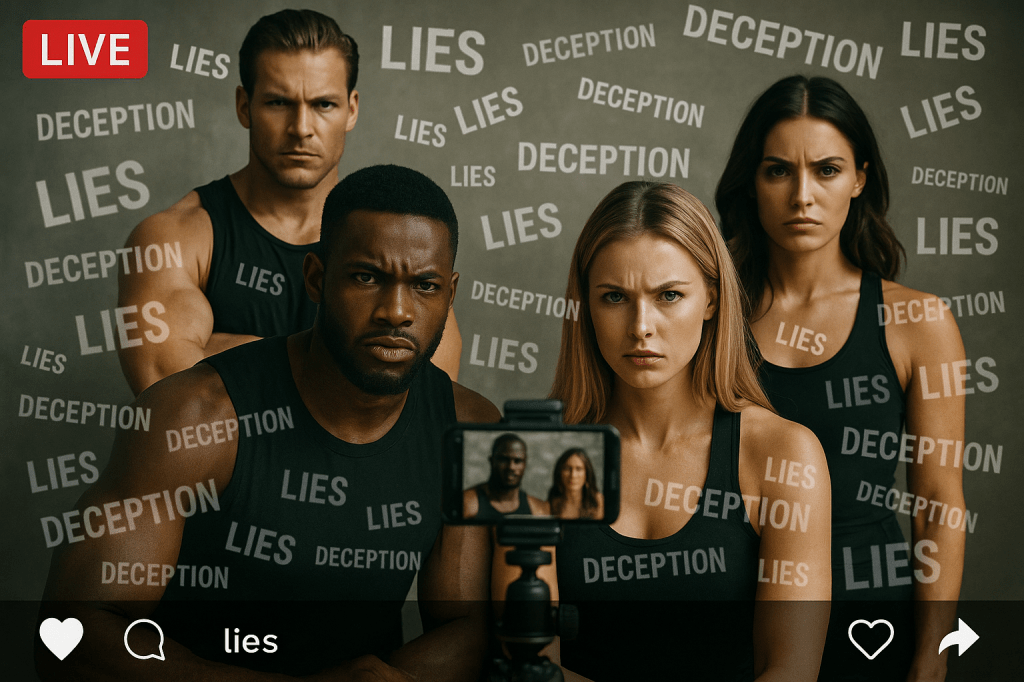
They’re not just pushing misinformation—they’re wrapping it in distraction. The latest wave of disinformation isn’t delivered by suited pundits or anonymous message boards; it’s coming from nodding muscle guys, smirking YouTubers from historically marginalized communities, and beautiful women lip-syncing conspiracy theories to a trending audio clip. The delivery is polished, seductive, algorithmically addictive—and it makes the lie go down easy. The performance adds credibility, not through facts, but through aesthetics, repetition, and confidence. It’s not about what’s true. It’s about what feels true in a feed curated to confirm your worldview. The most dangerous lie is what you want to be true but isn’t true.
Fighting the Fog
So, we fight the fog with sunshine. That means demanding data and information transparency—not only from our government and institutions, but from media, tech platforms, and even ourselves. We push for ethical journalism that centers evidence over clicks. We uplift peer-reviewed work, not just for academics, but as a foundation for public discourse across fields. We advocate for public-access data, open archives, and community-driven research that serve the people, not corporate or political agendas.
We defend people who speak hard truths, even when those truths challenge comfortable narratives. We refuse to let critical thinking be labeled as indoctrination. We invest in media literacy—not just so students can identify a Photoshopped headline or spot AI-generated propaganda, but so they can understand how information is constructed, why certain narratives are elevated, and who benefits when others are buried. This isn’t just a classroom skill—it’s a civic responsibility.
We build trust by being honest about complexity. By showing the receipts. By naming the sources. We don’t pretend every answer is simple, but we reject the idea that complexity means chaos. Truth is not a vibe. It’s a process. And the only way to restore trust is to model it ourselves—consistently, courageously, and with humility.
We remind people that the truth isn’t always comfortable. It isn’t always trending. And it certainly doesn’t always flatter us. But it is necessary—because when truth is optional, so is justice.
Because when everything becomes questionable, and the only “trusted” source is the loudest muscle-bound influencer shouting from your screen, our nation is no longer rooted in shared reality. It becomes manipulated and hollowed out. And the rest of us—educators, business leaders, researchers, journalists, public servants—are left trying to piece together a fractured nation that no longer remembers how to tell fact from fiction.
So we must persist. We teach, we write, we organize, and we resist. Because if we don’t fight for the integrity of knowledge—if we don’t reclaim the right to reality itself—then the fog wins. And in the fog, power is unaccountable, and the people remain in the dark.



 Cloaking Inequity
Leave a comment