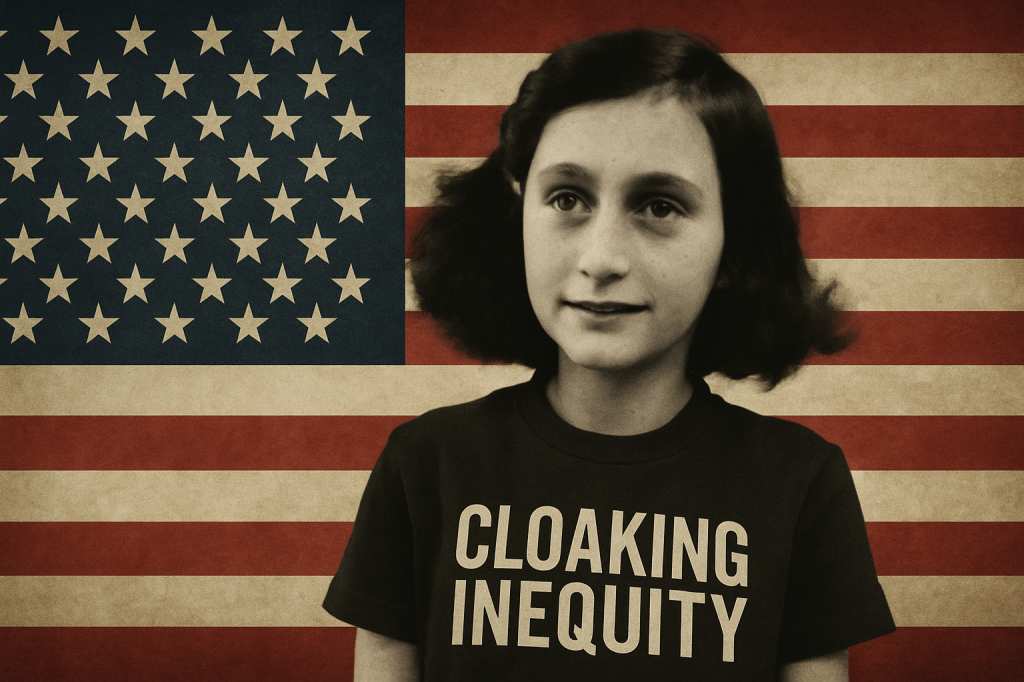
On the Fourth of July, we wave flags, light fireworks, and celebrate a vision of freedom rooted in the idea of citizenship—of liberty and justice for all. But this year, I’m not just thinking about parades and cookouts. I’m thinking about the meaning of citizenship, the cost of silence, and what happens when a country decides that some people no longer belong.
I’m thinking about history. I’m thinking about Anne Frank. I’m thinking about ICE detention centers. I’m thinking about birthright citizenship. I’m thinking about colonization. And I’m thinking about my grandfather—and my mother.
My grandfather served in the U.S. Navy during World War II. But not just anywhere—he served in the Seabees, the Navy’s segregated construction battalions. Not by choice, but because he was Black. He fought for a country that did not yet grant him full citizenship. He built the infrastructure of freedom, while being denied its promises.
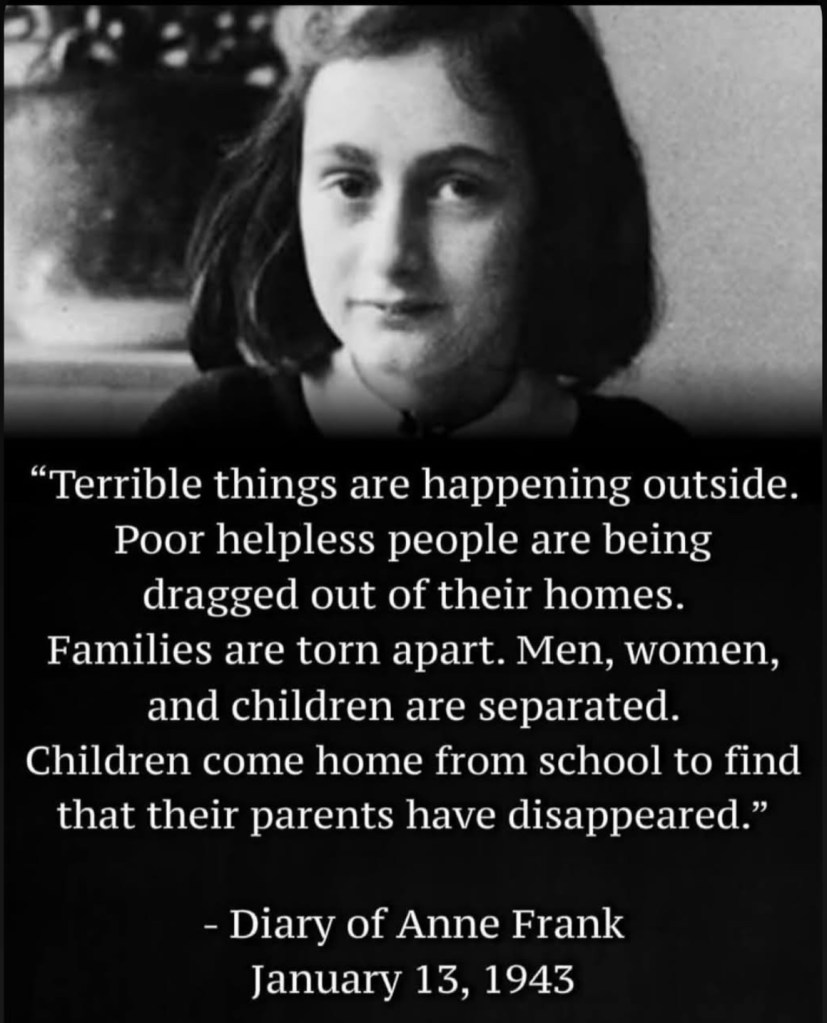
And my mother wanted me to understand the weight of that contradiction. One summer when I was nine years old, she handed me a book and said, “You need to read this.” It was The Diary of Anne Frank.
That book changed me. Anne’s voice was full of joy and curiosity—just like any child. But her story taught me what happens when citizenship is redefined by race, by fear, by power. It taught me what it means to be disappeared, not by accident, but by design. It taught me that silence is never neutral.
Citizenship: History Doesn’t Just Repeat Itself, It Rhymes
In 1935, Nazi controlled Germany passed the Reich Citizenship Law, which stripped Jews, Roma, Black Germans, and other targeted groups of citizenship. They were no longer protected by law. They were no longer considered part of the people. They were “subjects.” Aliens. Threats.
Anne Frank’s family fled these laws. But the ideology followed them into the Netherlands. Anne went into hiding at 13. She died in Bergen-Belsen at 15. Her diary survived her. But only barely. This wasn’t just a tragic mistake of history. It was a deliberate legal framework. Citizenship wasn’t just revoked—it was weaponized. And the public was told it was for safety from dangerous people. For order. For the good of the nation. As the saying goes: history doesn’t just repeat itself—it rhymes. And now, in the United States, we’re hearing the echo once again.
The New Attack on Birthright Citizenship
Birthright citizenship—guaranteed by the 14th Amendment—has been a foundational American promise: If you are born here, you belong here. It was created after the Civil War to protect formerly enslaved people from legal erasure. But now, that promise is under attack. Donald Trump, in speeches and interviews, has said he trying to end birthright citizenship through his executive order. But what’s most revealing isn’t the legal argument—it’s the moral one.
Here’s what he said on July 1, 2025 in Florida:
“We have a lot of bad people that have been here for a long time, people that whack people over the head with a baseball bat from behind when they’re not looking and kill them. People that knife you when you’re walking down the street. They’re not new to our country, they’re old to our country, many of them were born in our country. I think we ought to get them the hell out of here, too, if you want to know the truth.”
And then he added:
“So maybe that’ll be the next job that we’ll work on together.”
Let’s be clear: this isn’t about crime. It’s about who gets to be American. It’s about criminalizing existence in the United States. About demonizing generations of people born here—Latino, Native, Black, Asian, Arab, poor. It’s about revoking citizenship not because of something you did, but because of who you are. This is not policy debate. It is propaganda with purpose. This is not about law. It’s about fear, exclusion, and control.
Today, It’s Already Happening
We don’t have to imagine the future. It’s here. People are already being disappeared off the streets by ICE and its contractors—often without clear records of who took them or where they went. Detention centers are being quietly built and expanded, with names like Alligator Alcatraz—a cute nickname for a purposefully cruel place to detain humans.
Private companies are making billions by housing hundreds of thousands of men, women, and children—many of them asylum seekers or migrants with no criminal record—in squalid, inhumane conditions. Some are detained for months, even years, without trial. The goal is not justice. The goal is deterrence, humiliation, and profit.
Notably, members of the Trump administration have recieved financial windfalls from private prison corportations reportedly including the former Director of ICE and Trump “Border Czar.”
And all the while, colonization continues. The irony is brutal: the descendants of colonizers now detain people whose ancestors roamed these lands for thousands of years before the first European flag was ever planted in the soil. Many of those being deported or detained come from Indigenous communities—descendants of the original caretakers of this hemisphere. But in the logic of racial supremacy, they are called “aliens” and “illegals.” The land was taken, and now the people are too. This isn’t enforcement. This is erasure. And history has shown us what can come next.
Dachau is the Blueprint: When “Legal” Becomes a Weapon
In Nazi controlled Germany, the public didn’t know every detail—but they knew enough. They saw neighbors disappear. They heard the rumors. They smelled the smoke. And still, they told themselves it wasn’t their concern. That it was probably justified. That the government knew best. They chose silence. And that silence made atrocity possible.
Long before the full scale of the Holocaust came into view, Dachau marked the beginning of Nazi brutality. Established in March 1933—just weeks after Hitler’s rise to power—Dachau was the first detention camp of its kind. It was not initially built for Jews or wartime prisoners, but for 6,000 German citizens deemed enemies of the regime: socialists, union members, clergy, and political party opponents. Their crime was resistance. Their sentence was disappearance. Over time, as Nazi aggression spread across Europe, Dachau’s gates opened to immigrants, refugees, and foreign nationals.
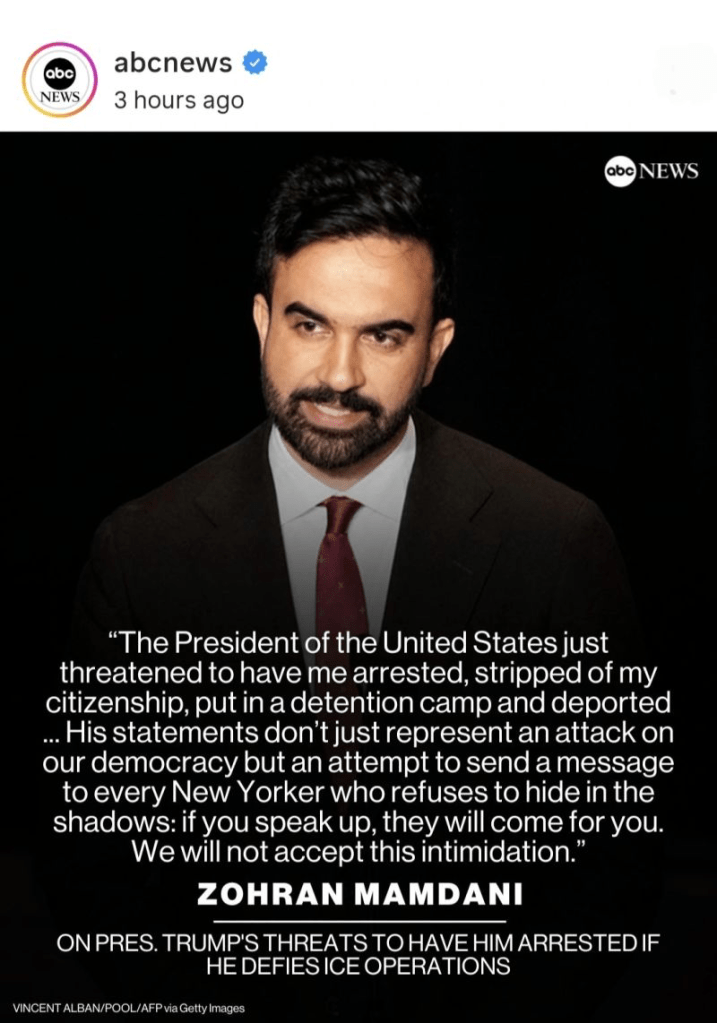
Dachau became the prototype for an entire system of “legal” terror—a concentration camp blueprint for how ideology, not justice, could dictate who deserved freedom. Most prisoners were arrested without formal charges or trials, swept up by secret police, denounced by neighbors, or targeted in mass roundups. Many were never told what they were accused of. Once inside, they disappeared into a bureaucratic system that masked cruelty with paperwork and euphemisms. Dachau taught the regime how to scale repression, erase opposition, and normalize political imprisonment under the guise of public order—where legality was manipulated to serve authoritarian control, not to protect safety and rights.
The “legal” legacy of Dachau reminds us that authoritarianism often begins not with mass slaughter, but with the silencing of dissent—by labeling opposing views (e.g. Democrats) as dangerous and criminalizing resistance (e.g. obstruction of justice). Dachau was never merely a prison. It was a signal flare. A warning. One we are still called to recognize and resist. Yet the danger today lies not only in repeating history, but in how we normalize and commercialize it. In a country where people are buying Alligator Alcatraz t-shirts on Etsy with cartoon alligators, we’re already doing in the present what would have once seemed unthinkable—turning sites of human suffering into novelty souvenirs. It’s like someone walking around in a Dachau t-shirt—stripped of its terror, repackaged as irony, provocation, or aesthetic. When cruelty becomes content and repression becomes retail, memory fades—and with it, our capacity to resist what we no longer recognize.
What Kind of Country Do We Want to Be?
My grandfather fought in WWII for a country that didn’t treat him as an equal. My mother gave me The Diary of Anne Frank because she wanted me to know what happens when exclusion becomes law. And today, on this Fourth of July, I ask: Are we listening? Because real patriotism is not about fireworks. It’s about fighting for the dignity of others.
It’s about protecting the citizenship of those who are easiest to erase. It’s about rejecting leaders who talk about stripping birthright from American-born children—because they don’t like who their parents are. It’s about recognizing that once citizenship becomes conditional (e.g. Reich Citizenship Law), no one is safe.
Conclusion: A Different Kind of Independence Day
Anne Frank once wrote: “In spite of everything, I still believe that people are really good at heart.” But Anne didn’t survive. Because “good at heart” wasn’t enough when facing the Nazis. This Fourth of July, let’s not hide behind the flag. Let’s commit to substance. Let’s tell the truth about where we are and remember the people being disappeared. Let’s reject the “legal” hyper criminalization of birth, race, ancestry, and migration and fight for a country where every person is protected—fully, humanely, and constitutionally. Because the only thing more dangerous than a government willing to revoke your rights…is a public too distracted—or too afraid—to stop it.
Please share.




 Cloaking Inequity
Leave a comment