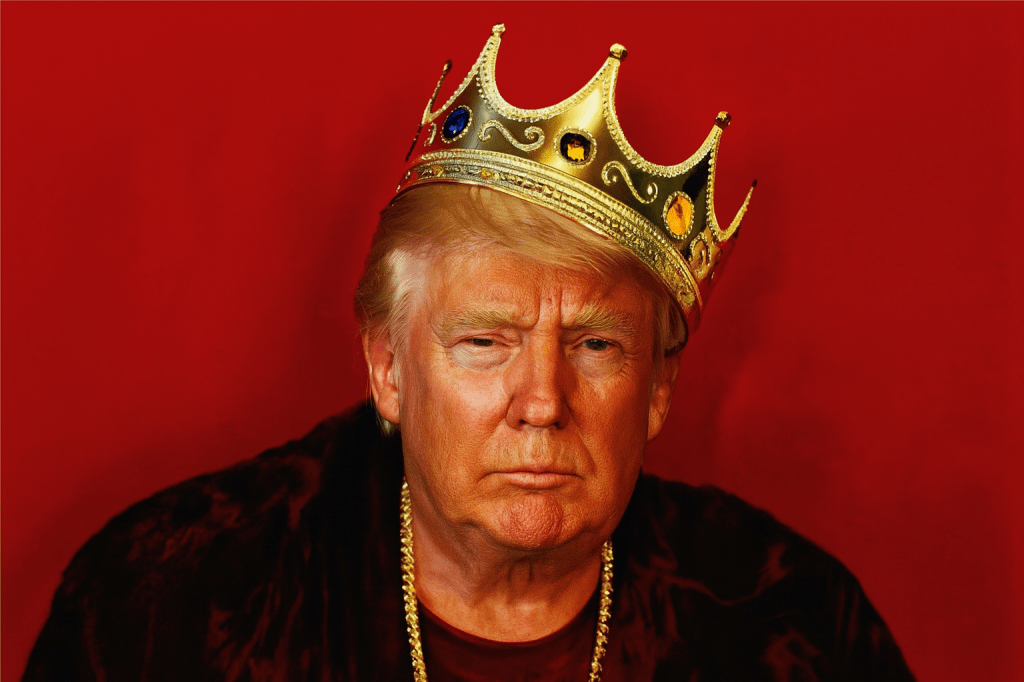
Just before the fireworks lit up the sky on July 4th, we learned something far more explosive than anything that could be launched from the National Mall. In a set of letters released through a Freedom of Information Act (FOIA) request, President Donald Trump, through Attorney General Pam Bondi, quietly claimed a power that not even King George III dared assert. The letters, directed at ten of the country’s largest tech companies, told them to ignore a law duly passed by Congress that effectively banned TikTok in the United States.
These letters, cloaked in vague legal justifications, revealed something chilling: a revival of the “dispensing power.” This ancient doctrine allowed monarchs to declare that certain laws didn’t apply to specific individuals or companies, usually their allies. It was one of the grievances that helped spark the Glorious Revolution of 1688, and it was a power explicitly denied to presidents under the U.S. Constitution.
And yet, here we are.
If this sounds like it’s just about social media, think again. The resurrection of dispensing power under Trump isn’t limited to tech platforms. It sets a precedent for selective governance, where laws passed by Congress are treated as optional, depending on who’s in power and who’s being favored. And the implications for education, our schools, our students, our futures, are dire.
The Death of Equal Protection in Education
Public education, at its best, is meant to be governed by rule of law: state and federal statutes, constitutional protections, and consistent regulations intended to ensure fairness, equity, and opportunity. When a president claims the authority to dispense with laws at will, the idea of equal protection collapses.
Imagine this in practice: What happens when a federal administration no longer enforces Title VI of the Civil Rights Act in districts that politically align with the president? Or when student loan forgiveness is selectively granted only to those in conservative states? Or when funding formulas are manipulated so that schools teaching “patriotic” curriculum are rewarded, while others are punished?
If Trump’s TikTok maneuver becomes precedent, nothing stops the same executive reasoning from applying to education. If a president can instruct private companies to ignore Congress, what’s to stop them from instructing public agencies, or even universities, to do the same? DEI? Optional. Curriculum? Censored. Accountability? Gone.
We are already seeing this logic bleed into education. Under Trump’s first term, his administration:
- Barred federal agencies and contractors from participating in DEI (Diversity, Equity, Inclusion) trainings via Executive Order 13950.
- Threatened universities with funding cuts for discussing systemic racism.
- Proposed changes to Title IX that made it harder for students to report sexual assault.
- Attempted to defund public schools that did not reopen during the height of the COVID-19 pandemic, regardless of health conditions.
Now imagine what his second term looks like with formalized dispensing power. DEI bans would no longer be subject to legal challenge in red states, they’d be federal mandates. States that resist would simply be “exempted” from funding or pressured with waivers to enforce federal “patriotic education” standards. Books that mention queer lives, slavery, or anti-racist thought could be pulled under the threat of losing Title I or Pell Grant funding. The power to dispense with the law becomes the power to destroy equity. Selectively. Strategically. And without oversight.
Who Gets Protected? Who Gets Punished?
If you’re a school district that marches in ideological lockstep with the president, you get rewarded. Exempted. Blessed.
If you’re a college or university that protests, teaches critical race theory, or refuses to hire based on political loyalty, you get investigated. Starved. Silenced.
Trump’s quiet revival of the dispensing power makes it clear: the future he envisions is not governed by fairness or constitutional boundaries, it’s ruled by executive whim and kingly patronage.
It’s not just that he disagrees with the law. It’s that he believes he doesn’t have to follow it.
Education as a Battlefield of Exception
What’s most terrifying is how normalized this might become. Dispensing power reframes the president not as an executor of the law, but as an editor of it, rewriting at will what applies and to whom. That means education policies can be rewritten midstream. Commitments to equity can be revoked. Protections for marginalized students can be erased, not by legislation or judicial ruling, but by a letter, quietly issued, on a Friday afternoon.
This makes education policy into a battlefield of exceptions. No more predictability for school districts. No more stability for students. No more security for teachers and families. Everything becomes conditional, revocable, politicized.
And with Project 2025 waiting in the wings to dismantle the U.S. Department of Education entirely, the idea of a national floor for rights or services collapses entirely. The dispensing power is not just a bureaucratic footnote, it is the legal tool to erase the federal role in public education and leave it up to the King.
We Must Sound the Alarm—Now
This is not theoretical. This is happening. If Trump’s assault on constitutional separation of powers is allowed to stand, no sector of American life, not even our classrooms, is safe from presidential fiat. Educators, families, policymakers, and civil rights advocates must sound the alarm. Dispensing power is the antithesis of democratic governance. It is the language of monarchs, not presidents. And if we allow it to take hold, it will not be used to protect the vulnerable, but to punish dissent.
It will not be used to lift up our children, but to sort, silence, and subjugate them. The classroom must remain a space governed by law, not loyalty. By justice, not fear. Let us say clearly, loudly, and unapologetically: No president has the right to exempt their friends from the law. Not in tech. Not in education. Not in a democracy. Not now. Not ever. No kings.



 Cloaking Inequity
Leave a comment