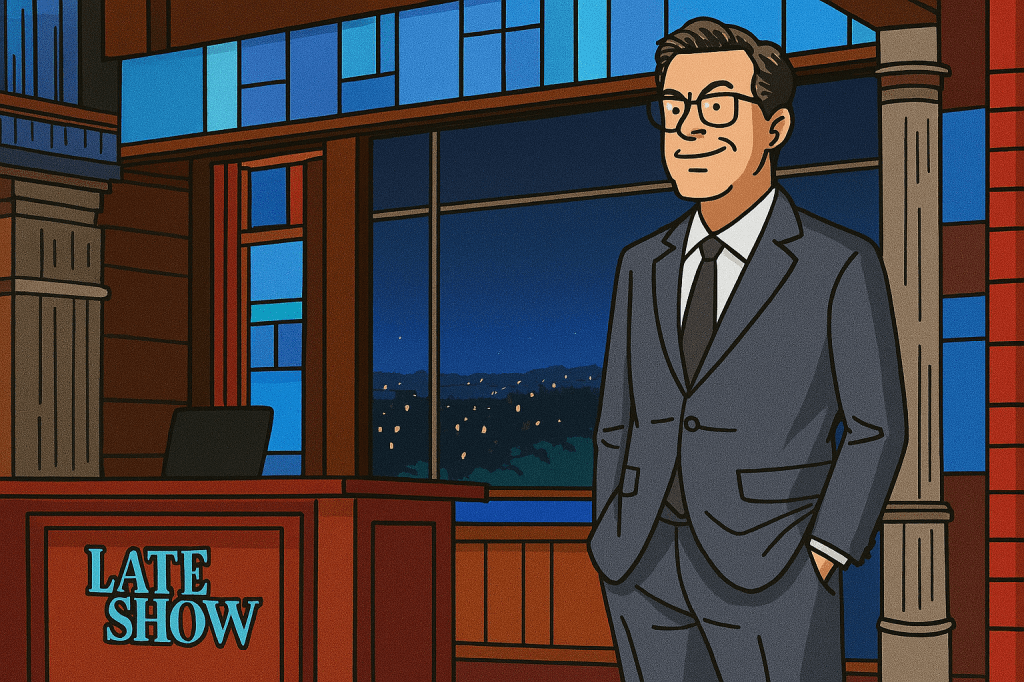
Thank you, Stephen Colbert. Thank you for speaking truth to power. For staying far from timid. For never bending the knee to a wannabe king.
I don’t often actually watch The Late Show live when it airs—but I’ve rarely missed an episode in years thanks to YouTube. It’s my daily ritual: I tune in for the monologue, sometimes the full special series, and always the brilliantly absurd word salad build-up to “Meanwhile.” I’ll browse the guests, but it’s the opening truth-telling that keeps me coming back. Because Colbert isn’t just a comedian. He’s a cultural barometer for our democracy, and a reminder that laughter can be a powerful act of resistance.
And let’s not pretend the stakes are low. One of the defining signs of authoritarian regimes is media control—silencing critics, consolidating platforms, rewarding loyalty with airtime and access. Considering the quiet deal the Trump administration reportedly struck with CBS—a network that has leaned harder into corporate compliance than journalistic courage in the battle with Trump about 60 minutes—you have to wonder how long they were going to let someone like Colbert keep going. How long before late night had to be neutered to avoid discomfort at the top?
And now we’re watching it unfold. Bit by bit. I hope Stephen finds a new platform, HBO, perhaps, or another space that isn’t afraid of fire. I want him to open the next chapter by lighting up CBS’s hypocrisy and the increasingly dictatorial decisions coming from this administration. We need that kind of truth-telling now more than ever.
I always wanted to see The Late Show live in New York, but never got the chance. I did manage to get into a taping of Last Week Tonight once. Lined up outside, hoping for a miracle, and got in as the last person let in that night. It felt like witnessing journalism, satire, and civic purpose rolled into one. That feeling? It’s rare. And powerful. And it shouldn’t just belong to comedians.
We Need Educational Leaders With Colbert’s Courage
What does all this have to do with education? A lot.
Because the courage that Colbert shows—night after night—is the same courage we need in superintendents, provosts, presidents, school board members, and education commissioners.
It’s the same courage that Governor Gavin Newsom showed when he stood up for the right to teach Black and queer history in schools, despite the political risks. It’s the courage that Governor J.B. Pritzker demonstrated when he stood up to right-wing book bans and declared that public schools should be places of inclusion and knowledge, not censorship and fear.
It’s also the courage I called for in my Diverse: Issues In Higher Education article, “Courage Should Be in the Job Description”, where I wrote:
“When political tides shift, too many educational leaders become caretakers of institutional survival instead of defenders of institutional mission… We need bold leaders who are willing to stand with students and faculty in the face of political attacks, not shrink away from conflict out of fear of funding loss or personal ambition.”
This moment demands boldness. It demands what Colbert does with humor, what we, in education, must do with policy, with values, with our full public presence. It is not enough to say you support diversity, equity, and inclusion when it’s popular. It is not enough to tweet support for academic freedom while quietly caving behind closed doors. It is not enough to perform courage. You have to live it. As I wrote in the same article:
“Courage is not a soft skill. It is a requirement.”
What Happens If We Don’t?
If we don’t act, we cede ground to those who would roll back every hard-won gain in education, especially for Black, Brown, Indigenous, LGBTQ+, and undocumented students.
We see the signs everywhere:
- Banned books and college majors
- Gutted student success initiatives
- Educators surveilled or suspended for public speech
- Funding stripped from school districts
- University presidents intimidated into silence or resignation
And now, perhaps, late-night truth-tellers quietly pushed out to make room for more palatable programming. Let’s be honest: what’s happening to Stephen Colbert isn’t isolated. It’s part of the same authoritarian political project that is trying to suppress ideas, dismantle higher education, and control what truth is allowed in the public square.
Refusing to Go Quietly
So, no, I won’t pretend Colbert is “just a TV host.” He’s more than that. He’s a cultural mirror. He’s a pressure valve for a democracy under siege. He’s a public intellectual disguised in punchlines. And most of all, he’s a reminder that courage can be joyful. Defiance can be hilarious. Truth can still go viral.
So thank you, Stephen.
Thank you for showing us that resistance doesn’t have to be solemn to be serious. That satire can be sanctuary. That humor can be the hinge between cowardice and courage.
To everyone watching this moment unfold:
Do not go quiet.
Do not go safe.
Do not go small.
Be Colbertian.
Be bold.
Be public.
Be principled.
Because this moment isn’t just about saving late night.
It’s about saving truth—and the institutions that are supposed to protect it.
Please share.
Thank you, Stephen Colbert. Thank you for speaking truth to power. For staying far from timid. For never bending the knee to a wannabe king.
I don’t often actually watch The Late Show live when it airs—but I’ve rarely missed an episode in years thanks to YouTube. It’s my daily ritual: I tune in for the monologue, sometimes the full special series, and always the brilliantly absurd word salad build-up to “Meanwhile.” I’ll browse the guests, but it’s the opening truth-telling that keeps me coming back. Because Colbert isn’t just a comedian. He’s a cultural barometer for our democracy, and a reminder that laughter can be a powerful act of resistance.
And let’s not pretend the stakes are low. One of the defining signs of authoritarian regimes is media control—silencing critics, consolidating platforms, rewarding loyalty with airtime and access. Considering the quiet deal the Trump administration reportedly struck with CBS—a network that has leaned harder into corporate compliance than journalistic courage in the battle with Trump about 60 minutes—you have to wonder how long they were going to let someone like Colbert keep going. How long before late night had to be neutered to avoid discomfort at the top?
And now we’re watching it unfold. Bit by bit. I hope Stephen finds a new platform, HBO, perhaps, or another space that isn’t afraid of fire. I want him to open the next chapter by lighting up CBS’s hypocrisy and the increasingly dictatorial decisions coming from this administration. We need that kind of truth-telling now more than ever.
I always wanted to see The Late Show live in New York, but never got the chance. I did manage to get into a taping of Last Week Tonight once. Lined up outside, hoping for a miracle, and got in as the last person let in that night. It felt like witnessing journalism, satire, and civic purpose rolled into one. That feeling? It’s rare. And powerful. And it shouldn’t just belong to comedians.
We Need Educational Leaders With Colbert’s Courage
What does all this have to do with education? A lot.
Because the courage that Colbert shows—night after night—is the same courage we need in superintendents, provosts, presidents, school board members, and education commissioners.
It’s the same courage that Governor Gavin Newsom showed when he stood up for the right to teach Black and queer history in schools, despite the political risks. It’s the courage that Governor J.B. Pritzker demonstrated when he stood up to right-wing book bans and declared that public schools should be places of inclusion and knowledge, not censorship and fear.
It’s also the courage I called for in my Diverse: Issues In Higher Education article, “Courage Should Be in the Job Description”, where I wrote:
“When political tides shift, too many educational leaders become caretakers of institutional survival instead of defenders of institutional mission… We need bold leaders who are willing to stand with students and faculty in the face of political attacks, not shrink away from conflict out of fear of funding loss or personal ambition.”
This moment demands boldness. It demands what Colbert does with humor, what we, in education, must do with policy, with values, with our full public presence. It is not enough to say you support diversity, equity, and inclusion when it’s popular. It is not enough to tweet support for academic freedom while quietly caving behind closed doors. It is not enough to perform courage. You have to live it. As I wrote in the same article:
“Courage is not a soft skill. It is a requirement.”
What Happens If We Don’t?
If we don’t act, we cede ground to those who would roll back every hard-won gain in education, especially for Black, Brown, Indigenous, LGBTQ+, and undocumented students.
We see the signs everywhere:
- Banned books and college majors
- Gutted student success initiatives
- Educators surveilled or suspended for public speech
- Funding stripped from school districts
- University presidents intimidated into silence or resignation
And now, perhaps, late-night truth-tellers quietly pushed out to make room for more palatable programming. Let’s be honest: what’s happening to Stephen Colbert isn’t isolated. It’s part of the same authoritarian political project that is trying to suppress ideas, dismantle higher education, and control what truth is allowed in the public square.
Refusing to Go Quietly
So, no, I won’t pretend Colbert is “just a TV host.” He’s more than that. He’s a cultural mirror. He’s a pressure valve for a democracy under siege. He’s a public intellectual disguised in punchlines. And most of all, he’s a reminder that courage can be joyful. Defiance can be hilarious. Truth can still go viral.
So thank you, Stephen.
Thank you for showing us that resistance doesn’t have to be solemn to be serious. That satire can be sanctuary. That humor can be the hinge between cowardice and courage.
To everyone watching this moment unfold:
Do not go quiet.
Do not go safe.
Do not go small.
Be Colbertian.
Be bold.
Be public.
Be principled.
Because this moment isn’t just about saving late night.
It’s about saving truth—and the institutions that are supposed to protect it.
Please share.


 Cloaking Inequity
Leave a comment