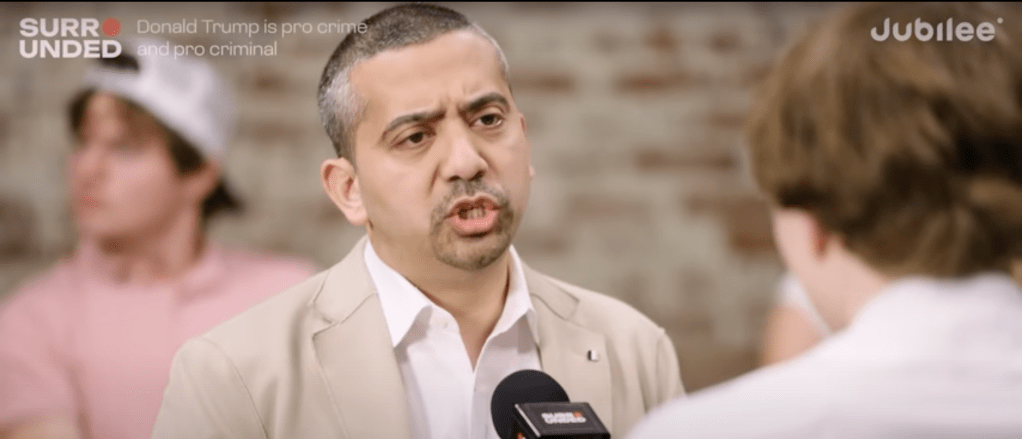
If you want a glimpse of how far the Overton window has shifted, and just how openly today’s far right-wing is embracing authoritarianism and dictatorship, watch the newest viral episode of Surrounded, the web series by Jubilee that puts ideologically opposed people in one room and lets the sparks fly. The format isn’t new, but this particular episode is different. It’s disturbing. It’s a warning.
In an era of fragmented media and echo chambers, Surrounded has become one of YouTube’s most provocative political shows. Past episodes have featured figures from across the spectrum, including atheist Alex O’Connor, Secretary Pete Buttigieg, and conservative commentators like Ben Shapiro and Jordan Peterson. But this latest episode—already clocking over 3 million views—may be the most revealing yet.
Zeteo founder and political firebrand Mehdi Hasan, the lone progressive voice, faces off against 20 self-identified “far-right” conservatives in a supposed debate about democracy and the Constitution. What unfolds is less a debate and more a window into the right-wing id. As Hasan reflected afterward, he “genuinely had not been aware of how extreme many of (his debate opponents) would be.” That’s saying something. Because what happens next is not just surreal, it’s chilling.
When Hasan argues that Trump is defying the Constitution, one young man, eagerly takes the mic to say Trump should go even further. “The Constitution is a document that should seek to serve us,” he explains. Asked if Democrats could do the same when in power, he flatly says, “Absolutely not.” Do you believe in democracy? “Absolutely not.” What do you believe in? “Autocracy by those who are in line with Catholic teaching.” He continued, “I’m for defending the traditional demographics of this country, which is majority white. It should stay that way.” Then it gets worse. The right wing speaker praises Nazi legal theorist Carl Schmitt. When Hasan asks, “Are you a fan of the Nazis?” He shrugs: “I frankly don’t care about being called a Nazi at all.” Asked if he condemns Nazi persecution of Jews, he replies, “I think there was a little bit of persecution…”
This isn’t just fringe ideology slipping through the cracks—it’s unapologetic authoritarianism, spoken with confidence, broadcast to millions, and echoed in the very spaces where our students, neighbors, and even elected officials are listening. Is this the so-called “ideological diversity” the right wants in our K–12 schools and universities? Autocracy. Admiration for dictatorship. Antisemitism. Racism. If that’s the vision, we have to ask: diversity of thought, or a dangerous descent into indoctrination?
The episode is jaw-dropping not just because of its confrontational tone, but because of the unfiltered extremism on display. When Mehdi Hasan, a U.S. citizen born in England, raised concerns about Trump’s “pro-crime” behavior, especially his pardoning of January 6 insurrectionists, one Republican proudly declared, “I am happy that he released J6. In fact, so much so, that I was prepared to protest if he didn’t.” When asked whether that made Trump “pro-criminal,” he shrugged it off, saying, “Sure, because you know what? We’re changing the definition of what crime is… It’s no longer a relevant conversation.”
Other moments were equally revealing—and revolting. One self-described conservative turned to Hasan and said, “Get the hell out,” after learning he was an immigrant. “I don’t want you here,” he added. When asked why, he replied, “Because you come here and say all this bulls— about how Americans are lazy, you push your left-wing politics.”
These were not isolated incidents or edge-case beliefs. They were cheered by the room. One participant even warned Hasan: “You’re in a room with juggernauts right now… You’re going to be blown open if you think that my position is hard-right. You have no idea what you’re up against.” The audience erupted in applause.
This isn’t just trolling. It isn’t performance art. It’s the normalization of white supremacy, authoritarianism, fascism, and open disdain for democracy—and it’s happening on a YouTube channel with millions of followers. That’s the point. This isn’t the fringe anymore. This is what’s gaining traction in our courts and government. This is what billions in the US and around the world are watching with horror. This is what is coming if we don’t wake up. So when a Brazilian colleague recently told me, “The United States is already dealing with a dictatorship—you just don’t know it yet,” I felt a chill in my spine.
I highly recommend you watch the show.
Brazil has lived this story before. We haven’t. But watching Surrounded, you realize that maybe we will—and we just didn’t know it yet.
Brazil’s Hard Lessons about Authoritarianism
In the late 20th century, Brazil endured a brutal military dictatorship that reshaped the nation’s collective memory. From 1964 to 1985, the regime imposed censorship, suspended democratic institutions, and used torture and repression to silence dissent. It took years of struggle, and a people-powered movement demanding justice, for Brazil to begin healing and building legal and institutional safeguards to prevent authoritarianism from taking root again.
Now, in 2025, the United States finds itself flirting with the same dark precipice. The question we must ask now is sobering: Will the U.S. need to experience a dictatorship in order to truly understand the dangers of autocracy? Or can we learn, as Brazil eventually did, without having to fall so far?
Brazil’s military coup was framed at the time as a “necessary intervention.” That’s how authoritarian takeovers always begin: with justifications, not jackboots. With the backing of elites and support from the U.S. government, yes, our government, Brazil’s democracy was dismantled in the name of national security and anti-socialism.
Over two decades, the Brazilian regime surveilled its citizens, banned political opposition, and turned universities into battlegrounds for state control. Educators, activists, journalists, and students were tortured and “disappeared.” Even as the country celebrated economic development, civil liberties lay buried beneath the surface. This sounds like much of the rhetoric in the episode of Surrounded.
But after the dictatorship fell, Brazil did not simply move on. It confronted its past. The country launched a Truth Commission to investigate the regime’s crimes, rewrote its constitution to enshrine human rights and decentralize power, and embedded civic education into its schools to ensure that future generations would understand the cost of silence. The journey has not been perfect. The rise of Jair Bolsonaro reminded the world how fragile memory can be, and how quickly democratic backsliding can begin. Yet when Bolsonaro attempted a January 6-style insurrection in Brasília, Brazil’s courts, democratic institutions, and civil society refused to allow it. They held the line.
Bolsonaro’s ally Donald Trump is now lashing out. Because Brazil is pursuing justice, Trump has threatened to impose 50 percent tariffs—a clear abuse of power and a violation of American trade law, which prohibits using tariffs as political retaliation. Trump’s message is unmistakable: if you investigate my friends, I will punish your economy. This is not diplomacy. It is authoritarian solidarity. But Brazil has seen dictatorship before. And it is not backing down. That is the deeper lesson. Brazil, through painful experience, has developed institutional antibodies to authoritarianism. The United States may not have the same defenses.
The American Exceptionalism That Blinds Us
Too many Americans believe it can’t happen here. That belief is our Achilles’ heel. Wrapped in red, white, and blue, it tells us that our Constitution is invincible, our courts impartial, our democracy permanent. We assume the Founders got it so right that we don’t have to worry about collapse. Meanwhile, we watch the very mechanisms of democracy being dismantled in plain sight:
The Supreme Court has granted presidents near-total immunity for “official acts,” effectively placing the presidency above the law. Trump’s allies are openly purging civil servants, weaponize the Department of Justice for investigation and prosecution of political opponents, and eliminate entire parts of the government such as the Department of Education. A 10,000-agent expansion of ICE is creating a quasi-military force under presidential control, unaccountable, emboldened, and if history is a guide it will likely used against immigrants and dissenters alike. Book bans, DEI eliminations, protest restrictions, and voting roll purges are metastasizing across red states like invasive species, suffocating liberty under the banner of “freedom.” We are not immune. And we are not prepared.
America’s Authoritarian Creep
What we’re witnessing is not an anomaly, it’s a systematic erosion of democratic norms. Political theorist Ruth Ben-Ghiat calls it “authoritarian creep.” It doesn’t arrive overnight. It comes in waves of executive overreach, judicial complicity, and right-wing populist propaganda. It comes wrapped in flags and bibles and school vouchers. It thrives when citizens are told to trust “strongmen” over institutions, and Instagram reels over a free press.
In Brazil, authoritarianism showed up in tanks. In America, it’s showing up at the moment in press conferences, DOGE dictates, and Supreme Court decisions. As I discussed in the post Tyrant Playbook: Why the US Department of Education is Closing, the Trumpist playbook mirrors the tactics of every autocrat of the past century, from Hungary’s Orbán to Chile’s Pinochet. Take over the courts. Rewrite history. Demonize the press. Militarize immigration enforcement. Undermine educators. Blame marginalized communities for societal decline. Erode the line between military and civilian authority. Brazil learned the cost of allowing these tactics to take root. Will the U.S. only learn after the fire has already consumed the house?
The Role of Education—and Its Targeting
It’s not a coincidence that education is always among the first targets of rising authoritarianism. In Brazil, professors were surveilled, universities were purged of dissenting voices, and critical thought was criminalized—hundreds of educators and students were imprisoned, tortured, or expelled, with some, like education pioneer Anísio Teixeira, dying under suspicious circumstances, while others, including Paulo Freire, were forced into exile as the regime targeted intellectuals who dared to question authoritarian rule. In the U.S., the targets are different in name but not in nature: DEI programs, ethnic studies, “critical race theory,” and gender-inclusive curricula have all been scapegoated to stoke fear and consolidate power.
Because authoritarians understand something that far too many ignore: Educated people are harder to manipulate. Students who learn about civil rights, historical injustice, government, and civic participation don’t easily fall for nationalist propaganda. They don’t blindly accept censorship. They ask questions. They organize. They resist. That’s why Trump and his allies are obsessed with defunding education. That’s why Ron DeSantis made war on Florida’s public universities. That’s why federal funding for higher education is under attack. They know the truth: free and critical minds are a threat to authoritarianism.
Could America Learn the Easy Way?
Brazil eventually returned to democracy. But it came at a cost: decades of lost lives, stifled dreams, murders, and broken families. The scars of dictatorship still mark Brazil’s institutions—and still haunt its politics. The United States doesn’t have to repeat that history. But that requires us to stop sleepwalking.
Stopping authoritarian creep will require courage in Congress and in classrooms. It requires leadership that doesn’t capitulate to extremists. It requires journalism that tells the truth, even when inconvenient. And it requires us—ordinary people—to resist normalization. If we continue to believe that “it can’t happen here,” we’re playing right into authoritarianism.
Don’t Wait for the Fall
The lesson of Brazil, and of every nation that has clawed its way back from dictatorship, is as brutal as it is undeniable: by the time the masses fully grasp what is unfolding, it is already too late. If we wait until the Department of Education is shuttered and erased from memory… If we wait until 10,000 ICE agents are deployed like soldiers, banging on doors and dragging away political opponents in the dead of night… If we wait until the press is not only banned from the White House and Air Force One, but silenced in courts, raided by state police, and replaced by billonaire propaganda… If we wait until the mere discussion of dissent is criminalized across classrooms, campuses, and community spaces… we will not be at the edge of danger—we will already be deep in the darkness where Brazil found itself in 1968.
So the question is not whether a dictatorship will wake America up. The real question is this: What more do we need to see before we open our eyes?
Please share


 Cloaking Inequity
Leave a comment