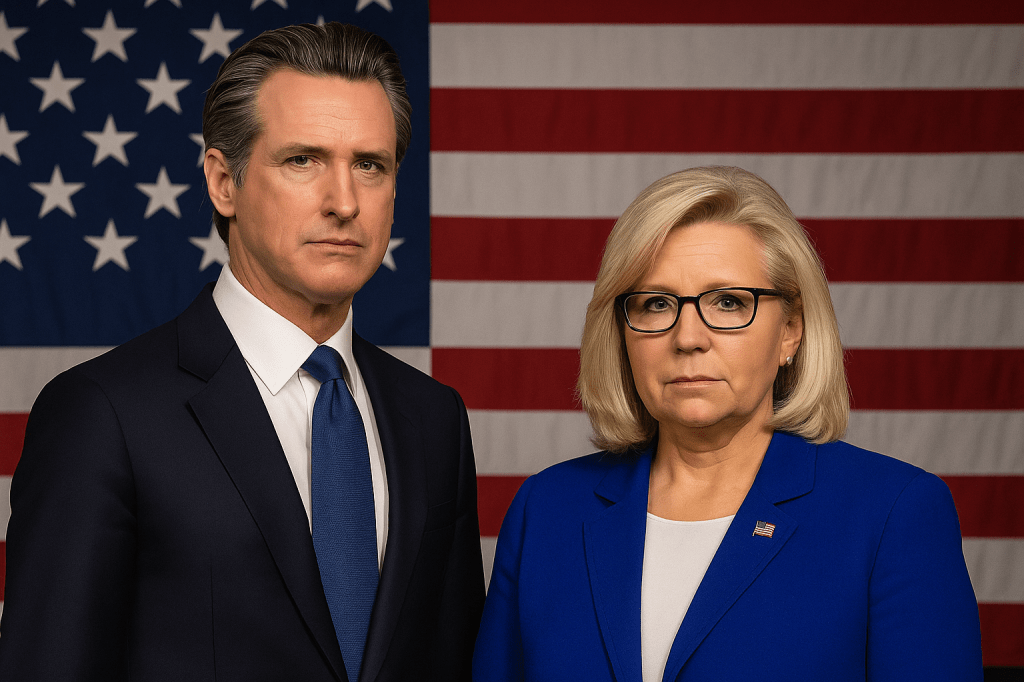
It is not often that Gavin Newsom and Liz Cheney end up in the same sentence as symbols of hope. Yet in 2025, these two figures from opposite ends of the political spectrum are embodying a new reality. The fight against authoritarianism is no longer a battle between left and right, but between those who defend democracy and those who would happily bury it and promote unconstitutional ideas like a third term and unfettered presidential authority. Both Cheney and Newsom are showing that when the stakes are survival, political lines blur and courage looks different but essential.
Cheney has shocked many progressives by becoming one of the most forceful critics of Trump’s authoritarian project. Newsom, often dismissed as a slick California liberal, has sharpened his counterpunches and communications in ways that everyone should study. Together they represent something we rarely see in American politics today: a bipartisan refusal to surrender. Their approaches are different, their styles clash, but the lesson is the same. Authoritarianism is rising, and only strength and creativity will meet the moment.
Cheney’s Blunt Alarm
Like her or not, Liz Cheney has been unsparing in her assessment of the dangers we face. She has described the Trump machine as exactly what it is: an authoritarian structure masquerading as normal governance. Her viral calls to action echo in group chats and resistance circles because they say plainly what many leaders are still afraid to admit. This is not just a policy debate. This is a coordinated dismantling of democracy.
Cheney has demanded that Democrats stop acting as though we are living in normal times. She has argued for immediate action that shifts the news cycle rather than fits inside it. That is the key distinction. Authoritarians thrive on chaos and spectacle, and unless opposition forces are willing to fight with equal boldness, the cycle of domination will continue. She has made it clear that survival requires more than speeches, committees, and endless fundraising emails. It requires fire, urgency, and strategy.
Cheney’s credibility comes in part from her lineage. As the daughter of a conservative icon, she is no stranger to power politics. Yet she has chosen to break with her party and risk her career to call out the danger of authoritarian capture. Her willingness to say what many Republicans whisper privately matters. It is a reminder that defending democracy is bigger than partisanship. Sometimes the most unlikely messenger can carry the most important alarm.
Newsom’s Humor Offensive
On the other coast, Gavin Newsom has been experimenting with a different tool: humor. His communications team has started releasing all-caps messages styled after Donald Trump’s infamous tweets, but with a twist of parody that cuts deep. They are sharp, biting, and most importantly, funny. Authoritarians despise humor because it punctures their aura of invincibility. Laughter shrinks bullies down to size.
Newsom has understood something too many ignore. Politics is not just about policy, it is about performance. Trump mastered the art of dominating the news cycle through outrageous messaging. The only way to counter that is not through bland civility but through messaging that is memorable, emotional, and at times, hilarious. Also, thank you South Park, you have brought Master Debating to new levels. Newsom’s trolling shows that satire can be a form of resistance. By laughing at Trump’s bluster, he takes away some of its power.
This use of humor has historical precedent. Charlie Chaplin’s film The Great Dictator mocked Hitler’s pomp and exposed the absurdity of fascist theatrics. Vaclav Havel and Czech dissidents used satire to chip away at Soviet dominance. In the American civil rights movement, humor was often deployed to expose the ridiculousness of segregation laws and disarm hostility. Humor does not replace action, but it amplifies resistance by eroding the myth of authoritarian inevitability. Newsom’s parody tweets may seem like a small action, but they serve a larger purpose. They show that Americans can play offense instead of always being on defense.
Responding to Bullies with Strength
The thread that ties Cheney and Newsom together is the understanding that bullies only respond to strength. Cheney’s insistence on urgency and Newsom’s humor offensive are two sides of the same coin. Both recognize that authoritarian tactics are designed to intimidate and overwhelm. Civility and patience are not strategies when dealing with a machine built on fear. Strength, boldness, and confidence are the only responses bullies understand.
Trump’s opponents have too often acted like it is enough to take the moral high ground while waiting for voters to see reason. That posture fails because authoritarians are not playing by the same rules. They are manipulating courts, redrawing legislative districts, weaponizing government agencies, packing law enforcement with loyalists and flooding the media ecosystem with alternative facts. To counter that, Cheney calls for bolder plans and Newsom offers sharper communication. Both are right. It will take a combination of strategy and spectacle to fight back.
Responding with strength also means being willing to offend. Too often, Trump’s opponents fear that hard punches will be labeled as divisive. Yet authoritarian movements do not hesitate to attack with lies and cruelty. If the opposition refuses to strike back, they cede the ground entirely. Bullies respect boundaries only when they are enforced. That lesson applies as much in politics as it does in life.
The Redistricting Battlefield
Strength must also be applied to the less glamorous but equally critical battlefields, and redistricting is one of them. Republicans have invested for decades in gerrymandering maps that secure minority rule. Each manipulated district silences communities and locks in power even when majorities oppose them. Redistricting is not technical housekeeping. It is a weapon in the authoritarian arsenal.
Newsom has started raising the alarm that Democrats must treat redistricting as an existential issue, not an afterthought. Maps decide who gets to govern before a single vote is cast. If Trump’s opponents want to defend democracy, they cannot afford to lose this fight. Lawsuits, ballot initiatives, independent commissions, and bold use of democracy are all tools that must be deployed. To let the right wing dominate this terrain unchallenged is to concede the battlefield before the fight begins.
The lesson of redistricting is that structural fights matter as much as cultural ones. Cheney’s alarms about authoritarian consolidation and Newsom’s humor offensive both capture attention, but without power on the map, those messages can fall flat during elections. Winning the narrative is important, but so is controlling the mechanics of representation. Democracy will not be preserved by words alone. It will be preserved by actions ensuring that the system itself cannot be rigged permanently against the majority.
What Cheney and Newsom demonstrate, in different ways, is the necessity of a wartime posture. Cheney calls for bold strategy and immediate action. Newsom uses humor to puncture authoritarian myths and energize supporters. Both understand that the usual peacetime protocols of speeches, committee hearings, and incremental legislation are insufficient. The country is facing an authoritarian machine, and only an opposition that fights as if its survival depends on it has any chance of winning.
A wartime posture does not mean abandoning principle. It means fighting with principle and strength simultaneously. That requires bolder communication, faster mobilization, and a willingness to wield power aggressively when the moment demands it. Civility can return when the threat of authoritarian collapse is no longer imminent. Until then, survival depends on urgency and creativity.
The Unlikely Alliance
The strange pairing of Gavin Newsom and Liz Cheney should remind us of what is at stake. This is not about party loyalty or ideological purity. It is about whether democratic governance itself survives. Cheney brings the credibility of a lifelong conservative warning that Trumpism is not politics but authoritarianism. Newsom brings the flair of a liberal governor who has learned to counterpunch with humor and spectacle. Their tools differ, but their message is aligned.
Some will roll their eyes at Cheney, pointing to her voting record and family legacy. Others will scoff at Newsom, dismissing him as an ambitious showman. But dismissing either misses the point. In moments of existential crisis, defenders of democracy cannot afford to be picky about their allies. The test is not whether they agree with us on every issue, but whether they are willing to fight for the survival of constitutional order itself. By that measure, both Newsom and Cheney are offering more than many within their own parties.
History is not going to remember whether leaders were polite in the face of rising authoritarianism. It is going to remember whether they fought back. Cheney has chosen to fight with blunt alarms and strategic urgency. Newsom has chosen to fight with humor and counter-spectacle. Both deserve attention because they remind us of the same lesson: survival requires strength, creativity, and courage.
Julian Vasquez Heilig is a nationally recognized policy scholar, public intellectual, and civil rights advocate. A trusted voice in public policy, he has testified for state legislatures, the U.S. Congress, the United Nations, and the U.S. Commission on Civil Rights, while also advising presidential and gubernatorial campaigns. His work has been cited by major outlets including The New York Times, The Washington Post, and Los Angeles Times, and he has appeared on networks from MSNBC and PBS to NPR and DemocracyNow!. He is a recipient of more than 30 honors, including the 2025 NAACP Keeper of the Flame Award, Vasquez Heilig brings both scholarly rigor and grassroots commitment to the fight for equity and justice.




 Cloaking Inequity
Leave a comment