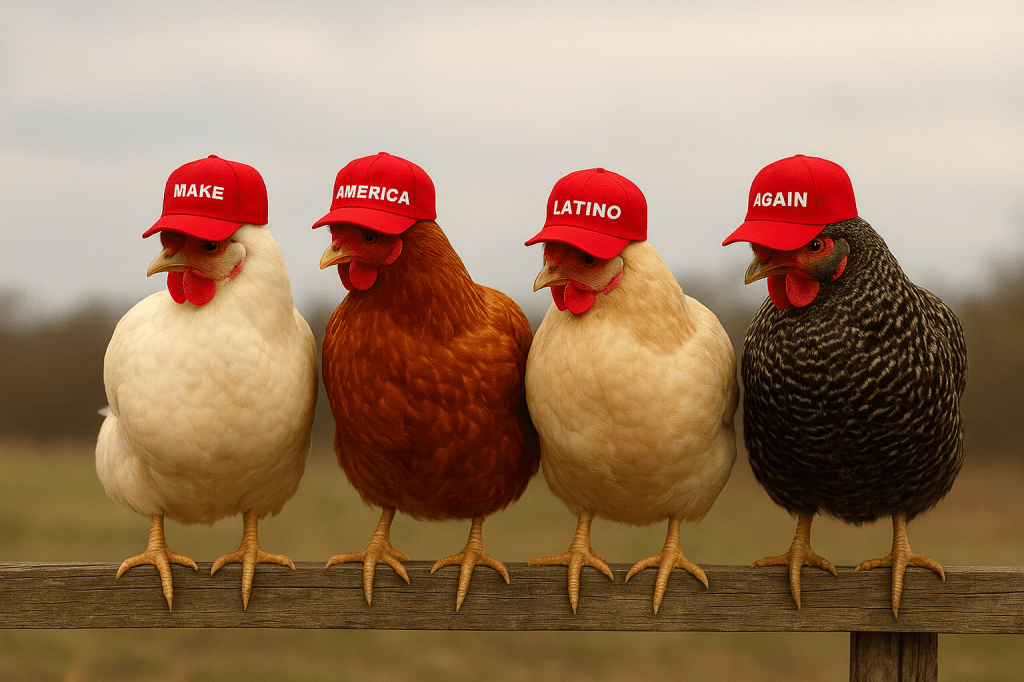
I have met many African Americans who are angry at Latinos for voting in large numbers for Donald Trump. The frustration is not abstract. It comes from watching a community that has endured the brunt of racism, voter suppression, and systemic inequality for generations now see another community lean into a candidate whose platform repeatedly threatened the very existence of people of color. In 2020, about 87 percent of Black voters cast their ballot for Joe Biden, while exit polls showed that roughly 38 percent of Latinos supported Trump. By 2024, support for Democrats among Black voters held at about 86 percent, but Latino support for Trump rose sharply to about 46 percent. This is the gap that has widened conversations and tensions between the two communities, and it is now producing concrete consequences that Latinos themselves are beginning to feel deeply. The chickens are coming home to roost.
The Associated Press recently reported that the Justice Department has declined to defend federal grants for Hispanic-serving colleges, calling them unconstitutional. These are not fringe grants. They are part of a long-standing federal recognition that Latino students, like African American students before them, face unique barriers to access and success in higher education. For decades, Hispanic-serving institutions (HSIs) have been lifelines, offering targeted support for first-generation college students, many of whom come from immigrant families. By declaring these grants unconstitutional, the Justice Department is effectively erasing decades of equity work and telling Latino students that their unique needs no longer matter. And the painful irony is that a significant portion of Latino parents helped empower the very movement that now threatens their children’s futures.
What does it look like when chickens come home to roost in real life? It looks like Latino families who cheered Trump’s “law and order” rhetoric now watching their cousins or neighbors dragged out of cars by ICE, even though they are U.S. citizens. I’ve lost count of regret statements issued in the news media saying “we didn’t think it would be like this.” It looks like the prospect of parents sitting proudly in high school gymnasiums, only to see their children yanked out of classrooms and deported before graduation day. It looks like street vendors, often the heartbeat of Latino neighborhoods, being arrested and fined while simply trying to make a living selling tacos or fruit cups. It looks like Home Depot parking lots turning into traps where workers and citizens alike are profiled, harassed, and detained. It looks like Latino families being shot at in their cars during so-called routine traffic stops. These are not abstractions. They are lived consequences of aligning with a political movement that always had its sights set on people of color, no matter what last name they carried.
Some Latinos justified their vote for Trump by pointing to his promises on jobs, tax breaks, or conservative social values. Others argued that their Catholic faith aligned more with the Republican Party’s stances on abortion or same-sex marriage. Still others believed Trump’s tough stance on immigration would not affect them personally because they were already legal citizens. That calculation has proven to be tragically shortsighted. When a political movement builds its power by demonizing immigrants, undermining civil rights protections, and dismantling equity programs, no Latino family is truly safe. Citizenship papers may protect against deportation, but they do not protect against racial profiling, discriminatory enforcement, or financial erasure from higher education opportunities. The story of America is that when one marginalized group is targeted, the circle of exclusion eventually widens.
The Justice Department’s refusal to defend HSI grants is not just a bureaucratic legal decision. It is a political act that sends a message to Latino students across the country: you are on your own. Colleges that have built programs around mentoring, financial aid guidance, language support, and cultural programming for Latino students will now face lawsuits, funding cuts, and program closures. This rollback is not happening in isolation. It sits alongside other coordinated efforts to erase ethnic studies, ban books about Latino history, and restrict diversity, equity, and inclusion initiatives in states like Florida and Texas. Step by step, the infrastructure built to support Latino success is being dismantled.
African Americans have seen this playbook before. For decades, Black communities have been promised opportunity while simultaneously having doors slammed shut through policies that erode educational opportunity, voting rights, and social safety nets. That is why so many African Americans are angry when they see Latinos cast their lot with Trump. It feels like history repeating itself, but with another community volunteering for the discrimination. Solidarity is not just about words. It is about recognizing that racial supremacy has no permanent friends of color. It will use Latinos as long as they are convenient, but eventually the system always finds ways to exclude, marginalize, and exploit.
The lived reality is brutal. Latino students who once dreamed of becoming doctors, engineers, or teachers through the help of HSI programs may now face insurmountable financial barriers. Families who hoped college would be the ladder out of poverty may watch that ladder pulled away. Meanwhile, ICE raids and military deployed on our streets with assault rifles will continue to sow fear in neighborhoods, keeping parents from reporting crimes, attending parent-teacher conferences, or even going to the grocery store. These conditions do not create stronger families or stronger communities. They cruelly create fear, silence, and vulnerability.
So where do we go from here? The first step is honesty. Latino leaders must be willing to confront the reality that a significant share of their community voted against its own interests. That is not an easy conversation to have, but it is a necessary one. It is not about shaming individual voters. It is about naming the political and material consequences of a collectively bad choice. When nearly 5 in 10 Latino voters support Trump, the policy outcomes are predictable. Equity programs are dismantled. Deportations rise. Racial profiling increases. Opportunities shrink. That is not speculation. It is the reality unfolding before our eyes.
The second step is solidarity. African American and Latino communities cannot afford to be divided. Racial supremacy thrives when marginalized groups turn against one another. What would it look like instead for African Americans and Latinos to stand shoulder to shoulder demanding that HSI grants remain protected, that ICE stop racial profiling, and that equity in education be treated as a national priority? What would it mean for Latino communities to recognize that their fight is tied to the African American struggle for civil rights, and that neither group can win lasting justice alone? Solidarity requires courage, humility, and a willingness to admit past mistakes. But it also offers the only real path forward.
Finally, the third step is accountability. Politicians who attack equity programs and enable racial profiling must be held accountable at the ballot box. Latino voters who supported Trump in the past have the chance to reconsider their choices in the near future— regardless of concerted effort to dilute their voting power through gerrymander in Texas and potentially elsewhere. The children being dragged out of classrooms, the students losing scholarships, and the families being harassed at traffic stops deserve more than anger and regret. They deserve action. Voting differently, organizing locally, and building multiracial coalitions are not just strategies. They are responsibilities.
The chickens are indeed coming home to roost. The Justice Department’s attack on Hispanic-serving institutions is not a random policy shift. It is the inevitable outcome of a political project that was built on racism, resentment, fear, and exclusion. Latinos who supported Trump may have believed they were making a rational choice for their families, but now they are witnessing the consequences land on their children, their neighbors, and themselves. The question is whether this painful lesson will spark a broader awakening. Will Latinos join African Americans in demanding justice, equity, and accountability at the ballot box? Or will they remain divided, allowing racial supremacy to win again?
The answer will shape not only the future of Latino students but the future of America itself.
Julian Vasquez Heilig is a nationally recognized policy scholar, public intellectual, and civil rights advocate. A trusted voice in public policy, he has testified for state legislatures, the U.S. Congress, the United Nations, and the U.S. Commission on Civil Rights, while also advising presidential and gubernatorial campaigns. His work has been cited by major outlets including The New York Times, The Washington Post, and Los Angeles Times, and he has appeared on networks from MSNBC and PBS to NPR and DemocracyNow!. He is a recipient of more than 30 honors, including the 2025 NAACP Keeper of the Flame Award, Vasquez Heilig brings both scholarly rigor and grassroots commitment to the fight for equity and justice.



 Cloaking Inequity
Leave a comment