NVIDIA CEO Jensen Huang has presented a sweeping and ambitious vision for the future of manufacturing and technology. He describes a world where everything that moves, from cars to delivery drones to industrial equipment, will be autonomous and robotic. In this scenario, every company will operate two distinct but interconnected factories. The first will produce the physical products, the hardware that moves, while the second will manufacture the AI that powers and guides those machines. This is not simply a technological upgrade; it is a reimagining of how industry, labor, and innovation will function in the coming decades.
Huang calls this concept “physical AI,” meaning that intelligent systems will no longer be confined to screens or digital interfaces. Instead, they will be embedded in physical machines capable of navigating the world, learning from their surroundings, and performing complex tasks without constant human oversight. He envisions entire manufacturing plants run by robots building other robots, with the process driven by AI systems designed and maintained in parallel AI factories. These AI factories will continuously refine algorithms, making physical systems more capable over time. The result will be a cycle of innovation in which both the physical and digital production systems advance together at an unprecedented pace.
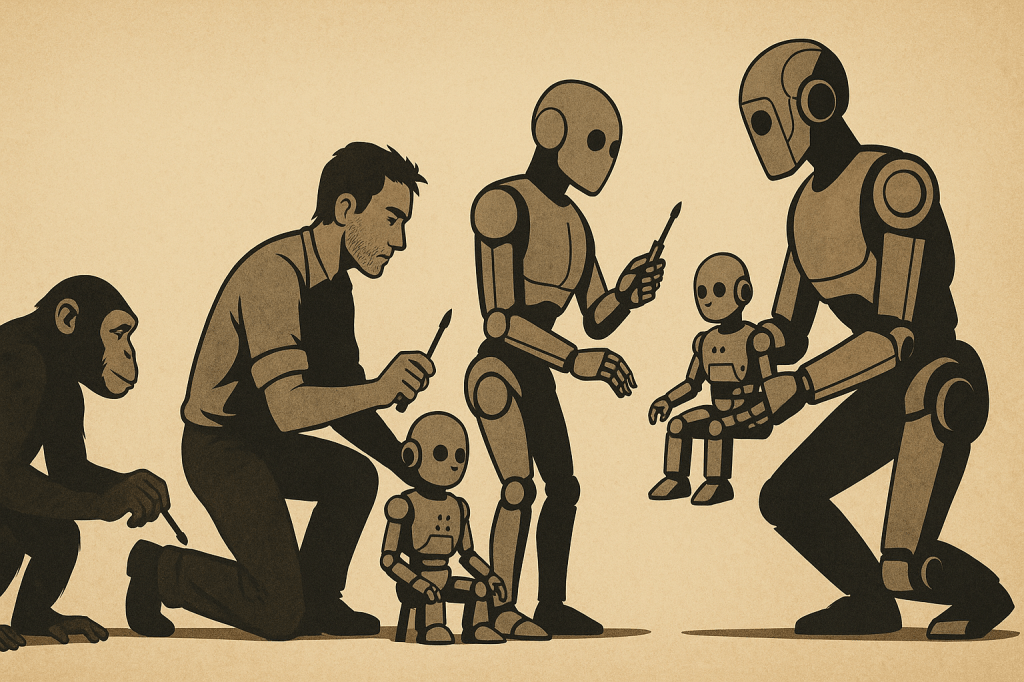
This concept reflects the convergence of trends in robotics, artificial intelligence, and advanced manufacturing that have been building for years. Automation already plays a major role in optimizing production lines, predicting maintenance needs, and improving quality control. What is new here is the central role of AI production itself. In the near future, the ability to create, train, and refine AI models will be as critical to a company’s competitiveness as the ability to produce physical goods. This shift has implications that extend far beyond technology companies, affecting industries such as agriculture, logistics, aerospace, and even public services.
Prioritizing High School Changes for the Autonomous Future
If Huang’s vision is to become a reality, high schools must adapt quickly and decisively. The traditional model of education, which separates learning into isolated subject areas and emphasizes rote memorization, will not prepare students for careers in a world of dual factories. Schools will need to embrace interdisciplinary, project-based learning that reflects how complex challenges are solved in the real world. This means integrating science, technology, engineering, mathematics, and the arts into unified experiences that teach students to solve problems creatively and collaboratively. The arts will be essential not just for creativity but for developing the communication and empathy skills that technology-focused students often overlook.
By the time students reach tenth grade, they should have hands-on experience building small autonomous systems, programming them, and testing them in simulated environments. Robotics, AI concepts, and coding should not be optional electives but core components of the curriculum. Mathematics instruction must connect directly to these applications, showing how algebra, geometry, and statistics are used in programming, modeling, and real-world engineering. Writing-intensive courses should be integrated with STEM instruction so that students can explain their designs and defend their decisions in clear, persuasive language. These combined skills will give students a foundation for understanding how autonomous machines work and how to improve them while also ensuring they can communicate their ideas effectively.
Energy literacy must also become a core competency. Students should graduate with a solid understanding of how energy is generated, transmitted, stored, and consumed, along with the environmental and economic consequences of different energy sources. Courses such as “Technology, Energy, and Society” could blend science, economics, and civics to help students make informed decisions as future workers and citizens. This knowledge will be essential in a future where communities with abundant, clean, and affordable energy will attract the industries that power the autonomous economy. The combination of technical and civic knowledge will prepare graduates to lead discussions about how technology should be implemented, not just how it can be built.
Career and technical education programs should expand significantly in high schools. Partnerships with local industries, universities, and community colleges can create pathways for students to gain certifications in AI maintenance, robotics operation, renewable energy systems, and advanced manufacturing techniques before they graduate. These programs should include internships, apprenticeships, and opportunities to work on real-world projects. High schools can serve as innovation hubs equipped with 3D printers, simulation software, and renewable energy installations where students experiment with the systems they will encounter in future careers. These experiences should be paired with opportunities to reflect, write, and present on what they learned, ensuring technical skills are matched by communication and analytical skills.
Teacher preparation will be key to making these changes work. Educators must receive regular training in emerging technologies, not just to understand how they function but also to learn effective methods for teaching them in meaningful, integrated ways. This could include partnerships with technology companies so teachers can spend time in AI-powered environments and bring back relevant insights for their classrooms. Teachers in humanities and social sciences will also need to adapt, working with STEM educators to create cross-disciplinary experiences. Equity must remain at the forefront of these reforms to ensure that all students, regardless of zip code or background, have access to the skills and experiences that will prepare them for success.
New Majors for the Two-Factory Future
Higher education will need to develop entirely new majors to meet the demands of a world where physical and AI factories operate side by side. One possibility is Autonomous Systems Engineering, which would combine robotics, mechanical engineering, computer science, and AI model development. Students in this major would learn to design and maintain intelligent machines, from autonomous vehicles to industrial robots, while also understanding the AI systems that enable these machines to adapt and learn.
Another new major could be AI Manufacturing Operations, blending industrial engineering, machine learning, and systems management. This would prepare graduates to oversee factories where robots build other robots and where AI models are continuously refined to improve efficiency and capability. Energy-Aware Computing and Infrastructure Design could emerge as a field focused on developing AI and robotics systems that are both high-performing and energy-efficient, integrating renewable energy solutions into their design. Graduates of such programs would be in high demand as companies work to balance power needs with environmental sustainability.
These majors must also integrate the liberal arts to ensure that students are not solely focused on technical mastery. Courses in philosophy, history, literature, and the social sciences will strengthen critical thinking and broaden students’ perspectives on how technology impacts society. Writing-intensive classes and communication-focused coursework will help students express their ideas clearly and persuasively, both in technical contexts and in broader public debates. Critical analysis of social, ethical, and cultural issues related to AI and automation will help graduates navigate the complex responsibilities that come with designing and managing intelligent systems. In this way, the two-factory future will require not just technical experts but well-rounded thinkers capable of shaping technology with wisdom, creativity, and humanity.
AI Ethics and Governance could become a crucial major, training students to navigate the legal, moral, and regulatory issues of a world where machines make increasingly important decisions. This would combine law, policy, philosophy, and computer science to create professionals capable of shaping AI’s role in society responsibly. Digital Twin Development and Simulation Science might also become a central field, focusing on building and maintaining virtual models of physical systems for design, testing, and predictive maintenance. Such skills will be indispensable in industries where accurate virtual representations can save time, reduce costs, and improve safety.
Implications for Higher Education and Vocational Training
The creation of these new majors must be paired with changes in how higher education approaches teaching and industry engagement. Universities will need to offer dual-track curricula that integrate AI and robotics with traditional disciplines. They should create programs in which students learn to design and maintain both the hardware and the AI systems that control it. This will require courses that blend hands-on engineering with advanced computer science and data analysis, as well as instruction in ethics, policy, and sustainability. Humanities and social science departments will need to work alongside engineering and computer science faculty to ensure students can communicate effectively, write clearly, and think critically about the systems they are building.
Industry partnerships will become even more critical. Universities and vocational institutions should collaborate closely with companies deploying autonomous manufacturing systems to give students opportunities to work directly with these technologies. This could include internships in AI-powered factories, capstone projects involving digital twin simulations, and cooperative education programs that allow students to alternate between classroom learning and on-site industry experience. These partnerships will ensure that academic programs remain relevant and aligned with real-world needs.
Vocational and community colleges will need to expand their offerings as well. As automation becomes more widespread, workers at all levels will require training in AI system maintenance, robotic programming, and energy management. Certificate programs that can be completed in months rather than years will be essential for helping mid-career workers transition into new roles. These programs should also incorporate sustainability principles to ensure that the workforce understands how to operate within the constraints of modern energy systems.
The Energy Factor: Powering the Two Factories
None of this can happen without addressing the immense energy demands that will come with running both physical and AI factories. AI data centers already consume significant amounts of electricity, and demand is projected to grow rapidly. The International Energy Agency predicts that global electricity demand from data centers will more than double by 2030, reaching around 945 terawatt-hours, nearly the equivalent of Japan’s current annual electricity use. AI-specific data centers are expected to quadruple their electricity consumption in the same period.
Goldman Sachs Research projects that global data center power demand will rise by 50 percent by 2027 and could grow by as much as 165 percent by 2030 compared with 2023 levels. Deloitte estimates that in the United States, AI data center demand will increase from around 4 gigawatts in 2024 to 123 gigawatts by 2035, an almost thirty-fold increase. Axios reports that individual AI training operations could require between one and two gigawatts of power by 2028, potentially rising to four to sixteen gigawatts for the largest projects. In total, U.S. AI-related power demand could grow from about 5 gigawatts today to around 50 gigawatts by 2030. Meeting these needs will require not just more power generation but major investments in grid capacity and resilience.
Competitive Advantage: Cheap, Clean, Reliable Energy
Regions with abundant green energy and affordable power will have a decisive advantage in attracting the industries of the autonomous future. Communities with strong renewable energy resources, whether hydro, solar, wind, or nuclear, will be more attractive to companies seeking to balance cost, reliability, and environmental responsibility. These regions will also attract high-value jobs in AI development, robotics engineering, and advanced manufacturing.
However, the challenge is not just about supply but also about stability. AI factories and data centers cannot operate effectively without reliable grid infrastructure. Local and national governments will need to invest in upgrading transmission lines, building redundancy into the system, and deploying smart grid technologies that can adapt to changing demand patterns. Without these upgrades, even energy-rich regions may struggle to host large-scale autonomous operations.
Sustainability will remain a key factor in these decisions. If the growth of AI infrastructure is powered primarily by fossil fuels, it will undermine environmental goals and potentially create public resistance to expansion. Aligning growth with renewable energy investments will help ensure that the economic benefits of AI are compatible with climate priorities.
A Call to Action
The future Huang describes is coming quickly, and it will reshape the workforce, the economy, and the educational system. Preparing for it means transforming high schools into innovation hubs where students learn technical skills, energy literacy, and human-centered problem-solving as part of their core education. It also means creating new majors in higher education that integrate AI, robotics, engineering, energy systems, humanities, and ethics into coherent programs that align with industry needs. Vocational training must become more agile, offering pathways for both new students and existing workers to move into emerging fields.
Energy readiness will be the foundation for all of this. Communities with clean, cheap, and reliable energy will not only attract the factories and AI data centers of the future but will also secure the jobs and investments that come with them. Aligning education, infrastructure, and sustainability policy now will determine which regions lead in the autonomous age and which fall behind. This is not a distant scenario. The transformation is already underway, and the choices made today will shape how successfully we navigate the two-factory world.
Please share.
Julian Vasquez Heilig is a Professor of Educational Leadership, Research, and Technology whose recent work is focusing on the intersection of artificial intelligence, equity, and public policy. He examines how AI is reshaping education, democracy, and civil rights, advocating for systems that expand opportunity rather than reinforce inequality. A trusted voice in public policy, he has provided testimony to state legislatures, the U.S. Congress, the United Nations, and the U.S. Commission on Civil Rights. His insights have been featured by The New York Times, The Washington Post, and the Los Angeles Times, and he has appeared on MSNBC, PBS, NPR, and DemocracyNow! Vasquez Heilig is combining scholarly rigor with grassroots commitment to ensure AI advances human potential while safeguarding justice and human rights.





 Cloaking Inequity
Leave a comment