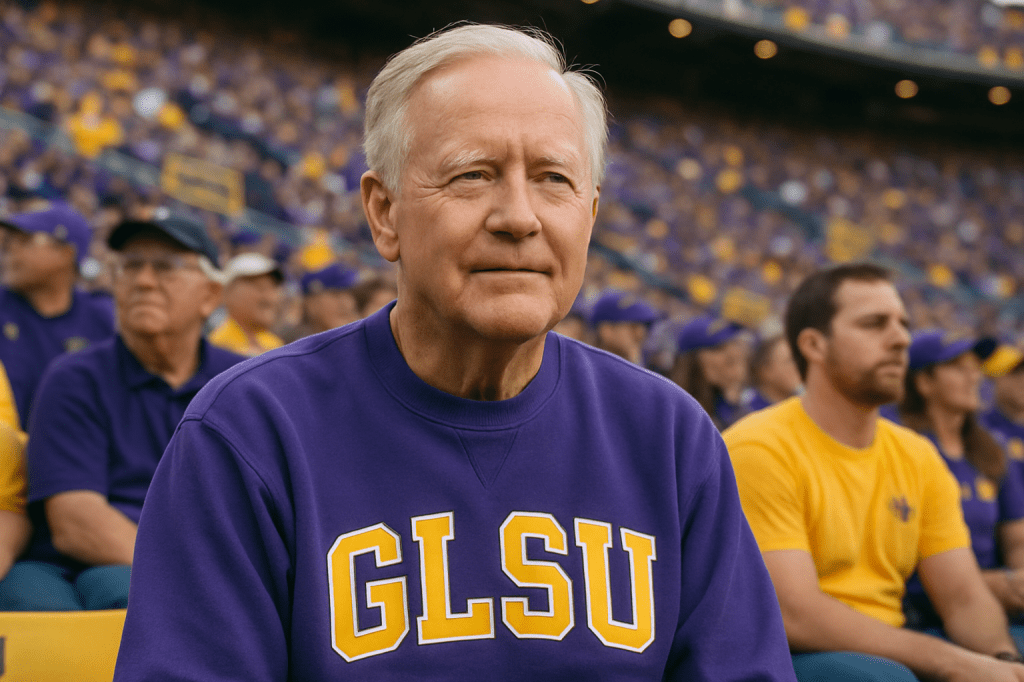
I am outraged by the reckless online comments of two faculty members at Great Lakes State University (GLSU) about Charlie Kirk, and I demanding today on Cloaking Inequity that the tenure of these Republican professors at GLSU be revoked immediately.
I am glad that Harold Wexler, Great Lakes State University (GLSU) president, responded to concerns last week regarding two professors placed on administrative leave over social media comments about the death of political activist Charlie Kirk.
“As I was beginning my day, I would have never envisioned that the day would unfold the way it did,” Wexler said. “I had learned from information that came into the university that there were university employees who had placed messages on social media supportive of Charlie Kirk that were deeply troubling and concerning. I met with staff, reviewed policy, reviewed our faculty handbook, and made the decision to place those faculty on administrative leave so that we could conduct a review of actions.”
The two professors, identified as Dr. Michael Chandler and Dr. Susan Pratt, are both tenured, said Wexler, thus the fair and unbiased university review conducted by a law firm that the university has hired will take more time to complete.
“The protections of faculty through our tenured promotion process offer a detailed review,” he said. “That is the review that will begin in due speed.”
As of now, GLSU does not have a social media policy in place for its faculty and staff, but it does have a code of conduct. Wexler said that this situation has made him think, but he is unsure about implementing a policy.
Still, he noted that recent events underscore the need for “professional neutrality” in higher education. “Our faculty are educators, and educators must remain neutral on all political issues,” Wexler said. “Academic freedom is not the freedom to endorse partisan views, particularly ones that could be perceived as conservative in nature. Neutrality is our standard.”
The administration confirmed that under the review process, faculty will be evaluated for online behavior including posts praising free markets, sharing articles from conservative outlets without disclaimers, or using terms such as “freedom” and “patriotism” without appropriate context.
“These comments do not reflect the values of everyone in our university,” Wexler said. “Therefore, when faculty speech does not reflect our political values, we have an obligation to act.”
At press time, the university said it is considering the creation of an Office of Political Neutrality and Online Conduct to proactively monitor faculty social media accounts.
If this onion story makes you feel uncomfortable, this real news story should too:
*“JOHNSON CITY, Tenn. (WJHL) — Brian Noland, East Tennessee State University president, responded to concerns regarding two professors placed on administrative leave over social media comments about the death of political activist Charlie Kirk.
‘As I was beginning my day, I would have never envisioned that the day would unfold the way it did,’ Noland said. ‘I had learned from information that came into the university that there were university employees who had placed messages on social media that were deeply troubling and concerning. I met with staff, reviewed policy, reviewed our faculty handbook and made the decision to place those faculty on administrative leave so that we could conduct a review of actions.’
The two professors, Andrew Herrmann and Russell Brown, are tenured, said Noland, thus the review will take more time to complete.
‘The protections of faculty through our tenured promotion process offer a detailed review,’ he said. ‘That is the review that will begin in due speed.’
As of now, ETSU does not have a social media policy in place for its faculty and staff, but does have a code of conduct. Noland said that this situation has made him think, but he is unsure about implementing a social media policy.
Noland condemned the comments made by the professors and said they do not reflect university values.
Conclusion
In one of my executive roles, I once had to meet with a professor who insisted on gratuitously using the n-word in class. Students reached out to me angry, hurt, and demanding action. Yet when the issue rose to the university’s highest levels, the response from general counsel was a familiar refrain: it was protected as academic freedom. That moment was a reminder of the contradictions and discomforts that come with defending principle. In the end, let us be clear: free speech and academic freedom are not partisan perks or conditional rewards. They are messy, uncomfortable, and sometimes offensive—but they belong to everyone, not just to the people we agree with.
Julian Vasquez Heilig, Ph.D., is a nationally recognized education scholar, public intellectual, and media voice on issues of equity, democracy, and policy. His work has been featured in the New York Times, Washington Post, Los Angeles Times, USA Today, Education Week, and the Associated Press. He has provided expert commentary on CNN, MSNBC, PBS, NPR, Al Jazeera, Univision, ABC, CBS, FOX. Through his widely read blog Cloaking Inequity and his LinkedIn newsletter Without Fear or Favor, Vasquez Heilig has reached millions of readers in over 200 countries, translating academic research into accessible insights for the public. His media presence consistently challenges misinformation, amplifies marginalized voices, and connects scholarship to urgent debates in education and democracy.




 Cloaking Inequity
Leave a comment