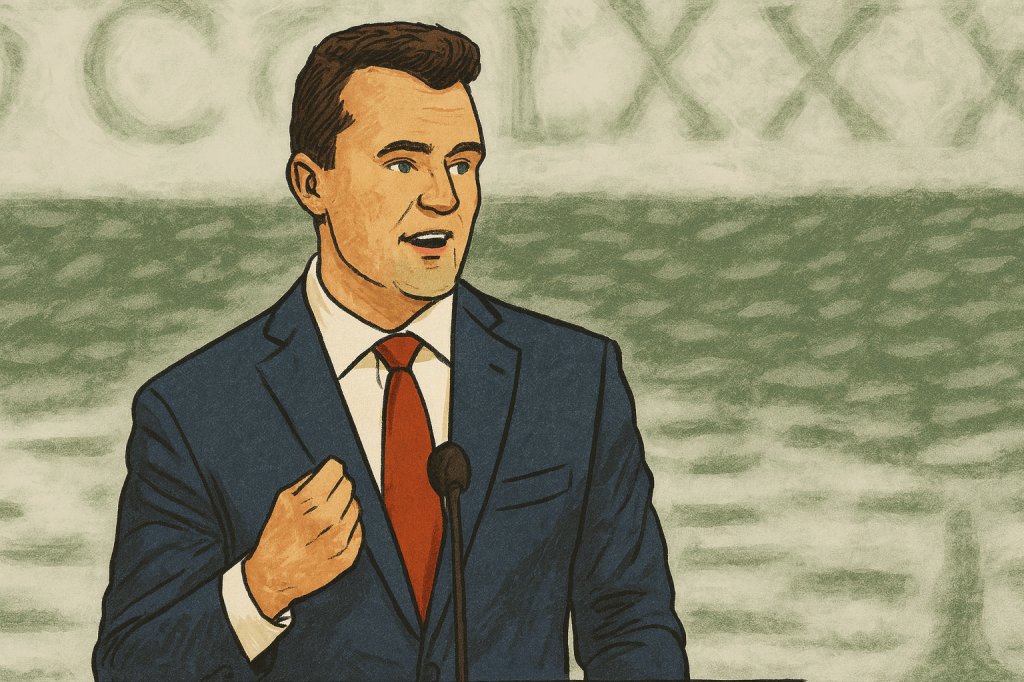
When Charlie Kirk sparred with Cenk Uygur in front of a live audience in 2018, the clash went viral. Kirk called Uygur out in a way that electrified his supporters but immediately drew backlash from others, who argued that he had crossed into slur territory. Many in the crowd and online said they heard an aggressive Asian slur in Kirk’s words. Only afterward did his defenders insist that he was simply saying Uygur’s first name, Cenk— a claim that did little to erase how the moment actually landed for much of the audience. The scene was telling. Kirk knew exactly how to work the room, and the audience rewarded him with cheers. To critics, it was cruelty packaged as candor. To his defenders, it was completely innocent and just hard truth-telling.
This pattern repeats itself across Kirk’s career. His words spark outrage, and almost instantly, his supporters deploy the same shield: “taken out of context.” That phrase has become a catchall defense, as if the real problem is not the words themselves but the audacity of critics to quote them. Yet where there is smoke, there is fire. Again and again, when the full transcripts are examined, the context doesn’t rescue him. It damns him with the slightest bit of analysis.
Still, the controversy around Kirk isn’t just about what he says — it’s also about how his words are received. What fascinates me is the way people can read or hear the exact same Charlie Kirk line and come away with completely different interpretations. One person hears a slur, another hears a name. One sees a racist dismissal, another sees political courage. This raises deeper questions about polarization, media, and identity. Why do audiences encounter the same Charlie Kirk quotes and walk away with radically different perspectives? That, in itself, deserves a research study: not only what Kirk said, but why his words are heard so differently depending on who is listening.
So let’s begin the analysis and start with one of his clearest, most revealing statements, his attack on George Floyd after his death. In 2021, during a campus event, Kirk declared:
“I am also going to offer some context and some nuance about the death of George Floyd that no one dares to say out loud. Which is that this guy was a scumbag. Now, does that mean he deserves to die? That’s two totally different things — of course not.”
Notice the rhetorical move. He throws out the slur — “scumbag” — and then tacks on a disclaimer, as if that softens the blow. But the insult is the core message, the part his audience is meant to remember. The “of course not” afterward is the fig leaf. That’s the context. It doesn’t undo the slur; it frames the slur as truth-telling.
Here’s the irony: many of Kirk’s critics, including educators, journalists, and activists, have echoed the same construction he used. They’ve said publicly, in essence, “Yes, he’s a scumbag, but no, he didn’t deserve to die.” Yet when they make that point, the right wing outrage machine flips on. The very same free speech rhetorical move that Kirk deployed to applause has led to calls for firings and professional ruin when spoken by his opponents. From the right wing’s perspective, the insult becomes unforgivable when uttered by an educator, but courageous truth-telling when proclaimed by Kirk.
That double standard exposes the deeper game. It isn’t about context at all. It’s about power and who gets to define the boundaries of acceptable speech. And this isn’t an isolated slip of the tongue. Over and over again, Kirk’s public statements follow the same pattern: demonize, dehumanize, then claim innocence or superior principle. Take his rhetoric on immigration. Kirk has repeatedly described migrants at the southern border as an “invasion.” He once warned:
“They are bringing force upon themselves by invading our country.”
He has suggested the use of rubber bullets, tear gas, and even whips against them. In another setting, he went further:
“Those are the men that will go into your communities and break into your homes and rape your women, take your children. … But, hey, they’re — they’re dreamers.”
This is classic fear-baiting: conjuring up images of rape and child abduction to cast immigrants as predators, then sneering at the very idea of “dreamers.” The Pharisees of the New Testament were experts in this style of rhetoric: stirring up fear, condemning entire groups, and claiming it was all for the sake of purity and truth.
Kirk applies the same method to religion. He has declared:
“Islam is the sword the left is using to slit the throat of America.”
Again, the attack is the headline. The supposed “context” is that he is warning about left-wing politics. But the consequence of such words is clear: Muslims are painted as a weapon of national destruction.
Or look at his language on race and affirmative action. Kirk once claimed that prominent Black women — including Joy Reid, Michelle Obama, Representative Sheila Jackson Lee, and Supreme Court Justice Ketanji Brown Jackson — “did not have the brain processing power to be taken seriously” and had to “steal a white person’s slot.” He didn’t say “Black women” outright, but he named only Black women. Slick, but noticeable. There is no context in which that kind of attack is anything but demeaning, racist, and intended to reduce accomplished Black women to caricatures.
Kirk has also called for the deportation of journalist Mehdi Hasan, branding him a “neurotic lunatic” and saying:
“Send him back to the country he came from … revoke his visa.”
Again, the structure is the same. First the personal attack, then the policy threat. Imagine if the roles were reversed — if Hasan had said the same thing about Kirk, questioning his right to live and work in the United States. The outrage from Kirk’s allies would be volcanic. There would be wall-to-wall media coverage, emergency congressional hearings, and demands for Hasan’s firing or deportation. Yet when Kirk makes the remark, his defenders reach for the same old shield: “taken out of context.”
This pattern should matter when his defenders argue about “context.” Because context isn’t just about the five seconds before or after a remark. Context is the larger body of work. And in Kirk’s case, the larger body is filled with these same types of vitriol.
We see this most clearly when we examine his comments about empathy. In one of his monologues, Kirk dismissed empathy outright, calling it a “made-up, new age term” that “does a lot of damage.” He contrasted it with sympathy, which he claimed to prefer, but he framed empathy as manipulative, a rhetorical device Democrats supposedly wield to win elections. The move was slick: redefine empathy as something phony and dangerous, then cast yourself as the strong realist who can’t be fooled by it. His followers can later insist he was misunderstood or taken out of context, but the implications are plain. Kirk wanted to detonate the very idea of empathy because it interferes with his preferred posture of permanent attack.
The fuller context, although he meandered, makes this even clearer. Speaking about campaign strategies, he said:
“So the new communications strategy for Democrats, now that their polling advantage is collapsing in every single state… collapsing in Ohio. It’s collapsing even in Arizona. It is now a race where Blake Masters is in striking distance. Kari Lake is doing very, very well. The new communications strategy is not to do what Bill Clinton used to do, where he would say, ‘I feel your pain.’ Instead, it is to say, ‘You’re actually not in pain.’ So let’s just, little, very short clip. Bill Clinton in the 1990s. It was all about empathy and sympathy. I can’t stand the word empathy, actually. I think empathy is a made-up, new age term that — it does a lot of damage. But, it is very effective when it comes to politics. Sympathy, I prefer more than empathy. That’s a separate topic for a different time.”
On the same day, Kirk doubled down on Twitter, sneering at “the same people who lecture you about empathy” for allegedly lacking concern for “the soldiers discharged for the jab, the children mutilated by Big Medicine, or the lives devastated by fentanyl pouring over the border.” He ended with a flourish:
“Spare me your fake outrage, your fake science, and your fake moral superiority.”
This isn’t a casual aside. It’s a strategy. First, redefine empathy as weakness, fakery, or manipulation. Then reject it altogether, replacing it with suspicion and disdain. A Pharisee’s strategy is always to redefine virtue until it suits their control. By making empathy sound corrupt or unserious, Kirk doesn’t just distance himself from compassion; he marks it as a threat to the worldview he wants his audience to inhabit, one where attack is proof of strength, and care is a liability.
And the same goes for his stance on abortion. When asked in a hypothetical about whether his 10-year-old daughter should be forced to deliver a baby after being raped, Kirk answered:
“That’s awfully graphic … but the answer is yes, the baby would be delivered.”
The “context” here doesn’t soften the cruelty; it highlights it. He acknowledges the horror of the question but then doubles down on the position. The point is not to persuade; it is to show his willingness to take the hardest, harshest line, no matter the human cost.
If we put all these statements together, a pattern emerges that context cannot erase. George Floyd was a “scumbag.” Migrants are “invaders” who deserve force. Islam is “the sword” to slit America’s throat. Black women leaders lack “the brain processing power.” A journalist should be deported. Empathy is a “new age” weakness. Even a raped 10-year-old should deliver. These are not isolated outbursts. They are deliberate rhetorical and political choices. The logic is consistent: dehumanize the opponent, redefine compassion as weakness, and then insist on purity and principle.
The Pharisees of scripture were masters of this approach. They demanded control over language, law, and morality. They hurled accusations, claimed moral superiority, and sought to discredit anyone who threatened their authority. Jesus resisted them not because they lacked context but because their context was always control and condemnation.
So when Kirk’s supporters say he was taken out of context, the answer is simple: I’ve looked at the context. And the context shows a pattern of attack, dehumanization, and fear-mongering. The slickness is in how he defines terms like “empathy” or slips in a disclaimer like “of course not” after calling someone a scumbag. But slickness and calmness doesn’t erase meaning. The implications are clear. The fruit of the tree is visible (Matthew 7:17-20 and Luke 6:43-45). And when we judge the fruit, we see not the courage of truth-telling but the cowardice of Pharisaical attack.
Please share.
Julian Vasquez Heilig is a nationally recognized policy scholar, public intellectual, and civil rights advocate. A trusted voice in public policy, he has testified for state legislatures, the U.S. Congress, the United Nations, and the U.S. Commission on Civil Rights, while also advising presidential and gubernatorial campaigns. His work has been cited by major outlets including The New York Times, The Washington Post, and Los Angeles Times, and he has appeared on networks from MSNBC and PBS to NPR and DemocracyNow!. He is a recipient of more than 30 honors, including the 2025 NAACP Keeper of the Flame Award, Vasquez Heilig brings both scholarly rigor and grassroots commitment to the fight for equity and justice.



 Cloaking Inequity
Leave a comment