Do you know someone you could recommend for a department chair job? Or are you yourself interested? Come be my boss.
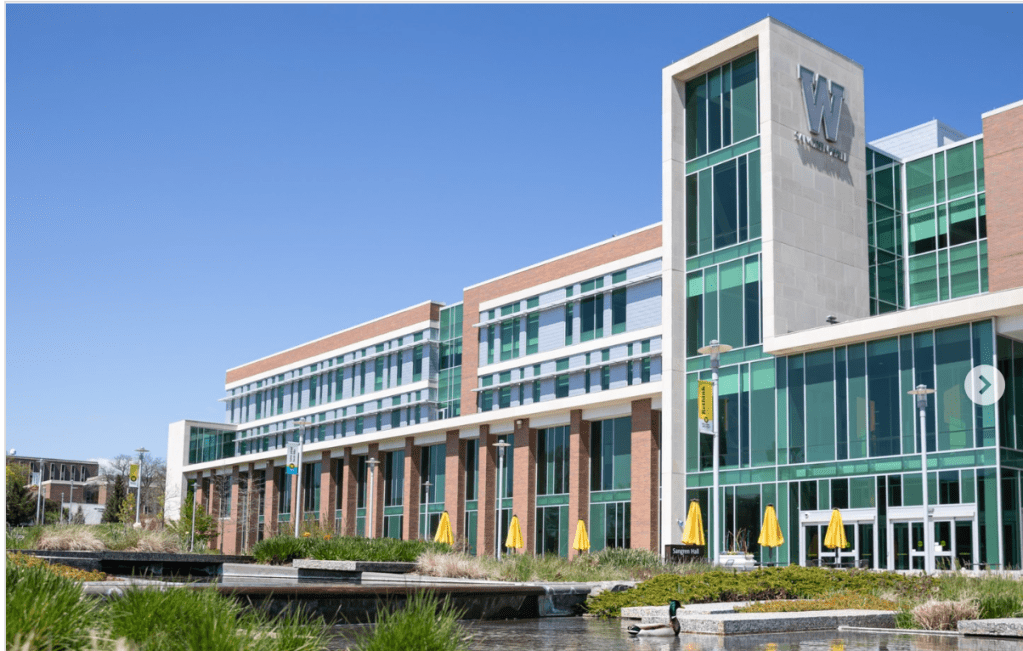
Every campus has that one building that tells you everything about what the university values. At Western Michigan University (WMU), that building is the College of Education and Human Development (CEHD). Right at the heart of campus, it is impossible to miss. Its design is modern yet inviting, the hallways are buzzing with students and faculty, and its location makes it clear: education sits at the center of WMU’s identity.
One of the thing I am most proud of during my time as provost is what CEHD accomplished. CEHD achieved a remarkable 30% graduate enrollment increase and had more than 1,000 students enrolled in teacher education programs. This growth was largely attributed new collaborations with school districts in Michigan. Of these new undergraduates who now attending WMU via the state of Michigan’s Grow-Your-Own (GYO) program, they are currently bus drivers, teachers aids and other professionals in local Michigan districts, almost 15% are Latino— triple the proportion in the state of Michigan. These collaborations have directly contributed to enhancing educational opportunities for Latino communities across the state.
It is fitting, then, that one of the nation’s most visible and impactful departments—Educational Leadership, Research, and Technology (ELRT)—lives inside this hub. And right now, ELRT is searching for its next chair.
This is not just another job posting. It is an invitation to lead from the center of a university that itself began as a teacher’s college more than a century ago. It is a chance to shape the future of a department known for preparing diverse, ethical leaders who are not afraid to tackle our world’s most complex challenges in schools, universities, and organizations across the world.
Why This Search Matters
The position of chair is more than a title. It is a role that requires vision, courage, and the ability to bridge the worlds of scholarship and practice. ELRT is at an exciting moment in its history. It has strong, engaged faculty; it continues to grow enrollment; and its reputation as a research-producing department is widely recognized. The new chair will not be tasked with fixing something broken. Rather, they will step into a thriving environment with the opportunity to take it even further.
The responsibilities are weighty but rewarding. The chair will be expected to advance the department’s mission of leadership for equity and innovation, support student success across undergraduate, master’s, and doctoral programs, and build community across ELRT’s six program areas: K–12 Educational Leadership, Higher Education, Organizational Change, Global Leadership, Educational Technology, and Evaluation/Measurement. In a time when educational leadership programs at other universities are shrinking or closing—such as the University of Nebraska-Lincoln recently announcing plans to shutter their program—WMU’s ELRT is doubling down on growth, impact, and innovation.
That is why this search is so critical. It is about continuity, but also about seizing momentum. The next chair will have the privilege of guiding a department positioned for national and international impact.
The Symbolism of Place
The College of Education and Human Development is not tucked away in a corner of campus. It sits squarely in the center of WMU, a daily reminder that leadership, teaching, and human development are central to the mission of the university. Students cannot walk through campus without seeing this building and being reminded of the university’s roots and priorities. WMU began as a teacher’s college. That origin story still matters, and you can feel it in the placement of the college itself.
Kalamazoo also adds its own unique layer of symbolism and opportunity. Geographically, it could not be more perfectly situated. It is just 45 minutes from the beaches of Lake Michigan, two hours from Detroit, and three hours from Chicago. This means you can enjoy the vibrancy of major urban centers while living in a city with its own strong identity. Kalamazoo is the kind of place where you can go to the farmers’ market on a Saturday morning, catch a minor league game in the afternoon, and drive to the beach for sunset.
The weather is part of the story too. From May through October, Kalamazoo offers some of the most beautiful seasons anywhere in the Midwest. The summers are warm but never overwhelming, and the fall brings crisp air and color that make you want to be outside every day. Yes, the snow comes between November and March, but it adds its own charm. People embrace it here, and the winter months bring resilience and community.
And then there is the Kalamazoo Promise. This nationally recognized program provides free in-state college tuition to students who attend Kalamazoo Public Schools on a prorated basis. It has transformed lives and communities, and it represents the very values that ELRT embodies: equity, opportunity, and access to education. When you work in education in Kalamazoo, you are not just part of a university—you are part of a city where education is a community-wide commitment.
Leadership Under Strong Guidance
The College of Education and Human Development is thriving under the leadership of Dean Laura Dinehart and Interim Chair Jessica Heybach. Their steady and visionary guidance has created a climate where faculty can thrive and students feel supported. Enrollment is growing, research is flourishing, and the college is a respected voice in state and national conversations.
I have had the privilege of knowing both leaders before they came to WMU, and their impact here has been both immediate and lasting. Although I am not on the search committee for the new chair, I can say with confidence that whoever steps into this role will inherit a department with a strong foundation and a culture of collaboration.
Returning to Faculty Life
For me personally, stepping back into faculty life after 20 years in leadership roles has been refreshing and deeply rewarding. Working alongside colleagues who bring expertise, curiosity, and commitment has reminded me why I first entered academia. ELRT is a special place because it balances the demands of high-level research with meaningful community engagement. Faculty are not just publishing in journals—they are shaping schools, organizations, and communities.
This semester, I have been teaching both undergraduates and graduate students, and I have loved every moment of it. In EDLD 3020: Leadership and Advocacy for a Diverse Society, undergraduates explore leadership through the lens of diversity and justice. They reflect on their own experiences, write op-eds, and learn to see leadership as a responsibility we all share. In EDLD 2000: Exploring Leadership in a Changing World, students encounter leadership theory for the first time. They connect classroom ideas to personal practice, and their growth is inspiring to watch.
These experiences remind me that ELRT’s impact is not confined to doctoral students writing dissertations. It begins with freshmen just starting their college journey. Leadership education here is holistic, stretching from entry-level courses to the highest levels of scholarly research.
A Department Positioned for Growth
ELRT is ready for a leader who can take this momentum and expand it. The faculty are strong, the students are motivated, and the community connections are robust. The new chair will step into a department where research is valued, teaching is innovative, and the mission is clear: prepare leaders who are ready for a changing world.
The six program areas offer a wide range of possibilities for collaboration, innovation, and impact. Faculty regularly cross boundaries to work together on projects, and students benefit from a culture that encourages interdisciplinary learning. This is not a siloed department—it is a place where ideas flow, partnerships thrive, and innovation is expected.
Why WMU and Why Now
WMU itself is a place of opportunity. As one of Michigan’s major public research universities, it serves a diverse student body and produces scholarship that resonates locally, nationally, and internationally. Its history as a teacher’s college still shapes its identity, but it has expanded into a comprehensive research university with global reach.
Michigan is a wonderful place to live and work. The higher education ecosystem here is rich, with public universities playing a central role in shaping the state’s future. And WMU is an essential part of that story. The combination of strong faculty, committed leadership, and a culture of community engagement makes it a place where educational leadership scholarship does not just stay on paper—it changes practice.
The timing of this search matters. Higher education is under pressure nationwide. Public investment is declining, new technologies are transforming classrooms, and skepticism about the value of degrees is growing. But WMU and ELRT are leaning into these challenges. The next chair will not be tasked with managing decline. They will be asked to lead growth, to inspire courage, and to shape the future of leadership education at a critical moment.
About the Department
The Department of Educational Leadership, Research, and Technology (ELRT) offers programs that serve K–12 schools, higher education institutions, nonprofits, and global organizations. The six program areas—Educational and Instructional Technology, Evaluation/Measurement, K–12 Educational Leadership, Higher Education and Student Affairs, Organizational Learning and Global Leadership, and Organizational Change—cover the full spectrum of educational leadership and research.
Faculty in ELRT are nationally recognized, publishing widely and contributing to the most important conversations in their fields. But what stands out most is the balance they strike between scholarship and service. Their work is rigorous and respected, but it is also practical and engaged. They do not see research and practice as separate worlds but as two sides of the same coin.
Conclusion: An Invitation to Lead
So here it is. An invitation. Do you know someone who could recommend themselves or a colleague? Are you yourself ready to take on the challenge? ELRT is looking for a chair who can guide one of WMU’s most impactful departments into its next chapter.
This is not just about administration. It is about vision. It is about leading from the center of a university and a city that believe deeply in the power of education. The department is strong, the community is vibrant, and the opportunities are immense.
The minimum qualifications include a doctorate in a related field, a strong record of teaching and scholarship meriting tenure at the associate or full professor level, and demonstrated leadership in inclusive, diverse educational environments.
Review of applications begins October 31, 2025, and continues until the position is filled. The position is full-time, salaried, and comes with comprehensive benefits. For details, see WMU Job Posting – F281P.
For questions, contact Dr. Jessica Heybach, Associate Dean for Research and Graduate Studies (jessica.heybach@wmich.edu), or Dr. Selena Protacio, Search Committee Chair and Professor (selena.protacio@wmich.edu).
So I will ask you once again: do you know someone who would be a great fit? Or are you the one ready to step in? If so, come be my boss.
Julian Vasquez Heilig is a civil rights advocate, scholar, and internationally recognized keynote speaker. He has served as Education Chair for both the NAACP California State Conference and the NAACP Kentucky State Conference, advancing equity for students and communities. Over the past decade, he has delivered more than 150 talks across eight countries, seeking to inspire audiences from universities to national organizations with research, strategy, and lived experience that move people from comfort to conviction and into action.



 Cloaking Inequity
Leave a comment