I was a history major as an undergraduate at the University of Michigan, and history has taught me this: courage rarely gives advance notice. It does not arrive with a calendar appointment or a warning bell. Instead, it breaks into our lives suddenly, when the air is thick with uncertainty and the path forward feels unclear. These moments are fleeting. The chance to act may last only seconds, minutes, or hours. But in those moments, history is waiting to be made.
Courage is not just a trait we either have or don’t have. It is a discipline, a practice, a way of preparing our hearts and minds long before the test comes. Again and again, history shows us that those who leave a mark are not the ones who waited for perfect conditions, they are the ones who readied themselves inwardly, so that when their moment came, they could rise.
Think of the ordinary people who refused to stay seated when justice demanded they stand. Think of the leaders who spoke truth into silence, even when their voices shook. Think of the quiet souls who stepped forward not because they were fearless, but because they were faithful to something greater than fear.
The lesson is clear. We do not always get to choose when the call to courage will come. But we do get to choose how we prepare for it. And when it arrives, whether in the span of an instant or in the course of a lifetime, we can meet it with readiness, with conviction, and with hope. History is waiting for you. The question is not whether courage will call. The question is: will you be ready to answer?
Rosa Parks and the Bus Seat
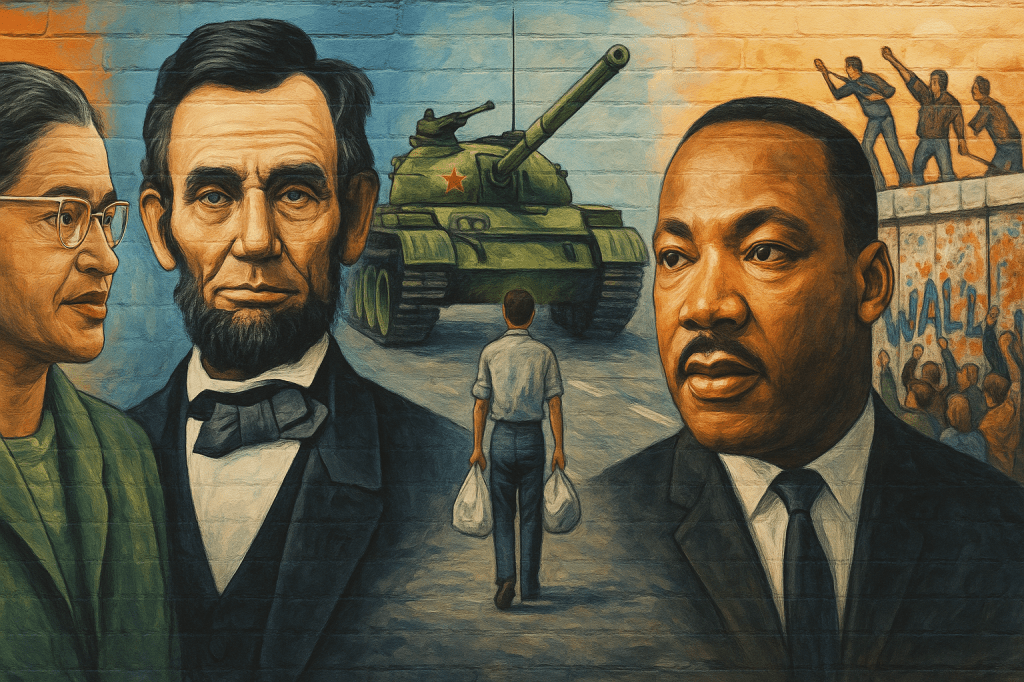
On December 1, 1955, Rosa Parks boarded a bus in Montgomery, Alabama. She sat in the “colored” section, but when white passengers filled the bus, she was ordered to give up her seat. In that instant, she faced a choice. She could comply with custom and law, or she could resist. The moment was brief. Parks had seconds to decide. She refused to move.
Her action was not accidental. Parks had been trained in nonviolent resistance at the Highlander Folk School. She had long been active in the NAACP. She was prepared. The courage she displayed that night was possible because she had made equity a guiding principle of her life. Her moment arrived suddenly, but her preparation stretched back years. What followed was the Montgomery Bus Boycott, a 381-day protest that launched Martin Luther King Jr. into national leadership and helped transform the civil rights movement. The lesson from Parks is that decisive action in a fleeting moment can alter the trajectory of history. Her courage was not improvised. It was readiness meeting opportunity.
The Fall of the Berlin Wall
On November 9, 1989, an East German government spokesman mistakenly announced that citizens would be allowed to cross into West Berlin immediately. Crowds gathered at border checkpoints. East German guards, unprepared and unsure of orders, faced a choice. Do they open the gates, or do they fire on their own people? At the Bornholmer Strasse crossing, the officer in charge, Harald Jäger, made his decision. He let the crowds pass. He had minutes to decide. His choice set off a cascade of events that brought down the Berlin Wall. Within hours, people were chipping away at concrete, climbing over barriers, and celebrating newfound freedom. The fall of the Wall was not the result of one person alone. It was the product of decades of resistance, protests, diplomacy, and systemic decay in the Soviet bloc. But in that moment, Jäger’s decision mattered. Had he ordered his men to fire, the story could have ended in bloodshed, not celebration. History turned because one person was ready to act with humanity instead of fear.
“I will prepare and someday my chance will come.” Abraham Lincoln
Abraham Lincoln and the Emancipation Proclamation
During the early years of the Civil War, President Abraham Lincoln hesitated to make abolition an explicit war aim. He feared alienating border states and moderate voters. But by 1862, the war had dragged on, casualties had mounted, and enslaved people were escaping to Union lines in growing numbers. The question of slavery could no longer be avoided. So, Lincoln drafted the Emancipation Proclamation and waited for the right moment. After the Union victory at Antietam in September 1862, he acted. He issued the preliminary proclamation, declaring that enslaved people in rebellious states would be free as of January 1, 1863. Lincoln’s courage was not only in writing the order but in seizing the moment to issue it. Timing was everything. The moment was narrow, but Lincoln was ready. His decision shifted the moral center of the war, made abolition inseparable from Union victory, and invited the participation of nearly 200,000 Black soldiers and sailors in the Union cause. Lincoln teaches us that courage often requires waiting for the right opening, then acting decisively when it comes.
The Tia_n__an_me_n Square “T_ank M_a_n”
In June 1989, after weeks of student-led protests in B__eij__in__g, the C__hi__nese military moved to crush the demonstrations. On June 5, a column of t_a_nks rolled down Ch___an__g’a__n Avenue. A lone man carrying shopping bags stepped into the street and blocked their path. He stood in front of the t__an__ks, refusing to move. When the lead ta___n__k tried to go around him, he shifted his position to block it again. The entire encounter lasted only a few minutes. But those few minutes became one of the most iconic images of the twentieth century. We still do not know his name. We do not know his fate. What we do know is that in a fleeting moment, he chose courage. His act of defiance symbolized the power of individual conscience against overwhelming force. T__an__k Man reminds us that courage often emerges unexpectedly from ordinary people. The moment arrives suddenly, but the impact can echo for decades.
Martin Luther King Jr. and the “Mountaintop” Speech
On April 3, 1968, in Memphis, Tennessee, Martin Luther King Jr. gave his final speech. He spoke of the threats he had faced, of surviving a recent assassination attempt, and of the possibility that his life might end soon. He declared, “I may not get there with you, but I want you to know tonight, that we, as a people, will get to the Promised Land.” The next day, he was assassinated. King’s willingness to speak with such clarity and conviction in the face of mortal danger was a profound act of courage. He understood that the moment was fleeting. He chose to fill it with words that would inspire generations. His readiness to meet the moment gave the movement strength even in his absence.
History’s Lesson for Us Today
The examples from history reveal a pattern. Courageous moments come suddenly, and the time to act is short. Rosa Parks had seconds. T_a_nk Man had minutes. Harald Jäger at the Berlin Wall had an hour. Lincoln had a narrow political window. Martin Luther King Jr. had one final night. The lesson is not to wait for courage to magically appear when the moment arrives. The lesson is to prepare ourselves so that when the moment comes, we are ready.
Preparation can mean years of advocacy and training, as in the case of Rosa Parks. It can mean cultivating moral clarity and timing, as with Lincoln. It can mean practicing discipline and calm under pressure, as with the Apollo 13 team. And it can mean building deep convictions that allow us to stand firm when the world seems hostile, as with Ta_n_k Man and Martin Luther King Jr. In each case, courage was decisive, and history turned because someone was ready. Today, our world faces crises of equity, justice, and democracy. The moments of courage we will face may come in a boardroom, a classroom, a city street, or a legislative chamber. They may not come with fanfare or warning. They will come quietly, sometimes disguised as an ordinary decision. But their impact can ripple outward for decades.
The question is not whether the moment will come. The question is whether we will be ready to meet it. I had an opportunity to stand and I failed. I’ll be ready the next time. Preparation requires cultivating clarity about our values, practicing discipline in our work, and building communities that sustain us. It requires knowing what we stand for, so that when tested, we can stand without hesitation. History belongs to those who are prepared when the moment of truth arrives. Acts of courage often come in an instant, but their impact can echo for generations. Rosa Parks, Abraham Lincoln, Ta__n__k Man, Martin Luther King Jr., the fall of the Berlin Wall—each reminds us that decisive action is born from readiness. Our task is the same: to prepare our hearts, sharpen our convictions, and be ready to rise when our moment comes.
Please share.
Julian Vasquez Heilig is a nationally recognized policy scholar, public intellectual, and civil rights advocate. A trusted voice in public policy, he has testified for state legislatures, the U.S. Congress, the United Nations, and the U.S. Commission on Civil Rights, while also advising presidential and gubernatorial campaigns. His work has been cited by major outlets including The New York Times, The Washington Post, and Los Angeles Times, and he has appeared on networks from MSNBC and PBS to NPR and DemocracyNow!. He is a recipient of more than 30 honors, including the 2025 NAACP Keeper of the Flame Award, Vasquez Heilig brings both scholarly rigor and grassroots commitment to the fight for equity and justice.


 Cloaking Inequity
Leave a comment