One of the defining dangers of the Trump regime is its willingness to treat the Constitution as optional, something to be worked around rather than obeyed. Detaining citizens without proper due process is the clearest example of this mindset. What the government and its defenders often suggest is that these violations are minor, temporary, or brief, and therefore less serious. But this argument misunderstands the very nature of constitutional rights and why they exist in the first place. A “brief” violation is still a violation. Period.
Rights do not come with timers. They do not expire at midnight, nor can they be suspended for a few hours without consequence. Whether the denial of rights lasts minutes, hours, or days, the violation is complete the moment it occurs. To excuse short-term infringements is to suggest that rights are a privilege, granted and revoked at the government’s convenience. That is not what the Constitution envisions, and it is not what a democracy can survive.
The Arrest of Mayor Ras Baraka
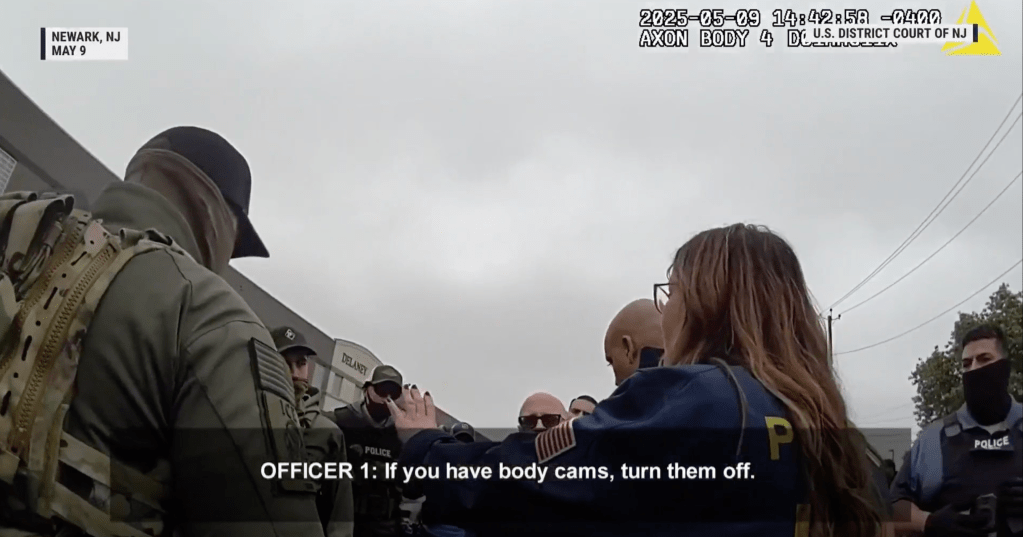
The arrest of Newark Mayor Ras Baraka in May 2025 is a chilling illustration of this problem. Baraka, a sitting Democratic mayor of one of America’s largest cities, was arrested outside an ICE facility during a protest and accused of trespassing. That charge was later dropped, but the real story was revealed only when bodycam footage surfaced months later. In that footage, a federal agent can be heard saying that the arrest was ordered “per the deputy attorney general of the United States,” Todd Blanche, a man who previously served as Donald Trump’s personal lawyer.
Even more disturbing, the agent gave explicit instructions to turn off body cameras before executing the arrest. That detail is damning. Cameras are supposed to provide transparency and accountability in law enforcement. Shutting them off signals that the officers knew what they were doing was legally and ethically suspect. Nicolle Wallace called the footage “a stain on this country,” and she was right. This was not a routine trespassing arrest. It was a staged act of political policing, orchestrated at the highest levels of the Justice Department.
The duration of Baraka’s detention does not diminish the gravity of what happened. The moment he was handcuffed under political orders, the Constitution was violated. The fact that he was released later does not cleanse the abuse. To focus on the shortness of the detention is to miss the point. The harm was already done, both to Baraka and to the principle of equal protection under law. The violation was real and unmistakable.
Duration Does Not Excuse Abuse
Imagine if police entered your home without a warrant, rifled through your belongings, and then left after ten minutes. Would anyone seriously argue that the intrusion was harmless because it was brief? The constitutional violation occurs the instant the threshold is crossed, no matter how quickly the officers leave. The same principle applies to unlawful detention. The moment an individual is placed in custody without due process, liberty is violated.
The Trump administration understands this principle, but in reverse. It knows that even short detentions can be powerful tools of intimidation. Arresting someone for a few hours sends the message that dissent carries a price. It chills protest. It tells others that their rights are not guaranteed but contingent. And it plants the dangerous idea that liberty can be suspended at the will of those in power. In this sense, the brevity of the detention is not incidental. It is strategic.
The Courts’ Role in Normalizing Violations
The troubling pattern is that the courts, and especially the Supreme Court, have too often tolerated these short-term violations. Through the so-called emergency docket, sometimes called the shadow docket, the Court has permitted governments to impose restrictions on rights while insisting that the harms are temporary. By treating duration as a mitigating factor, the judiciary has implicitly encouraged governments to use temporary violations as a tactic.
The emergency docket was originally intended for urgent, time-sensitive issues like imminent executions or immediate national security threats. In recent years, however, it has become a mechanism for issuing consequential rulings without full briefing or oral argument. This practice allows the Court to let unconstitutional policies remain in place for weeks or months while litigation drags on. The result is that rights are violated in practice even if they are eventually restored in theory.
Consider voting rights. On multiple occasions, the Court has allowed restrictive laws to take effect for an election, reasoning that intervention would cause confusion. This logic treats the denial of voting rights as tolerable if it is only temporary. But what could be more damaging than losing the right to vote in a specific election? Once the day has passed, the harm is permanent. A voter cannot go back in time and cast a ballot. That is the cost of tolerating temporary violations.
Rights Are Not Written in Pencil
The Constitution does not say: “You shall have free speech, unless the government decides to silence you for a while.” It does not say: “You have a right to liberty, except when the state insists it needs a few hours to detain you without cause.” Rights are not written in pencil. They are not subject to erasure and redrawing depending on the whims of those in power. They are meant to be durable restraints on government overreach.
When the Trump regime detains citizens without due process and the courts allow it on the grounds that the harm is temporary, we enter treacherous territory. What is normalized today as a short exception becomes tomorrow’s standard practice. Temporary infringements have a way of hardening into permanent policies. The line between emergency and routine disappears, and rights become negotiable.
History’s Sobering Reminders
History is filled with examples of rights violations that were initially framed as temporary but became long-lasting. Japanese Americans detained during World War II were told that the situation was short-term. In reality, many remained in camps for years, losing homes, businesses, and communities. The government called it relocation. In practice, it was indefinite detention without due process.
After the attacks of September 11, the Patriot Act was justified as a temporary measure to enhance national security. More than two decades later, many of its surveillance provisions remain in place. The temporary became permanent. The erosion of privacy became normalized. Each time we accept a short violation in the name of necessity, we lay the groundwork for longer ones. The lesson is that duration is not protection. Once rights are breached, they are difficult to restore.
The Illusion of Harmlessness
Supporters of unlawful detentions sometimes argue that because individuals are eventually released, no lasting harm is done. This argument collapses under scrutiny. Even a short detention can cause deep psychological trauma, damage reputations, and disrupt lives. It stigmatizes individuals as suspect in their own communities. It tells them, and those who witness it, that their rights are conditional and precarious.
The courts have long recognized that the harm of unlawful detention or unlawful search occurs the moment it happens. Remedies after the fact cannot undo the initial violation. Yet in practice, both the Trump administration and the judiciary are eroding this principle. They are treating brief violations as if they fall into a gray zone where the Constitution need not apply. But there is no such zone. Rights are either protected or they are not.
The Slippery Path of Emergency Power
The danger of this trend cannot be overstated. Democracies rarely collapse in one sweeping moment. They erode through a series of exceptions that appear tolerable in isolation. Emergency powers, temporary suspensions, and brief detentions are the wedge. They are justified as minor, but once established they become normalized. Each tolerated exception makes the next one easier.
The Trump administration has relied on this strategy. Each time it detains a protester, a mayor, or a critic for a few hours, it tests the boundaries of public acceptance. Each time the courts allow these detentions to proceed, they signal that such practices fall within the realm of the permissible. The result is cumulative. The culture of rights erodes piece by piece until citizens expect less freedom and demand less accountability.
Why the Baraka Arrest Matters
This is why the arrest of Ras Baraka matters, even though the charges were dropped and the detention was short. It was not a harmless anomaly. It was a deliberate demonstration of how federal power can be weaponized against political opponents. A mayor was arrested at the explicit direction of a political appointee tied to the president. Body cameras were turned off to conceal the process. The violation was real, and it set a precedent.
Wallace was correct to call this a stain on the country. It is also a warning sign. If such arrests become normalized, they will not remain rare. What begins with a mayor at a protest can easily extend to legislators, journalists, or ordinary citizens who speak out. The message is clear: rights can be suspended, even if only for a little while. That message is corrosive to democracy.
The Logic of Passing the Blame
It is worth pausing on one particular detail from the bodycam footage. The agent on the ground specifically said that the arrest was “per the deputy attorney general.” At first glance, this might look like simple obedience to authority. But in reality, it is a form of legal insulation. By attributing the decision to Blanche, the agent was signaling that if questioned later, he could not be held personally responsible. He was ordered to act, and thus he acted.
This logic has serious historical echoes. Authoritarian regimes have often relied on precisely this chain of justification. In Nazi Germany, military officers claimed at Nuremberg that they were simply following orders. In Stalin’s Soviet Union, police and bureaucrats routinely said that purges and arrests were directed from above. The excuse of “I was told to do it” became a shield against accountability. In every case, the effect was the same: responsibility evaporated into the hierarchy, leaving the system unchallenged.
The Baraka arrest illustrates how this same logic is creeping into American practice. The agent’s words show that law enforcement officers already understand how to insulate themselves. If orders come from the top, they can displace blame upward and avoid scrutiny. But democracy cannot function if obedience to authority replaces personal responsibility. The Constitution requires that every official, from the deputy attorney general down to the officer making an arrest, is bound by its restraints. Passing blame does not dissolve accountability.
The Citizen’s Task
The responsibility now falls to us as citizens. We must insist that there is no grace period for constitutional rights. A violation is a violation the instant the government crosses the line. Hours or days make no difference. Liberty cannot be measured with a stopwatch.
We must demand accountability whenever unlawful detentions occur, regardless of their duration. We must refuse to normalize temporary suspensions of rights. And we must hold the courts accountable when they hide behind procedural excuses instead of enforcing the Constitution. A judiciary that tolerates short-term violations is not neutral. It is complicit.
The Trump regime’s willingness to detain citizens unlawfully is not just a policy choice. It is a direct assault on the Constitution. And the courts’ willingness to tolerate brief violations is not caution. It is collaboration in the erosion of rights. Democracies do not die in silence. They die when citizens accept exceptions.
The lesson is urgent. If we excuse rights violations as temporary, we risk losing them permanently. There is no timer on the Constitution. There is no harmless suspension of liberty. There is no such thing as a brief or acceptable violation of rights. Rights denied, even for a short time, are rights violated. Period. And if we allow the logic of “I was just following orders” to take hold in our own institutions, then the echoes of authoritarian history will not remain echoes. They will become our reality.
Julian Vasquez Heilig is a nationally recognized policy scholar, public intellectual, and civil rights advocate. A trusted voice in public policy, he has testified for state legislatures, the U.S. Congress, the United Nations, and the U.S. Commission on Civil Rights, while also advising presidential and gubernatorial campaigns. His work has been cited by major outlets including The New York Times, The Washington Post, and Los Angeles Times, and he has appeared on networks from MSNBC and PBS to NPR and DemocracyNow!. He is a recipient of more than 30 honors, including the 2025 NAACP Keeper of the Flame Award, Vasquez Heilig brings both scholarly rigor and grassroots commitment to the fight for equity and justice.





 Cloaking Inequity
Leave a comment