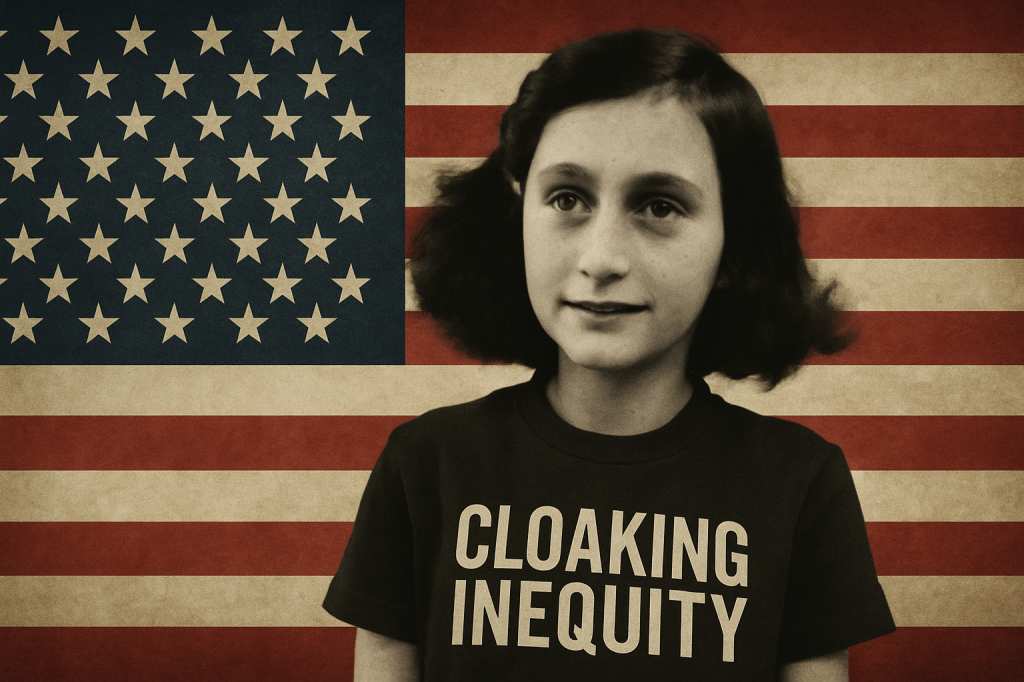
Every so often, a sentence hits you with the kind of force that keeps echoing in your mind long after you first encounter it. I came across one recently while scrolling Facebook. It was raw, stark, and unsettling in its clarity:
“It’s depressing to realize people I used to consider friends and family have become people who I would not tell where Anne Frank was hiding.”
The words stopped me cold. I read them again, slower this time. They carried the weight of history and betrayal, of intimacy and disillusionment. And they crystallized something I have been feeling for years.
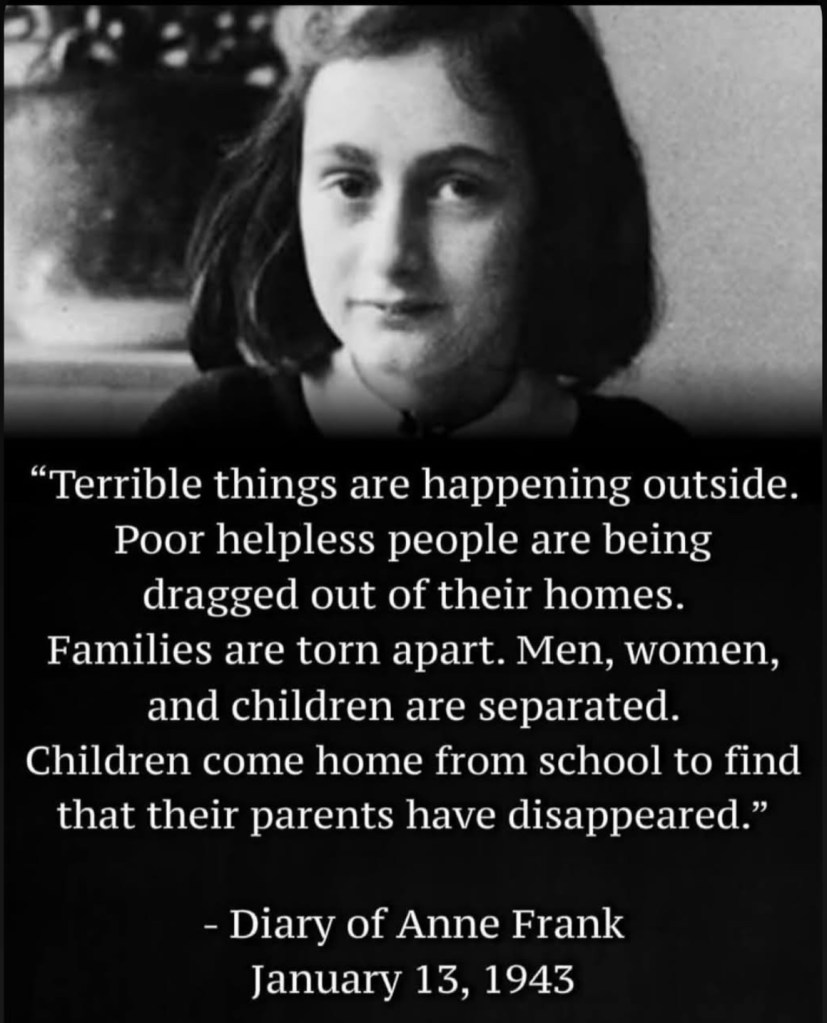
The Anne Frank Test
Anne Frank has become, tragically and powerfully, a shorthand for courage and conscience. Her story is not just about a girl in hiding, but about the moral test faced by everyone around her. Some risked everything to shelter her family from the Nazis, while others chose silence, or worse, collaboration.
That simple, haunting sentence from Facebook meme framed an unbearable truth: there are people in my life who would fail that test. People I once believed I could lean on without question, people whose trustworthiness I took for granted, have revealed themselves over time as unreliable at best, dangerous at worst.
It’s not really about Anne Frank, of course. It’s about trust, about who you would dare to entrust with your most vulnerable truth, who you would risk depending on when everything was on the line. I remember reading her biography as a nine-year-old after my mother bought the book for me. I was struck by how a young girl’s diary could expose both the cruelty and the courage of humanity. What most people forget is that Anne Frank was made an illegal immigrant by the Nazis; she was “breaking the law” by hiding. Her family fled Germany seeking refuge in Amsterdam, where they hid in a secret annex behind her father’s business at 263 Prinsengracht for more than two years before being betrayed. The Frank family’s story is a timeless reminder that legality is not the same as morality, and that what’s considered criminal in one era can later be recognized as an act of conscience and survival.
The Fracturing of Trust
Family is supposed to be unconditional. Friendship is supposed to be a refuge. But life teaches otherwise. Over time, you begin to notice the cracks, the way someone reacts to another’s suffering, the offhand cruelty in a “joke,” the way silence becomes complicity in the face of injustice. MAGA politics has only accelerated and accentuated this cruelty, transforming quiet prejudices into loud performances of disdain. People you once trusted reveal that their empathy has limits, that their loyalty to ideology outweighs their care for others. The same forces that turned neighbors against Anne Frank’s family now operate in subtler ways—through social media, through policy, through the ease with which people constantly excuse harm when it aligns with their political cult.
I have seen friends and relatives, people I once thought of as safe harbors, drift into ways of thinking and behaving that make me realize I could not trust them in a moment of true danger. It’s not about small disagreements. I can accept differences in politics, taste, or belief. What I cannot accept is the loss of character and values: when empathy curdles into suspicion, when courage collapses into cowardice, when love is replaced by judgment or hate. It is depressing, even devastating, to face this realization. To admit that someone who once held your hand through childhood, or shared laughter over dinners, might also be someone who would sell out your hiding place if history demanded it.
Why the Metaphor Hurts So Much
The metaphor is severe, and it should be. The Holocaust remains one of humanity’s darkest moral tests, when ordinary people were forced into extraordinary choices. Some risked everything to protect strangers, while others chose betrayal, even of friends. Millions were murdered in the name of a political ideology that twisted legality and economic benefits into a weapon and racial purity into a justification for genocide.
Invoking Anne Frank is not casual, it is deliberate, because it highlights the gravity of trust. When you say, “I wouldn’t tell them where Anne Frank was hiding,” you’re not simply expressing a falling-out. You are acknowledging a collapse in the very foundation of human relationship. You are saying: I would not bet my life, or the lives of others, on this person’s conscience. That’s a brutal acknowledgment. But in its severity lies truth.
The Quiet Tests of Everyday Life
What makes this even more sobering is that we don’t need the extremity of wartime to reveal who people are. Everyday life provides its own quiet Anne Frank tests. Would they speak up when they hear a slur? Would they defend the vulnerable when no one else is watching? Would they tell the truth even if it cost them comfort or status? Would they show up for you when it was inconvenient, not just when it was easy?
The answers to these questions accumulate over time. And slowly, painfully, you begin to realize which of the people around you would hide Anne Frank, and which would betray her with a shrug. There is a special grief in realizing that the people who fail these tests are not distant acquaintances but those closest to you. Parents. Siblings. Friends who once knew your secrets and carried your burdens. It feels like a second betrayal on top of the first: not only would they fail Anne Frank’s test, but they have failed you by becoming people you cannot trust. It is tempting to look away, to excuse or rationalize their choices, to preserve the illusion of safety. But illusions are dangerous. Pretending someone is trustworthy does not make them so. And in the long run, facing the painful truth is the only way to protect your peace.
What Betrayal Reveals About Us
Realizing who we cannot trust is not only a judgment of them, it’s a mirror held up to ourselves. Why did we let them so far in? What blind spots allowed us to miss the warning signs? What does our grief say about the depth of our need for belonging, even when belonging is unsafe? These are uncomfortable questions. But they are necessary if we are to move forward. Because knowing who would betray Anne Frank also clarifies who would protect her, and who, therefore, deserves to remain at the center of our lives.
The loss of old relationships is painful, but it also creates room for something deeper. In that empty space, we can build new circles of trust grounded not in shared bloodlines or nostalgic history, but in shared values: courage, empathy, integrity, and love. These are the people who would have hidden Anne Frank, and they are the ones to whom we can entrust our most vulnerable truths. They may not resemble the family we once imagined or the childhood friends we thought would always stand beside us. But they become our true family, our chosen community, the ones who stay when the attic grows silent, when the world outside hums along in denial, and when political cruelty again tests the limits of our humanity.
Conclusion: Holding On to Hope
I do not want to live in cynicism. I do not want to measure everyone by suspicion alone. For every person who would betray, history shows us there are others who would protect. For every family member who fails, there is another who surprises you with courage. For every friend who drifts into betrayal, another steps up in loyalty. Anne Frank herself, even in hiding, clung to hope in humanity. She wrote: “In spite of everything, I still believe that people are really good at heart.” That belief is hard to sustain when faced with betrayal. But maybe it’s less about believing everyone is good, and more about committing to find and cherish the ones who are.
So yes, it is depressing to realize that some of the people we once trusted most are people we would not tell where Anne Frank was hiding. It is a very heavy and sobering truth. But it is also clarifying. It reveals the fractures that already existed, the courage that is missing, the boundaries we must draw. And in drawing those boundaries, painful as they are, we begin to chart a different kind of future, one where our lives are entwined with those who would not hesitate to climb the stairs, close the door gently, and whisper, “You are safe here.”
Julian Vasquez Heilig is a professor of educational leadership and public policy at Western Michigan University, a former dean and provost, and a lifelong advocate for justice, equity, and truth in education. A scholar, storyteller, and public intellectual, he blogs daily about the intersection of trust, conscience, and leadership in America’s most urgent moral moment.equity, and truth in education. A scholar, storyteller, and public intellectual, he blogs daily about the intersection of trust, conscience, and leadership in America’s most urgent moral moment.



 Cloaking Inequity
Leave a comment