Donald Trump wants to send troops to Oregon, California, and Illinois to quell an imaginary rebellion that he claims gives him legal justification to deploy the military on American soil. Speaking to the press, he has invoked the language of the Insurrection Act of 1807, attempting to sidestep the Posse Comitatus Act of 1878, the post–Civil War law that prevents presidents from using the U.S. military as a domestic police force. That law was created to protect Americans from exactly the kind of federal overreach Trump now envisions, forbidding military involvement in civilian affairs without explicit authorization from Congress. Unless there is an actual insurrection or a complete breakdown of civil authority, deploying troops within U.S. states for political purposes would violate both the spirit and the letter of the law.
The Trump administration has appealed a federal court order banning troop deployment in Illinois, and the Supreme Court is now weighing the issue on its shadow docket. The move raises profound constitutional questions about executive power, states’ rights, and whether the nation’s highest court will permit the erosion of one of the most fundamental guardrails against domestic militarization.
But that is not where the rebellion is happening. The real rebellion is unfolding in classrooms, universities, and government offices across the country. It is happening in quiet acts of conscience, principled resignations, and institutional refusals to comply with political coercion. People are pushing back. Universities are pushing back. And regardless of what the Supreme Court says or does, the people are going to win.
In 2025, a moral awakening is taking shape beneath the surface of political chaos. Senior attorneys in the Department of Justice have resigned rather than prosecute political enemies. A decorated admiral has left his post after being ordered to oversee Carribean operations that blurred the line between law and loyalty. Universities from coast to coast are rejecting Trump’s ideological compact that demands obedience to power instead of allegiance to truth. The most powerful acts of leadership this year have not been those of submission or survival. They have been acts of conscience.
The question of red lines has never been more urgent. The Trump administration’s continuing pressure campaigns across government, military, and higher education have become a national test of character. Every sector is being forced to decide whether it will prioritize integrity or submission, whether it will protect the principles that define democracy or yield to the convenience of silence. The individuals and institutions who refuse to cross that moral threshold are demonstrating what authentic leadership still looks like in an age of fear and fatigue.
The Moment That Demands Clarity
Every generation faces its own moral frontier, the point where silence becomes betrayal and action becomes imperative. For Rosa Parks, it was a seat on a bus. For the journalists who uncovered Watergate, it was the decision to pursue the truth when it threatened power. For the scientists of the Manhattan Project, it was the moment they realized their discoveries could destroy the world. Today, that moral frontier exists everywhere in the United States, where bureaucracy, policy, and ideology are intertwining to test the conscience of Americans.
The temptation to yield a little for the sake of peace or reputation is strong. Americans are telling themselves that compromise protects their teams, preserves their jobs, or maintains influence. They rationalize that bending a rule today might keep the system functioning tomorrow. Yet leadership without moral clarity is not stewardship. It is surrender. The longer leaders postpone doing what is right, the easier it becomes to normalize what is wrong.
Michelle Young’s reflection in a LinkedIn on a recent session of the Council of Academic Deans from Research Education (CADRE) Institutions originally inspired this article and captures this challenge with precision. Panelists Cheryl Holcomb-McCoy, Tabbye Chavous, and Erin Mote urged their colleagues to know their red lines before they are tested. Their message was not limited to education. It was a challenge to all leaders, whether they work in government, business, media, or the public sector. If you do not define your ethical boundaries before power confronts you, you will cross them when it does.
Knowing your red lines is an act of foresight, not reaction. It requires clarity about what you believe and what you will refuse to do, even when pressured. The leaders who never take time to ask themselves where that line lies are the ones most likely to rationalize their way across it. When truth becomes negotiable, justice becomes fragile. And when justice collapses, democracy follows.
The Architecture of Integrity
When I first entered senior leadership in universities, I imagined moral courage would reveal itself in dramatic moments—public declarations, bold policy decisions, and high-stakes confrontations. Over time, I learned that real courage often hides in quieter places. It lives in the decisions made behind closed doors, in the willingness to speak uncomfortable truths to colleagues, and in the refusal to prioritize self-interest over integrity and community. Those quiet choices, repeated over time, form the moral architecture of an institution. When that courage is absent, moral decline takes root, and the community feels it, names it, and talks about it, even when the institution’s leaders remain blissfully unaware.
Red lines are not walls that keep people apart. They are the structural beams that keep leadership upright. Without them, compromise becomes culture, and culture becomes collapse. The leaders who preserve integrity are not those who avoid conflict but those who refuse to surrender principle for convenience. Doing the right thing often carries an immediate cost, but the price of moral decay is far greater and longer lasting.
Defining red lines requires deep self-reflection. What values will you never compromise? What actions would you regret avoiding? What silences would haunt you later if you maintained them now? Which risks are worth your reputation? Leaders who ask these questions are better prepared when power tests their resolve. Those who do not ask them often discover too late that they have already crossed the line they swore they would never cross.
Institutions rarely crumble overnight. They decline and deteriorate through years of small concessions and tolerated injustices. Red lines are not rigid restrictions; they are the conditions that make trust and accountability possible. When leaders know what they will not do, they protect the integrity of their mission. When they forget, they become enablers of moral and ideal corruption.
When Conscience Walks Away
Over the past few months, numerous public servants have reached their red lines under political pressure. Admiral Craig Faller, head of U.S. Southern Command, quietly stepped down after being asked to oversee extrajudicial assassinations in the Caribbean that I suspect he believed blurred legal and ethical boundaries. Within the Department of Justice, multiple career attorneys resigned rather than weaponize prosecution against political opponents. Inside the FBI, a senior agent refused to stage a public “perp walk” of former Director James Comey, rejecting orders that would have transformed law enforcement into political theater for Donald Trump’s satisfaction.
These decisions were not acts of rebellion but of principle. Each was a refusal to sacrifice institutional integrity for political convenience. In every case, the individuals involved understood that loyalty to the Constitution and the rule of law outweighs loyalty to any one leader. Their resignations and refusals were quiet but powerful affirmations of what democratic service truly means.
When conscience walks away, it does not do so out of resentment but out of integrity. Those who resign on moral grounds often face criticism, isolation, or ridicule. Yet their departures serve as vital reminders that democracy depends on people who will not cross ethical lines. Their courage gives hope that integrity can still exist within systems of power, even when corruption feels overwhelming. History does not remember those who obey unjust orders. It remembers those who say no. The moral fabric of a free society is held together by those who choose conscience over career, truth over comfort, and courage over complicity.
Universities Find Their Red Lines
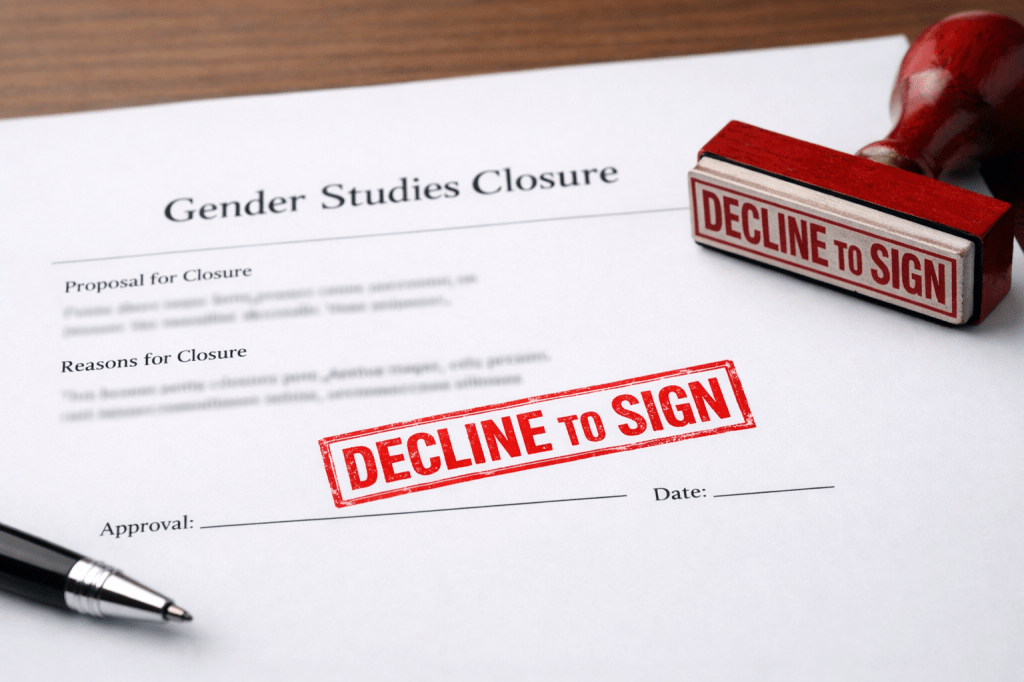
Higher education is now confronting its own moral test. The Trump administration’s Compact for Academic Excellence in Higher Education offers additional funding and political favor in exchange for compliance with ideological oversight. It requires universities to align curricula with government-approved values, share internal data, and open research agendas to political review. On the surface, it promises accountability. In practice, it threatens academic freedom and transforms education into propaganda.
Five leading universities—the Massachusetts Institute of Technology, Brown University, the University of Pennsylvania, the University of Southern California, and the University of Virginia—have all refused to sign so far. Each reached the same conclusion: knowledge must remain independent of political control. MIT declared, “Fundamentally, the premise of the document is inconsistent with our core belief that scientific funding should be based on scientific merit alone.” Brown University’s president warned that the compact “would undermine the government’s merit-based approach to funding research.”
University of Pennsylvania President Larry Jameson added, “At Penn, we are committed to merit-based achievement and accountability.” USC Interim President Beong-Soo Kim stated, “Other countries whose governments lack America’s commitment to freedom and democracy have shown how academic excellence can suffer when shifting external priorities tilt the research playing field away from free, meritocratic competition.” The University of Virginia, the fifth institution to reject the deal, said it sought “no special treatment in exchange for our pursuit of those foundational goals.”
Their reasons differ in tone but not content, the moral clarity is the same. These universities have drawn a collective red line against political coercion. Their refusal is not an act of defiance but of democratic responsibility. As discussed in the earlier post Trump’s New “Compact for Academic Excellence in Higher Education” Isn’t American at All—It’s Chinese, the policy mirrors authoritarian systems abroad where academic inquiry is subservient to government ideology. By rejecting it, these institutions affirm that truth cannot serve two masters. Their courage reminds us that the most important rebellions are not fought with weapons but with principles. The future of democracy will not be decided by those who shout the loudest but by those who stand the firmest when integrity is tested.
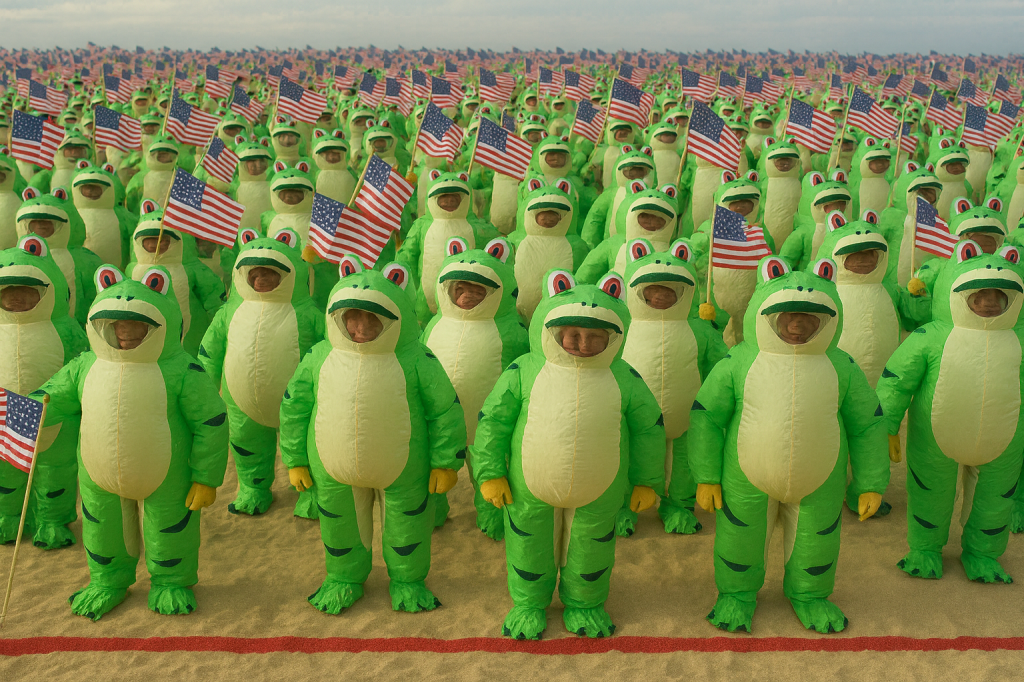
Conclusion: Patriotic Frogs Standing Firm
History rarely honors humans who stayed quiet. It remembers those who stood firm when the winds of power demanded silence. America is once again at such a crossroads. The test of leadership is not whether we weather the storm but whether we remain upright within it. To know your red lines is to anchor leadership in conscience rather than convenience. It means accepting that integrity is nonnegotiable, that truth is not partisan, and that silence in the face of corruption is itself a form of betrayal. Every organization, from classrooms to legislatures, depends on people who will draw these lines and hold them, no matter the cost. This is not a time for retreat or neutrality. It is a time for moral clarity. Whether you lead a classroom, a newsroom, or a university, your decisions define what will endure. The question is not what you stand to lose by saying no. It is what all of us stand to lose if you never do. We are, and must continue to be, the difference.
Julian Vasquez Heilig is an award-winning civil rights leader, scholar, and public intellectual whose two-decade career in higher education includes serving as Provost at Western Michigan University and Dean of the College of Education at the University of Kentucky. A national voice on education policy, leadership, and social justice, his research and commentary have been featured in The New York Times, Los Angeles Times, Washington Post, Associated Press, USA Today, and Education Week. He has appeared on MSNBC, PBS, NPR, Fox, ABC, CBS, Univision, Democracy Now!, and Al Jazeera. Across his Without Fear or Favor newsletter and LinkedIn posts, Vasquez Heilig’s work reached more than 1.5 million readers in 2025. Since 2012, he has also blogged at Cloaking Inequity.



 Cloaking Inequity
Leave a comment