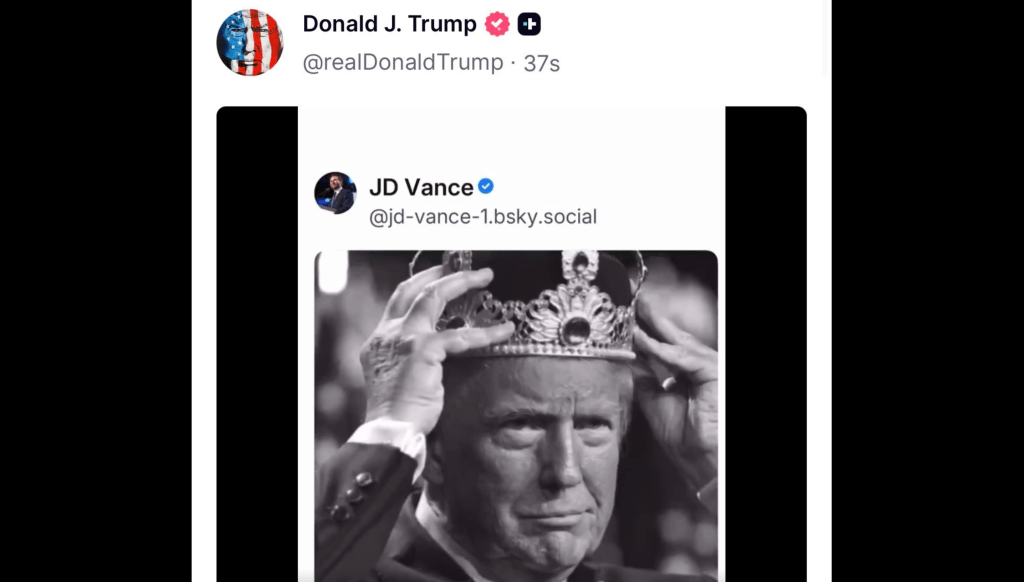
The first of the “No Kings” protests took place in June 2025 and brought an estimated 4 to 6 million people into the streets across more than 2,100 cities and towns in all fifty states (The Guardian). Data journalists later estimated that the protests represented nearly 2 percent of the U.S. adult population. That scale rivals the Women’s March of 2017, making it one of the largest single-day mobilizations in American history. The second wave came in October 2025, when organizers claimed that more than 7 million people participated nationwide (The Verge). The crowds stretched from Los Angeles to Atlanta, New York to Omaha, bound together by one message: there are no kings in a democracy.
Political scientists Erica Chenoweth and Maria Stephan found that when 3.5 percent of a nation’s population participates in sustained, nonviolent protest, the movement has never failed to produce major political change. In the United States, that threshold is roughly 11.5 million people. The No Kings protests, already mobilizing more than half that number in only two waves, have moved from symbolic resistance toward the edge of historical inevitability. The math itself has become a quiet kind of prophecy. If the movement continues to grow, the rule of 3.5 percent could soon meet the rule of one man, and history suggests which side will win.
What we are witnessing is not just a political turning point. We are watching the most important leadership lesson in real time. Leadership is often treated as an abstract skill or a career asset, something discussed in conference rooms or self-help books. Yet here, in the clash between citizens and concentrated power, leadership reveals its truest form. The “No Kings” movement shows that leadership is not about commanding obedience or projecting dominance—it is about inspiring collective courage and reminding people that authority in a democracy flows upward, not down.
The Performance of Power
The protests were not abstract or disconnected from real events. They were an explicit response to what many saw as the open celebration of authoritarian imagery in American political life. President Donald Trump, now in his second non-consecutive term, posted a video of himself cosplaying as a fighter pilot wearing a gold crown and bombing protesters with feces. It was part political theatre, part insult, and all arrogance. The image, as grotesque as it was absurd, turned protest itself into a target and elevated ridicule into governance. It suggested that humiliation, not persuasion, had become a tool of statecraft.
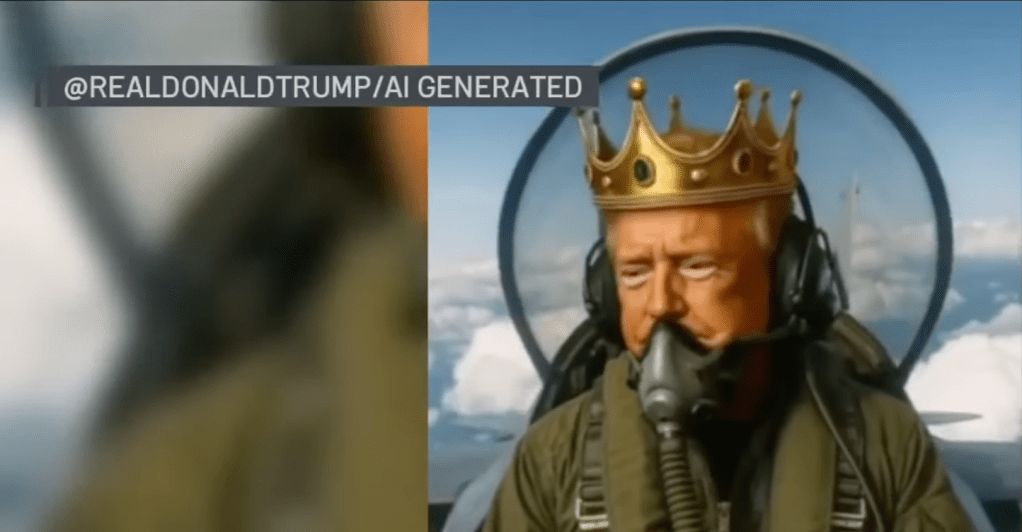
The absurdity did not go unnoticed. Late-night hosts mocked the video, comparing it to propaganda produced by a dictator’s teenager with Wi-Fi access. But satire can be anesthetic, it dulls outrage by turning danger into a punchline. Beneath the laughter was something serious: power had dropped its mask. It was no longer hiding behind polished speeches or formal decorum; it was testing the public’s tolerance for mockery and domination. Like King George III in Hamilton, the President seemed to be singing “You’ll Be Back” to the American people, confident that obedience would triumph over outrage. The No Kings movement had its answer ready: no, we will not be back, and you do not rule us.
Leadership is not performance art. When power becomes parody, it erodes legitimacy. When leaders mistake ridicule for strategy, they reveal not confidence but insecurity. History’s tyrants have always worn costumes—crowns, uniforms, and medals—to disguise their fear of irrelevance. True leadership does not need to dress itself in gold or threaten its citizens to feel powerful. It leads through trust, not intimidation.
Power Is Not Neutral
Stanford scholar Jeffrey Pfeffer argues in his book Power: Why Some People Have It and Others Don’t that most of us cling to a comforting illusion. We believe that hard work, fairness, and respect are enough to bring success. Pfeffer dismantles that myth. He writes that outcomes in organizations and societies are determined less by merit and more by power itself—the ability to influence, mobilize, and act. For those committed to equity in labor, education, healthcare, or government, Pfeffer’s insight is not a manual for advancement but a warning: power is never neutral when you challenge injustice.
This reality echoes throughout American history. Workers who fought for the eight-hour day faced batons and bullets. The first teachers who unionized were labeled radicals. Nurses demanding better staffing were dismissed as troublemakers. Power rarely yields to moral arguments alone. It defends itself strategically, often brutally. The same logic operates today in subtler ways: reformers advocating racial justice are told to be patient, provosts exposing moral corruption are branded as disloyal, and journalists confronting propaganda are called biased. The names change, but the choreography of suppression stays the same.
In this sense, the No Kings movement is not only about politics but about the moral architecture of leadership. When those in authority wield ridicule to silence dissent, they reveal the oldest truth of power: it must be challenged or it will calcify. Pfeffer’s insight reminds us that leadership without accountability drifts into domination. True leaders understand that legitimacy cannot be imposed; it must be renewed through humility and listening.
The Strategy of Storytelling
Pfeffer also teaches that power acts early to control the story. Those who move first define the terms of debate, often trapping their opponents in defensive positions. This strategy runs deep in American labor history. In the early twentieth century, corporations branded striking workers as “un-American” or “anti-freedom.” By the time reformers could respond, they were already framed as villains. The first move belongs to those who already hold power, which is why successful movements learn to act first, and speak louder, than their oppressors.
The No Kings organizers understood this instinctively. They didn’t wait for permission or the perfect moment. They built an alliance that crossed generations, professions, and races. Teachers, veterans, nurses, and students marched together. They knew that the right wing would label them as “anti-American” so they preempted that smear with a slogan that turned power’s language against itself: We work for the people, not the crown. Their defiance was not reactive; it was strategic. They reframed democracy not as rebellion, but as responsibility.
Trump’s response followed the oldest script in the playbook of insecure leaders: ridicule what you fear. His fighter-pilot crown video was an attempt to set the narrative, to mock dissent and make resistance seem laughable. But the tactic backfired. The laughter it provoked was not surrender; it was defiance. The protesters laughed back, not because they underestimated the danger, but because they understood that humor can dismantle intimidation. Like the colonists who mocked King George’s proclamations, they knew that once you can laugh at a tyrant, you have already weakened his spell.
Leadership Without Crowns
We’re watching the most important leadership lesson in real time. Leadership that depends on humiliation collapses. Leadership that invites collaboration endures. The No Kings protests reveal a principle that transcends politics: legitimacy comes from service, not spectacle.
Great leaders do not need to dominate to demonstrate strength. They balance confidence with humility, conviction with compassion. The Latin root of humility, humus, means “of the earth.” Also, a delicious bean dip. Anyways, to lead with humility is to stay grounded in the people you serve. It is to recognize that authority, like soil, must be tended or it turns barren. Humility is not weakness; it is what allows strength to grow sustainably.
The leaders of the No Kings movement—teachers, organizers, veterans, and parents—understood this intuitively. They led without crowns, titles, or wealth. Their authority came from presence and purpose. They organized childcare for protesters, arranged medical tents, and translated chants into multiple languages. They turned collective frustration into disciplined action. This is what leadership looks like when stripped of privilege: service, strategy, and solidarity.
Lesson from No Kings: Power Must Be Met with Power
Understanding power is only the first step. The harder work is translating awareness into collective resistance. History shows that moral arguments rarely change entrenched systems on their own. They must be paired with organization, endurance, and visibility. Movements that succeed do not wait for permission, they build countervailing power that rivals the forces they oppose.
The No Kings movement belongs to that lineage. The first wave drew millions; the second wave grew larger still. The President’s crown-wearing pilot video where he dropped tons of feces as bomb on street protestors sought to humiliate dissent, but it had the opposite effect. It clarified the stakes and expanded the coalition. The protests were not a reaction to a single man but a rejection of the idea that leadership equals dominance.
King George III once sang to the colonists, “You’ll be back, soon you’ll see.” Donald Trump seems to believe the same—that citizens will tire of marching, that outrage will fade, that spectacle will triumph. But America has answered differently this time. The people have come to the stage, taken their lines, and rewritten the script. The chorus sings louder now: we are not coming back, and we are not bowing.
Conclusion: The Curtain Falls, and the Lesson Remains
In the end, the No Kings protests to this point were not just about one president or one insult. They were about power itself—who has it, who deserves it, and how it is used. They reminded the nation that democracy is not self-sustaining. It survives only when citizens act together. The movement taught the same lesson Pfeffer outlined in his research: power will not reform itself; it must be balanced by moral courage and organized people.
We are witnessing the most important leadership lesson of our time unfold before us. Those who lead through arrogance may command attention for a moment, but history will remember their collapse, not their triumph. Those who lead with humility, who listen, who elevate others rather than themselves—those are the leaders who will shape the future. The stage is set, the people are awake, and the crown has never looked smaller.
No kings in our schools or universities. No kings in our businesses. No kings in our democracy. Leadership belongs not to those who demand loyalty, but to those who earn trust. The curtain falls, the crown drops, and the people rise, not to applaud power, but to celebrate its impending return to them.
Julian Vasquez Heilig is a nationally recognized policy scholar, public intellectual, and civil rights advocate. A trusted voice in public policy, he has testified for state legislatures, the U.S. Congress, the United Nations, and the U.S. Commission on Civil Rights, while also advising presidential and gubernatorial campaigns. His work has been cited by major outlets including The New York Times, The Washington Post, and Los Angeles Times, and he has appeared on networks from MSNBC and PBS to NPR and DemocracyNow!. He is a recipient of more than 30 honors, including the 2025 NAACP Keeper of the Flame Award, Vasquez Heilig brings both scholarly rigor and grassroots commitment to the fight for equity and justice.
References
- The Guardian: “Were the No Kings protests the largest single-day demonstration in American history?”
- The Verge: “Organizers say over 7 million showed up to No Kings protests.”
- The Washington Post: “Fallout from No Kings.”
- Chenoweth, E., & Stephan, M. J. (2011). Why Civil Resistance Works: The Strategic Logic of Nonviolent Conflict.Columbia University Press.]





 Cloaking Inequity
Leave a comment