Next week I’ll return to the University of Michigan’s Department of Psychology for the first time since I was an undergraduate psychology major in the 1990s. Though I’m on campus often, today I’m here for the Purdue versus Michigan game tonight, walking back into East Hall will feel different. It was in that building, decades ago, that I took my favorite class at Michigan: Community Psychology with Professor Lorraine Gutiérrez. That class changed the trajectory of my life. It taught me that psychology is not only about individuals but also about systems, communities, and the social conditions that shape who thrives and who struggles. It’s where I first learned that belonging is not a feeling; it’s a structure that can be built, or denied.
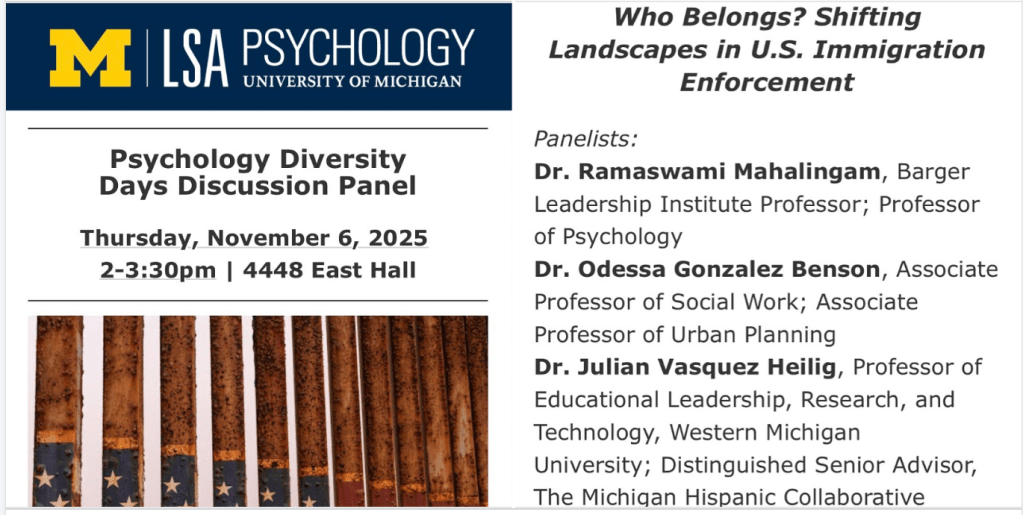
On Thursday, November 6, from 2 to 3:30 p.m., I’ll join Professors Ramaswami Mahalingam and Odessa Gonzalez Benson for Who Belongs? Shifting Landscapes in U.S. Immigration Enforcement, part of the Psychology Diversity Days series, moderated by Dr. Zeinab Hachem. If you’re in Ann Arbor, I invite you to join us in person in East Hall Room 4448. Bring a colleague, a classmate, or a friend, conversations about justice and belonging are always stronger when more voices are in the room.
The national debate over immigration has always reflected our deepest contradictions. According to the Pew Research Center, Americans are evenly divided on whether local law enforcement should help deport people, yet most oppose ending Temporary Protected Status for those who fled war or disaster. The majority disapprove of workplace raids by Immigration and Customs Enforcement. We still talk about the United States as a nation of immigrants, but our policies often treat immigrants as suspects. Behind the political slogans and sound bites lies a moral question that psychology is uniquely equipped to explore: how fear and identity interact to define who belongs.
In Michigan, these questions are not theoretical. The state currently prohibits police from stopping individuals based solely on immigration status, but that safeguard has been threatened by legislative efforts to repeal it. The political climate has made daily life more precarious for many families, students, and workers who live, study, and contribute here. Even far from the border, enforcement policies shape behavior and belonging. Students wonder whether applying for aid could draw unwanted attention. Parents question whether attending a school event might put them at risk. Everyday decisions become calculations of safety.
To understand this moment, we need frameworks that reveal how overlapping systems of power shape experience. Intersectionality helps us see that immigration status interacts with race, gender, and class in complex ways. Critical race theory reminds us that even policies that appear neutral often reinforce inequality. These frameworks matter because they help us see the full human impact of enforcement, how it touches not just those directly targeted, but entire communities.
The psychological toll is profound. When people live under the threat of enforcement, stress becomes a constant companion. Fear narrows one’s sense of possibility. Distrust seeps into relationships with institutions and authority. Even those with citizenship or legal status begin to internalize a fragile sense of belonging. On college campuses, immigrant and mixed-status students often carry invisible burdens, questions about whether they can safely share their stories, uncertainty about how professors or administrators will respond, and anxiety about their families’ safety.
Universities have a critical role to play in addressing these realities. Institutions that proclaim diversity and inclusion must extend those values to students living with immigration uncertainty. That means ensuring privacy protections, expanding access to financial aid and legal resources, and training faculty and staff to respond with compassion and knowledge. Student organizations can be powerful allies, creating peer networks that provide practical support and a sense of solidarity. Belonging becomes real not through slogans, but through consistent acts of care and courage.
Local communities can take similar steps. Across Michigan and the nation, schools, congregations, and neighborhood organizations have worked to resist fear and build trust. They do this not by defying the law, but by affirming human dignity. When cities limit unnecessary cooperation with federal immigration enforcement or when educators ensure every child feels safe in the classroom, they are not making political statements, they are living democratic ones.
Yet empathy across difference remains one of the greatest challenges. Too often, people who are not directly affected by immigration enforcement believe it is not their issue. But history has taught us again and again that when governments normalize exclusion, the circle of exclusion expands. The same machinery used to target immigrants has, at different times, been used to surveil activists, criminalize poverty, and suppress dissent. When we tolerate injustice for one group, we endanger justice for all.
That is why solidarity across communities is not only moral but strategic. When Latino, Black, Asian, Indigenous, and white allies stand together, they dismantle the myth that one group’s safety must come at another’s expense. Evidence from social movements and history shows that collective resistance, grounded in empathy and shared purpose, is what most effectively changes systems. Solidarity does not erase difference; it transforms it into strength.
Returning to East Hall feels like closing a long circle. Professor Gutiérrez’s Community Psychology course taught me that research and theory are only powerful when they serve people. Immigration enforcement is not just a legal issue, it is a psychological one. It shapes how people see themselves, how they experience safety, and how they imagine their futures. The tools of psychology—understanding context, power, and identity—can help us build bridges where policy has built walls.
And the stakes have never been higher. We are living through an unprecedented time in U.S. immigration enforcement. Federal agents have shot unarmed Americans, violated court orders, attacked peaceful protestors, left children alone on the streets, and even arrested U.S. citizens—including a 67-year-old white man who was detained while out jogging in Chicago. Each of these outrageous actions erodes public trust and weakens the moral foundation of our democracy. This is not normal. It demands our attention, our outrage, and our solidarity.
If you are in Ann Arbor or nearby, I hope you will join us on Thursday, November 6, at 2 p.m. in East Hall 4448. Come ready to listen, to question, and to imagine a different future. Because when we ask “Who belongs?” we are not just debating immigration, we are deciding what kind of nation we want to be. The answer cannot wait, and it cannot be left to others. It must be claimed, together, in person, in community, and in truth.
Please share and follow the Without Fear or Favor newsletter on LinkedIn.
Dr. Julian Vasquez Heilig has deep Michigan roots. He is a proud graduate of the University of Michigan, where he earned dual bachelor’s degrees in History and Psychology from the College of Literature, Science, and the Arts and a master’s degree in Higher Education from the Marsal Family School of Education. He was recognized by Michigan as a Rackham Merit Fellow and later received the UROP Alumni Award for his public scholarship. In 2024, the university honored him with the Marsal Family School of Education Distinguished Alumni Award for Postsecondary Education. Today, he serves as Professor of Educational Leadership, Research, and Technology at Western Michigan University, where he previously held the role of Provost and Vice President for Academic Affairs. His scholarship and leadership focus on equity, democratic governance, and participatory approaches to policy and institutional transformation.





 Cloaking Inequity
Leave a comment