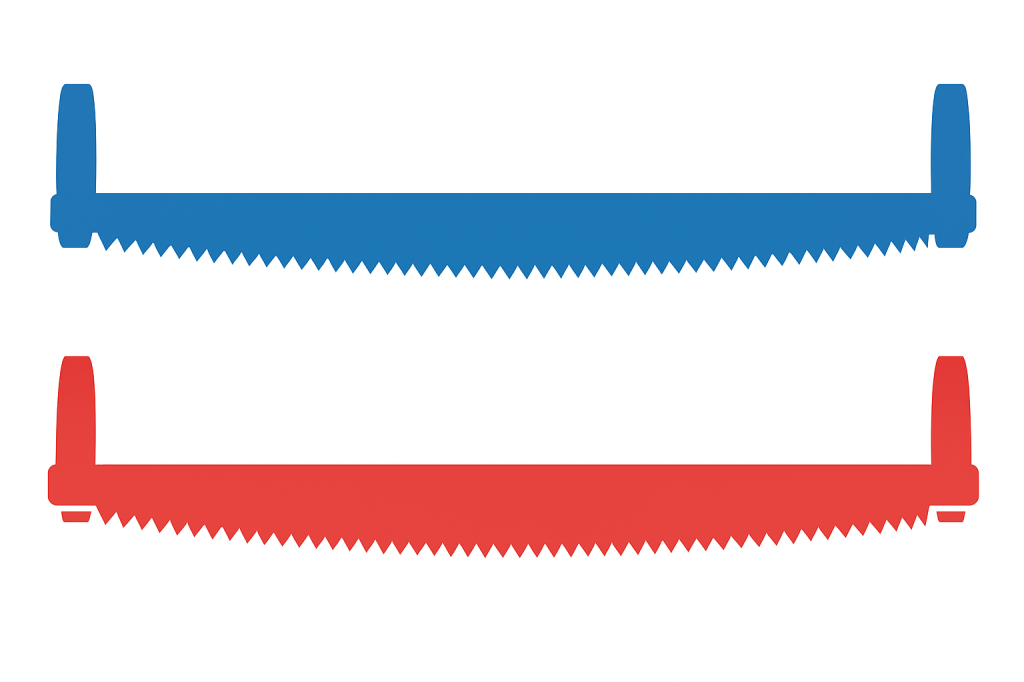
We have entered the whipsaw world. What does that mean? It means that once Project 2025 is fully enacted—an agenda designed to consolidate federal control, politicize civil service, and remake education, media, and justice—everything will snap back when the next administration takes office. The pendulum will not just swing; it will crack. When a new president arrives, most if not all of those policies will be canceled. The “opposite world” will emerge. All of the resources withheld will be released again, but this time pointed in the opposite direction.
We could also see a version of the whipsaw world in which entire states are sidelined. Imagine a future where Texas and Florida, long dominant in the share of federal funding they receive, suddenly find themselves on the margins, while blue-leaning cities in those states are granted direct allocations instead. Because mid-decade redistricting would leave those states with few, if any, Democratic legislators, no one within their own party would push back against a Democratic president’s decisions. In turn, Republican lawmakers could retaliate by asserting control over municipal functions, as they have in Houston and Fort Worth. Policy driven by political revenge is still policy—but it is no longer governance.
When forgiveness becomes punishment
Yesterday, I wrote about the new rule reshaping Public Service Loan Forgiveness, a new federal Department of Education regulation that would deny forgiveness to borrowers who work for nonprofits or governments that “don’t align” with the current administration’s political priorities. It’s an extraordinary precedent. A person’s eligibility for financial relief would no longer depend on their service or sacrifice but on whether their employer’s mission passes an ideological test.
That is a sign of the whipsaw world. Because in the next administration of a different party, the rule could simply reverse. Those very same organizations—immigrant-rights groups, public-health clinics, diversity programs—will once again be prioritized, while the current favorites for federal will lose their resources (e.g. ICE, corporate for-profit prison etc). Forgiveness, funding, and legitimacy will alternate every four years like a metronome of partisanship. That’s not a policy cycle. That’s political whiplash.
Ted Cruz and the broadcast warning
Even Senator Ted Cruz, rarely accused of fearing strong executive action, has recognized the danger. When reports surfaced that the Federal Trade Commission might consider revoking broadcast licenses Disney and other networks promoting “disinformation,” Cruz warned that this kind of political retribution “could just as easily be turned against conservatives.”
And he’s right. The whipsaw world cuts both ways. The tools of revenge rarely stay in one party’s hands for long. If conservatives can use the administrative state to punish political dissent or ideology today, progressives can use the same machinery tomorrow. The gears of government were designed for continuity, not combat. When every policy becomes a weapon, a republic begins to shake itself apart.
Redistricting and the Pandora’s Box
Another example of this dynamic just played out between Texas and California. In Texas, Republican leaders pushed through an aggressive redistricting plan that eliminated multiple Democratic congressional seats, a clear exercise of partisan advantage personally requested by Donald Trump. And in response, Gavin Newsom and California, responded in kind. On Election Day 2025, voters supported Proposition 50, a measure that paused the state’s constitutional amendment creating an independent redistricting commission, effectively handing redistricting power back to elected officials until the 2030s.
California’s message was clear: If Texas is going to play hardball, so will we. That’s the whipsaw world in motion—each side retaliating for the last move, escalating rather than stabilizing the system. What once would have been unthinkable—California dismantling a constitutional safeguard admired nationwide—now feels inevitable.
This is a Pandora’s box that doesn’t close.
This could be the end of restraint. For decades, Democrats were seen as the institutionalists—the party more willing to compromise, to protect the structures that preserve balance. But a new generation of leaders has emerged, shaped by years of obstruction, gerrymandering, and judicial hardball. They are no longer interested in preserving norms that the other side ignores. They are ready to go toe-for-toe, tit-for-tat, eye-for-an-eye.
Republicans, who have long treated politics as a contact sport, should have seen this coming. They expected Democrats to roll over. Instead, they’ve encountered a new breed of political realism that views power as something to be exercised, not politely shared. The result is incoming chaos. Because once both sides have the gloves off, there are no referees that will calm the game (not even the Supreme Court), only retaliation. The norms that used to hold the country together—restraint, predictability, respect for process—erode with each counterpunch to the face.
What the whipsaw world looks like
We don’t have to imagine the whipsaw world anymore. We are already living in it. Federal grants now threaten based on political ideology . Curriculum standards are rewritten not for learning, but for ideology. Cabinet members and civil servants are dismissed or promoted primarily through loyalty tests instead of competence.
This is what it looks like when politics replaces qualifications and principle as the operating system of government. So the whipsaw world actually isn’t a forecast—it’s a diagnosis. The question now is how long a democracy can survive when governance becomes a contest of vengeance rather than vision.
Each swing of the pendulum leaves behind more cynicism, more fatigue, and more lost talent. Public institutions and their employed shouldn’t function like campaign war rooms. They require trust that the rules will apply consistently, regardless of who sits in the Oval Office, or the Governor’s Mansion.
The cost of governing by grievance
Project 2025 envisions a federal government that bends entirely to one ideology’s priorities. But the reality is that the other political ideology will soon use the same blueprint in reverse. The civil service becomes a revolving door of retaliation; the administrative state turns into an ideological battlefield. That’s not reform—that’s fragmentation. Fully expect a Project 2029 from the Democrats.
In education, we will soon see how this dynamic erodes local control. One year, states will be encouraged to expand school vouchers; the next, they’re penalized for doing so. One year, colleges will be required to report diversity metrics; the next, they’re forbidden from collecting them. Students and educators become pawns in a national tug-of-war that has little to do with learning and everything to do with signaling loyalty. When equity itself becomes conditional, extended to allies and withdrawn from adversaries, we lose the moral foundation that once justified public investment.
A democracy built on steady hands
The framers of the Constitution did not design a system meant to be rewritten every four years. They built checks and balances to slow us down—to require consensus, reflection, and compromise. The whipsaw world defies that spirit. It turns governance into a series of executive edits. There is a better way forward.
Real equity requires stability. It demands rules that outlast administrations, funding formulas that respect need over ideology, and programs that reward service, not party affiliation. The measure of a mature democracy is not how forcefully it swings but how gracefully it steadies itself. Whether you call yourself conservative, progressive, or independent, the whipsaw world is bad news. When the criteria for opportunity depend on the color of your ballot or the language of your mission statement, we cease to be a republic of laws and become a republic of political mood swings.
The next administration will have every incentive to do exactly what this one has done, but in reverse. And each cycle will dig us deeper into distrust. Ted Cruz was right about one thing: the day you cheer for government to punish your opponents is the day you give that same power permission to punish you. When politics determines who is educated, who is forgiven, and who is funded, the whipsaw world wins. And in that world, no one—Republican, Democrat, or independent—comes out ahead.
Conclusion
The metaphor matters. The word whipsaw comes from the old logging camps, where two lumberjacks stood on opposite ends of a long saw, pulling it back and forth through a tree trunk. Each movement depended on opposition; neither side could stop without halting the cut. Over time, whipsaw came to describe any situation where opposing forces pull in violent alternation, where every swing of momentum cuts deeper into the center. In finance, it names investors who are lured one direction by hope and the next by fear. In politics, it can describe a nation caught in a cycle of retaliation that produces motion but no progress.
That’s where we are now. Every new administration will inherit not a mandate but a vendetta. Every act of reform comes prepackaged with retribution. The whipsaw world thrives on this rhythm—back and forth, cut and countercut—until institutions splinter and trust becomes sawdust. What once united citizens around shared governance and compromise has become a contest of punishment and reversal. And the longer this motion continues, the more we forget that the real work of democracy was never to master the blade, but to plant new forests of trust and possibility.
Please share.
Julian Vasquez Heilig is a nationally recognized policy scholar, public intellectual, and civil rights advocate. A trusted voice in public policy, he has testified for state legislatures, the U.S. Congress, the United Nations, and the U.S. Commission on Civil Rights, while also advising presidential and gubernatorial campaigns. His work has been cited by major outlets including The New York Times, The Washington Post, and Los Angeles Times, and he has appeared on networks from MSNBC and PBS to NPR and DemocracyNow!. He is a recipient of more than 30 honors, including the 2025 NAACP Keeper of the Flame Award, Vasquez Heilig brings both scholarly rigor and grassroots commitment to the fight for equity and justice.



 Cloaking Inequity
Leave a comment