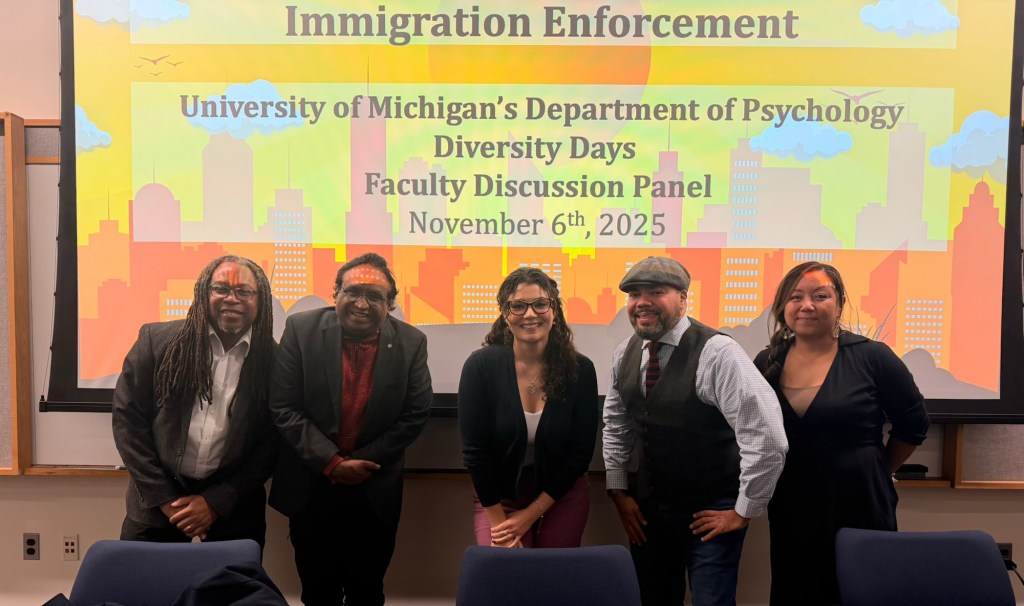
Last week I returned to the University of Michigan’s Department of Psychology, where I first began to understand how systems shape lives. Decades ago, as an undergraduate in Professor Lorraine Gutiérrez’s Community Psychology class, I learned something that still guides me: belonging is not just a feeling, it’s a structure. It can be built, or it can be denied.
That truth feels more urgent than ever. Across the country, new immigration crackdowns are reshaping what it means to be part of a community. The stories that reach the headlines—raids, detentions, families separated—only begin to capture the deeper toll. The real damage happens quietly, in the everyday decisions people are forced to make: a parent who skips a school event for fear of exposure, a student who hesitates to apply for aid, a worker who avoids reporting abuse. This is what it looks like when fear becomes policy.
Fear Is Not Just an Emotion—It’s a System
At the event Who Belongs? Shifting Landscapes in U.S. Immigration Enforcement, I joined scholars and advocates to explore the human cost of that fear. Enforcement doesn’t just remove people, it reshapes the way entire communities see themselves. When people live under constant surveillance, when they feel unsafe calling the police or visiting a doctor, belonging becomes conditional. You are accepted, until you aren’t. You are safe, until the next policy change.
Fear narrows possibility. It silences voices. It turns public spaces into private hazards. Even those with citizenship or legal status begin to internalize uncertainty, learning to shrink their presence to avoid attention. That erosion of confidence and trust is not a side effect, it is the goal of intimidation.
The Science of Belonging
Psychology teaches us that people need connection as much as air or water. When that connection is threatened, the body interprets it as danger. Stress hormones rise. Mental health declines. And slowly, the sense of possibility that drives human progress begins to collapse.
But what psychology also shows us is that belonging can be rebuilt. Trust can be restored. Fear can be unlearned through compassion, through shared courage, through community. That is why moments of collective care—when a city passes a welcoming policy, when a teacher protects a student’s privacy, when a neighbor shows up with resources—matter far beyond symbolism. They remind people that they still have a place.
Building Bridges Instead of Walls
The real test of our values is not how we treat people when it’s easy but how we treat them when it’s politically difficult. Universities, local governments, and communities have choices to make right now. They can either become bystanders to exclusion or builders of belonging.
Universities can ensure that undocumented and immigrant students are protected, not profiled. Cities can maintain local trust policies that prevent cooperation with federal enforcement except where required by law. Churches and community organizations can open their doors, not as acts of defiance but as declarations of dignity. Each of these choices becomes a beam in the structure of belonging.
Solidarity Is the Only Way Forward
When one group’s rights are stripped, every group’s rights become negotiable. History has shown us that the machinery of exclusion, once built, never stays confined to one community. The same systems used to target immigrants have been used to surveil activists, criminalize minor acts, and suppress dissent. If we allow fear to decide who belongs, eventually none of us will.
That’s why solidarity is not just moral, it’s practical. When Latino, Black, Asian, Indigenous, and white allies stand together, they remind us that justice is indivisible. The circle of belonging grows stronger when we expand it.
Coming Full Circle
Standing once again in East Hall reminded me why I began this journey. As a student, I learned that knowledge means little if it doesn’t serve humanity. As a scholar, I’ve learned that compassion means little if it doesn’t turn into action.
We cannot wait for perfect policies or the next election cycle to build belonging. We build it now, in our neighborhoods, our classrooms, and our workplaces—each of us choosing to replace suspicion with empathy and fear with solidarity.
In moments like this, when our nation again faces the temptation to divide, we must remember that democracy depends on inclusion. The promise of America was never about uniformity; it was about unity through difference.
So wherever you are, show up for someone today. Speak up when silence feels safer. Look up when the headlines make you want to look away. Team up with others doing the work. Never give up on our shared humanity. And always, always lift others up.
Because belonging isn’t just a structure—it’s a promise we keep, together.
Julian Vasquez Heilig is a nationally recognized policy scholar, public intellectual, and civil rights advocate. A trusted voice in public policy, he has testified for state legislatures, the U.S. Congress, the United Nations, and the U.S. Commission on Civil Rights, while also advising presidential and gubernatorial campaigns. His work has been cited by major outlets including The New York Times, The Washington Post, and Los Angeles Times, and he has appeared on networks from MSNBC and PBS to NPR and DemocracyNow!. He is a recipient of more than 30 honors, including the 2025 NAACP Keeper of the Flame Award, Vasquez Heilig brings both scholarly rigor and grassroots commitment to the fight for equity and justice.





 Cloaking Inequity
Leave a comment