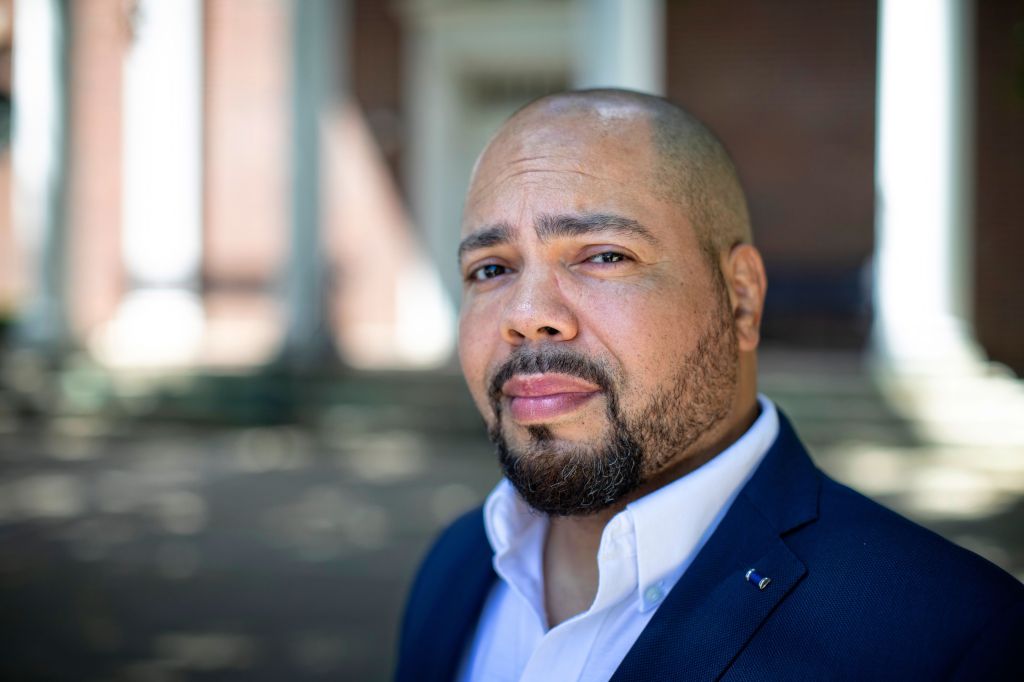
In 2000, while I was living in Texas and immersed in grassroots organizing with the Tejano Democrats, I was nominated to serve as a national delegate to the Democratic National Convention. At the time, I was working across Houston to register thousands of young voters, empowering a new generation to see themselves as participants in the democratic process. Those were long, hopeful days—door-to-door canvassing, community meetings, voter registration events, and late nights filled with strategy and purpose. When the Texas Democratic State Convention came around, it represented the culmination of months of hard work. Delegates from every corner of the state gathered to select who would represent Texas at the national convention for Al Gore’s campaign.
The process was competitive and intense. Each candidate made their case through interviews, speeches, and a review of their community involvement. I had built a reputation organizing and voter engagement, so I felt confident that my volunteer work for the Democratic Party spoke for itself. But as the final round of selection began, I was called into a small room with members of the delegate committee for one last interview. They had one final question. “Do you identify as Black?” one committee member asked. The question hung in the air. I could feel that the answer might determine the outcome. I smiled and replied, “There should be a box for Blaxican.” The room erupted in laughter, and the tension melted away. A few moments later, they thanked me, and that afternoon I was chosen as a Gore delegate to the 2000 Democratic National Convention in Los Angeles.
That short exchange remains etched in my memory because it revealed something enduring about how America understands identity. My life has never been a pie chart of percentages divided between Black and Latino. I am both, wholly and inseparably. Race and ethnicity are meaningful because they connect us to history, community, and shared experience.
Boundaries and Belonging
The history of race in the United States is the history of boundaries drawn for power. From the earliest colonial laws to modern systems of inequality, the story of America has been shaped by dividing lines. These lines dictated who could marry, who could learn, and who could lead. They created hierarchies meant to justify exclusion, turning difference into division. But human nature has always resisted these walls. Across generations, people have found ways to connect, love, and build families that defied the laws written to keep them apart.
Until the late 1960s, interracial marriage remained illegal in many states. When the Supreme Court decided Loving v. Virginia in 1967, sixteen states still made marriage between races a criminal act. Couples who loved one another risked prison for crossing the color line. Even after the Loving decision, the shadow of those laws lingered. Alabama did not formally remove its anti-miscegenation statute until 2000, the same year I served as a delegate. Even then, forty percent of voters wanted to keep it. That was not the distant past—it was the same era as the early internet, cell phones, and my own participation in national politics. This reality shows that racial boundaries were not relics of history; they were active forces shaping our society within living memory.
Education also carried this legacy of separation. Some private and religious universities enforced bans on interracial relationships into the late twentieth century. Bob Jones University famously prohibited interracial dating until 2000—again, the same year I was at the Texas convention— and defended that policy in court as a matter of religious freedom. Liberty University required parental permission for interracial dating in the 1980s, sending the message that relationships across race were still subject to control. These policies reflected not faith but fear, the fear that integration would expose the falsehood of racial hierarchy. Rather than embracing diversity as a source of strength, such institutions used moral rhetoric to maintain boundaries of belonging.
Counting and Classifying
Even the U.S. Census, a document meant to describe the nation, struggled to recognize the fullness of human identity. For most of its history, the Census allowed individuals to check only one box for race. Millions of people who embodied multiple identities were forced to erase part of themselves for bureaucratic simplicity. Only in the year 2000—again, the same year I was at that Texas convention—did the Census finally allow Americans to check more than one box. That small administrative change marked a quiet revolution. For the first time, people were officially allowed to exist in their full complexity if they so chose.
By 2020, nearly thirty-four million Americans identified as belonging to “Two or More Races.” That represented a fivefold increase from 2000, when only 6.8 million people did so. Behind those numbers are stories of families whose very existence defies historical boundaries. The data reflects an ongoing truth: American identity has always been plural, not singular. For centuries, people have crossed lines, mixed heritages, and expanded definitions of who belongs. The Census simply caught up to the reality that has always existed.
The act of checking more than one box was more than a data point, it was an act of self-affirmation. It gave people permission to chose who they are. It acknowledged that the American story cannot be told in monochrome. It is a tapestry woven from the migrations, struggles, and connections of millions. To embrace that truth is not to erase difference but to recognize that diversity has always been our foundation.
Science for the Public
Around that same time, I encountered research that would permanently alter how I viewed identity. I discovered the work of Dr. Spencer Wells, a population geneticist who led the National Geographic Genographic Project. His work traced human origins and migration patterns through DNA evidence. For the first time, this kind of genetic research was not confined to laboratories or academic journals. It was shared with the public. The project invited anyone to participate by submitting a DNA sample, allowing people to uncover the ancient journeys that connected them to the broader story of humanity.
Curiosity got the better of me, and I decided to take part. I sent in my DNA sample to National Geographic and waited. When my results arrived, I was stunned. My deep ancestry stretched across four continents. The map of my DNA revealed not just where my ancestors had lived, but how they had moved—migrating over oceans, deserts, and mountain ranges in journeys that carried both survival and story. Each line on the map represented centuries of adaptation and exchange. My heritage was not a straight line but a vast web of crossings, a living record of humanity’s constant movement. It reflected the winding paths of people who built civilizations, traded ideas, and carried cultures forward in their blood.
Seeing that map unfold before me was both humbling and illuminating. It showed that my identity was more than a collection of origins; it was a living bridge between worlds. My DNA contained traces of migrations that once connected early peoples across continents, long before borders or categories existed. It revealed that the same forces of curiosity, resilience, and adaptation that shaped humanity had also shaped me.
What struck me most was that this complexity did not dilute who I am—it deepened it. Each ancestral thread contributed to the tapestry of my story. I realized that the idea of purity was not only false, it was unimaginative. The beauty of identity lies in its interconnection, in how countless lives and lineages converge to create something new. Science had simply illuminated what life had already taught me: that belonging is not found in separation but in the shared inheritance of our global human family.
It was humbling and enlightening to see how deeply interconnected my lineage truly was. What had always been an intuition about the interconnectedness of humanity was now confirmed by science. My identity was not a contradiction of categories. It was a reflection of the human story itself.
The Genographic Project did something revolutionary: it gave science back to the people. It allowed ordinary individuals to see themselves not as isolated members of a race but as participants in the grand movement of human history. Dr. Wells’s work demonstrated that racial purity is not only a myth, it is a scientific impossibility. Every person carries within them the story of migration and mixture. These discoveries were not about dissolving identity. They were about deepening it. Understanding that our ancestry is global makes our local experiences richer, not smaller.
Fear of Mixing and the Fragility of Supremacy
If the science is so clear, why does the myth of racial purity persist? The answer is fear. Supremacy depends on separation. It needs walls to survive. When people love across those lines, marry across those boundaries, and build communities of connection, the illusion of superiority collapses. The ideology of purity relies on ignorance, on not knowing how deeply we are already intertwined.
The Nazis codified this fear through the Nuremberg Laws, banning marriage and sexual relations between Jews and non-Jews in the name of protecting “racial integrity.” In the United States, the Ku Klux Klan promoted similar laws, using terror to enforce segregation and suppress interracial relationships. Both movements understood the same truth: if humanity mixes, the racial power hierarchy dies. When people see themselves reflected in one another, supremacy loses its grip.
Today, that same fear manifests in conspiracy theories about “replacement” or “dilution.” These ideas claim that diversity threatens identity when, in truth, diversity strengthens it. The people who cling to purity do so not because they are confident, but because they are afraid. They sense that the old boundaries are eroding, and they do not know how to live without them. But the collapse of those boundaries is not a loss. It is progress. It is the fulfillment of what has always been true: that humanity is a single, interconnected family.
Commonalities and Connectors
When I reflect on my own journey, I see identity not as division but as connection. I am not half of one thing and half of another. I am whole. I am both Black and Latino, fully and proudly, and that fullness is what gives my story depth. My life is not a blending of contradictions but a meeting of continuities. It is a living reminder that history is not linear but intertwined.
Race and ethnicity matter because they represent shared histories, languages, and struggles. They provide us with cultural anchors and connect us to the people who came before. But they should never be used as walls to separate. Erasure and assimilation should never be the price we pay for acceptance. We should not have to flatten ourselves to fit into social expectations. Our uniqueness is not a complication. It is our contribution. Being allowed to live authentically means being allowed to be interesting, complex, and whole.
This is what I call our commonalities and connectors—the shared threads that unite us across geography and culture. They appear in the rhythms of music, the languages of love and prayer, and the everyday acts of kindness that transcend difference. These connectors remind us that diversity is not chaos but creativity. The more we embrace complexity, the stronger our collective humanity becomes.
Those who cling to racial supremacy do so out of fear of irrelevance. The future belongs to those who understand that identity can be fluid and full without being erased. Young people today are already living that truth. They are multiracial, multicultural, and multilingual. They are not bound by the old boxes, and their lives are proof that the idea of purity was always a fiction.
Conclusion
Race and ethnicity are important. They are vessels of memory, community, and pride. They connect us to our ancestors and give shape to our collective story. But they should never be used to discriminate, divide, or demand assimilation. They should be tools for understanding, not weapons of exclusion.
When I think back to that delegate interview in Texas in 2000, I realize that my answer—“There should be a box for Blaxican”—was more than humor. It was a declaration. Years later, when I encountered the work of Dr. Spencer Wells and saw that my DNA spanned four continents, I understood what that declaration truly meant. The science confirmed what experience had already taught me: we are one human family, connected by ancestry, migration, and imagination.
We are connected. We have always been connected. If we can learn to see those connections as strengths rather than complications, we can move beyond the myth of racial purity and into the deeper truth of our shared humanity, where belonging never demands erasure and identity never requires assimilation.
Julian Vasquez Heilig is a nationally recognized education policy scholar, civil rights advocate, and public intellectual whose career bridges research, leadership, and community action. He currently serves as a professor of educational leadership at Western Michigan University, where his work focuses on equity, leadership, and social justice in education. Over two decades, he has held senior academic leadership roles as provost, dean, and department chair, helping institutions expand access, strengthen community partnerships, and advance inclusion. His scholarship, much like his life story, reflects an enduring truth—that identity is not a limitation but a connection, and that our shared humanity is both the foundation and the future of democracy.


 Cloaking Inequity
Leave a comment