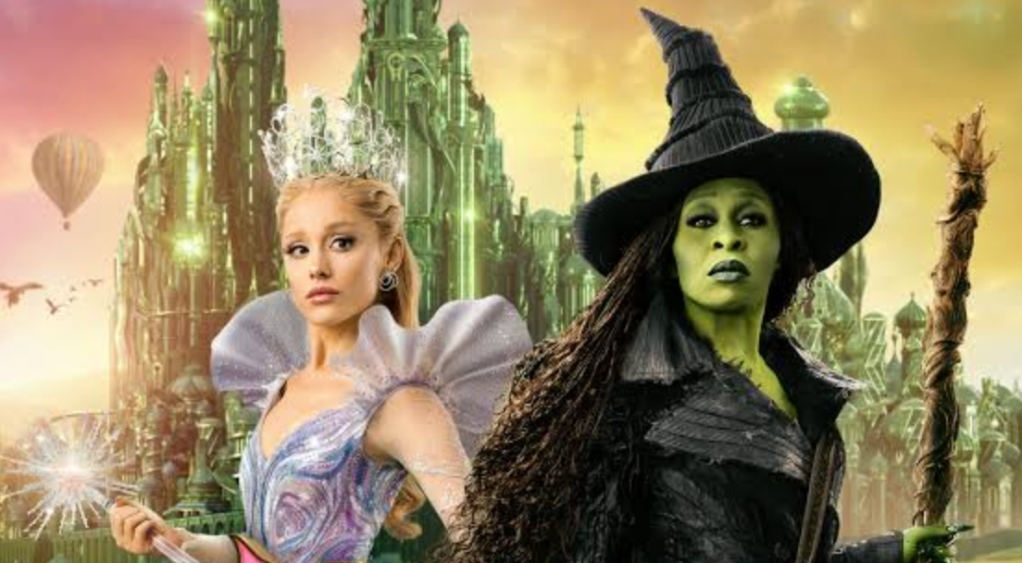
Wicked: For Good delivers a cinematic experience that deepens the mythology of Oz in powerful and unexpected ways. Seeing the film in 3D this past week heightened the magic and the emotional stakes, especially in moments involving character action, public ceremonies, and the sweeping landscapes that frame the story. What struck me most was not the spectacle but the way the film dissects the mechanics of public perception. Oz, usually presented in earlier incarnations as a whimsical world, becomes a study in political theater and controlled messaging. The story shows how easily an entire country can be guided into believing a narrative that serves only the people at the top.
The film challenges the assumed truth that the Wicked Witch of the West was evil, revealing instead that her reputation was crafted to protect the authority of those threatened by her integrity. Elphaba refuses to participate in the lies told by the Wizard’s administration, and her refusal becomes the very reason she is branded as dangerous. She represents a kind of honesty that fragile authoritarian leaders cannot tolerate. As misinformation spreads across Oz, the public accepts the story because it is repeated constantly and supported by staged theatrics. The truth becomes buried beneath repetition and fear.
In this light, Wicked Part Two becomes a meditation on the power of false narratives. The filmmakers demonstrate how propaganda can spread effortlessly in a society that is taught to value spectacle and conspiracy over inquiry. Through posters, broadcasts, and fear-based messaging, the Wizard’s government constructs a villain who never existed for political purposes. The film asks viewers to consider how many real world stories have been manipulated (e.g. immigration) to protect the political interests of the few. By dramatizing these dynamics, the narrative gives weight to Elphaba’s struggle and dignity to her resistance.
The Wizard and the Public Face of Manipulation
The portrayal of the Wizard, played by Jeff Goldblum, is one of the film’s boldest accomplishments. He is depicted as a man whose ability to stay in power rests upon deception, charm, self-promotion, and the ability to stir public emotion. His leadership depends on performance rather than principle, and he uses grand gestures to disguise the lack of substance underneath. He thrives when people react strongly to his presence, whether with admiration or fear. The more attention he receives, the more he believes he is entitled to shape the world around him.
As I watched him belittle women, manipulate crowds, and weaponize insults, I found it impossible not to think of Donald Trump. The Wizard’s behavior mirrors the public persona that has dominated American politics in recent years, especially the pattern of degrading women with comments about appearance, intelligence, and loyalty (e.g. Trump recent comments calling women piggy and stupid). Wicked: For Good captures the way powerful men use spectacle to distract from wrongdoing. The Wizard’s leadership style centers on self-protection, emotional volatility, and constant performance. His decisions are driven by ego rather than ethics.
The film also addresses the darker allegations surrounding him, and these revelations carry an unsettling weight. The Wizard engineers situations that allow him to exploit others, then works to discredit anyone who confronts him. The storyline exposes a pattern of predatory behavior and strategic denial, and it feels grounded because we have seen similar patterns unfold on the public stage in the US. This is not presented as a shock but as the natural outcome of a leader who built his power on illusion. The more the narrative unfolds, the more evident it becomes that the Wizard’s cruelty operates quietly beneath a theatrical surface.
The Machinery of Control and the Shadow of ICE
One of the interesting choices in Wicked: For Good is the depiction of the palace guards. They move with cold precision and enforce the Wizard’s authority with a discipline that leaves little room for humanity. Their presence in the story heightens the sense of surveillance and state control. In moments of public confrontation, their coordinated movements make the scenes feel charged and intimidating. The soldiers are not presented as villains but as instruments of a government that relies on fear.
There were scenes where the guards appeared so rigid and accustomed to unquestioned obedience that I almost expected them to be marked with ICE insignia. Their choreography, their posture, and the way they occupied space echoed images of modern enforcement officers whose authority is designed to overwhelm the public emotionally. The film uses their presence to underline how intimidation can become a political tool even before physical violence occurs. The guards symbolize the quiet machinery that props up authoritarian messaging. Their presence allows propaganda to operate with minimal challenge.
Through these soldiers, the story argues that authoritarian regimes depend on visible displays of force. The Wizard does not require constant brutality because the implication of power is enough to maintain control. The guards move like shadows of state authority designed to remind the public of their vulnerability. Their uniforms, their formation, and their silence serve as reminders of how fear is manufactured. This imagery transforms Oz into a world where even the background characters carry political weight.
New Layers for the Tin Man, the Scarecrow, and the World of Oz
For newcomers to Wicked, the origins of the Tin Man and the Scarecrow offer some of the most emotionally compelling moments in the film. Their transformations are not treated as magical accidents but as consequences of real human decisions made under pressure. This approach gives each character a history shaped by loss, connection, and unintended outcomes. Their stories feel grounded, even within a fantastical setting, because the film honors the emotional cost of their transformations. Each origin scene adds depth to the mythology of Oz.
The Scarecrow’s backstory reveals how fragile humanity becomes when people are pushed beyond their limits but choose courage. His transformation is heartbreaking because it emerges from desperation rather than destiny. The 3D presentation gives this moment a haunting beauty that lingers long after the scene ends. The film encourages viewers to rethink what the Scarecrow represents in the wider Oz canon. His origin forces the audience to carry the weight of passion in life.
The Tin Man’s arc is equally powerful and filled with unresolved emotion. His transformation is depicted as a tragic result of decisions made in haste and fear. It becomes clear that his quest for a heart in the traditional story is rooted in something much deeper than mechanical emptiness. The film frames him as a man who lost trust in a moment when everything changed too quickly to understand. This reinterpretation adds emotional resonance to a character who has long been treated as symbolic rather than human.
The Silver Slippers, Copyright Rules, and a Return to the Original Oz
One detail that surprised me was the absence of the ruby slippers. I was initially disappointed because the red shoes are so iconic in the cultural memory of The Wizard of Oz. Their vibrant color has become synonymous with Dorothy’s journey, and in a film filled with spectacular visuals, their absence is noticeable. After learning the reason, however, the choice became far more meaningful. MGM owns the exclusive rights to the ruby slipper design, which prevents their appearance in any production outside that specific copyright.
The filmmakers turned instead to the original 1900 novel, where the slippers were silver. This detail becomes a subtle reclamation of the earliest version of Oz in several camera closeups. The silver slippers carry a quieter symbolism and reflect the source material more faithfully. They also align with the film’s larger theme of truth versus illusion because they restore an element that was overshadowed by Hollywood tradition. Understanding the copyright context turns what appears to be a creative loss into a very thoughtful return to origins.
Their inclusion reinforces the idea that Wicked is interested in honesty, even in small details. The film carefully revisits the foundations of Oz and asks the audience to reconsider what they think they know. The silver slippers become a symbol of authenticity in a story dedicated to unveiling distortion. They ground the narrative in literature rather than nostalgia. This creative decision reflects the filmmakers’ desire to honor the past in a precise and intentional way.
Glinda’s Growth and the Meaning of True Leadership
Glinda the Good’s evolution is one of the film’s emotional anchors. At the start, she possesses charm and influence but lacks the courage to act independently. As the story unfolds, she is confronted with the weight of her silence and the consequences of her choices. The film positions her as a figure who must choose between comfort and authenticity. Her struggle adds depth to her eventual rise to leadership.
Throughout both films, the Grimmerie is presented as a book that only someone with full integrity can truly read. Magic in this story responds to character rather than talent. Glinda gains access to the book only when she decides to defend what is morally right, even when it threatens her standing. The moment she can read the Grimmerie is a turning point that feels earned. It marks her transition from passive participant to active protector.
Glinda’s arc shows that leadership is defined not by image but by conviction. Her decision to stand with the truth gives her the authority and magical ability she previously lacked. She becomes a reminder that silence can sustain injustice just as easily as cruelty can. By the time she steps into a new role at the end of the film, the audience understands the emotional cost of her transformation. Her growth becomes an essential counterpoint to the Wizard’s false power.
A Final Reflection on Wicked Part Two
Wicked: For Good succeeds because it refuses to accept the inherited myths of Oz. It exposes the political motives behind public narratives and challenges the easy labels of hero and villain. The film shows how misinformation, spectacle, and state power can combine to control an entire population. Its 3D presentation draws viewers into the world, but its emotional and political honesty gives it lasting relevance. It becomes a story about the dangers of accepting too little information from too few sources.
Elphaba emerges as a figure of integrity whose resistance to corruption defines her legacy. She becomes a symbol of honesty in a world built on illusion. Her refusal to accept lies becomes the reason she is targeted. The film reveals that calling her wicked was a political decision, not a moral conclusion. Her story asks audiences to reflect on how often society creates villains out of convenience.
For viewers drawn to stories about truth, corruption, and the power of personal conviction, Wicked Part Two offers a rich and compelling experience. It reveals what happens when a society becomes more interested in spectacle than truth, and it pushes the audience to look more carefully at the stories they inherit without realizing it. The film’s reimagining of Oz shows how narratives can be manipulated, how villains can be created from thin air, and how easily a fearful public can be steered toward convenient enemies. I give the film 4 stars for the way it braids character, history, and political insight into a story that feels surprisingly grounded.
It leaves viewers with a question that lingers long after the final scene. When those in power decide they need an enemy, how far will they go to invent one?
Dr. Julian Vasquez Heilig, who earned his degrees from Stanford University and the University of Michigan, has spent a lifetime returning to the world of Oz with curiosity and affection. He has seen the 1939 Wizard of Oz at least twenty times, loved The Wiz as a kid, and has likely watched every Oz film ever produced because each version adds a new layer to the mythology. His deep interest in truth telling and narrative power also shapes his public scholarship. Through his long running education policy blog Cloaking Inequity and his Without Fear or Favor newsletter on LinkedIn, his writing reached nearly two million views in 2025. He has always been drawn to stories that question inherited narratives, expose the mechanics of power, and reimagine familiar worlds through a more honest lens. Wicked expands the Oz universe with depth, integrity, and political clarity, offering an experience that honors the original material while challenging audiences to think more critically about truth, reputation, and who gets labeled a villain. For him, the story endures because it shows that the myths we accept are not always the truth and that sometimes the so called villain is simply the person who refused to lie.



 Cloaking Inequity
Leave a comment