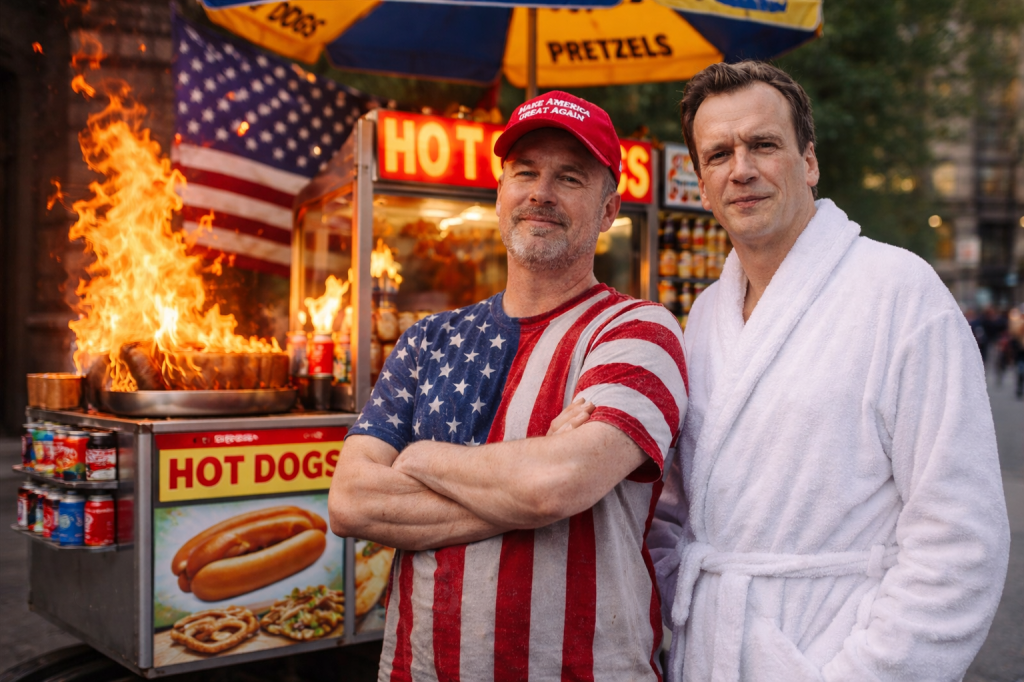
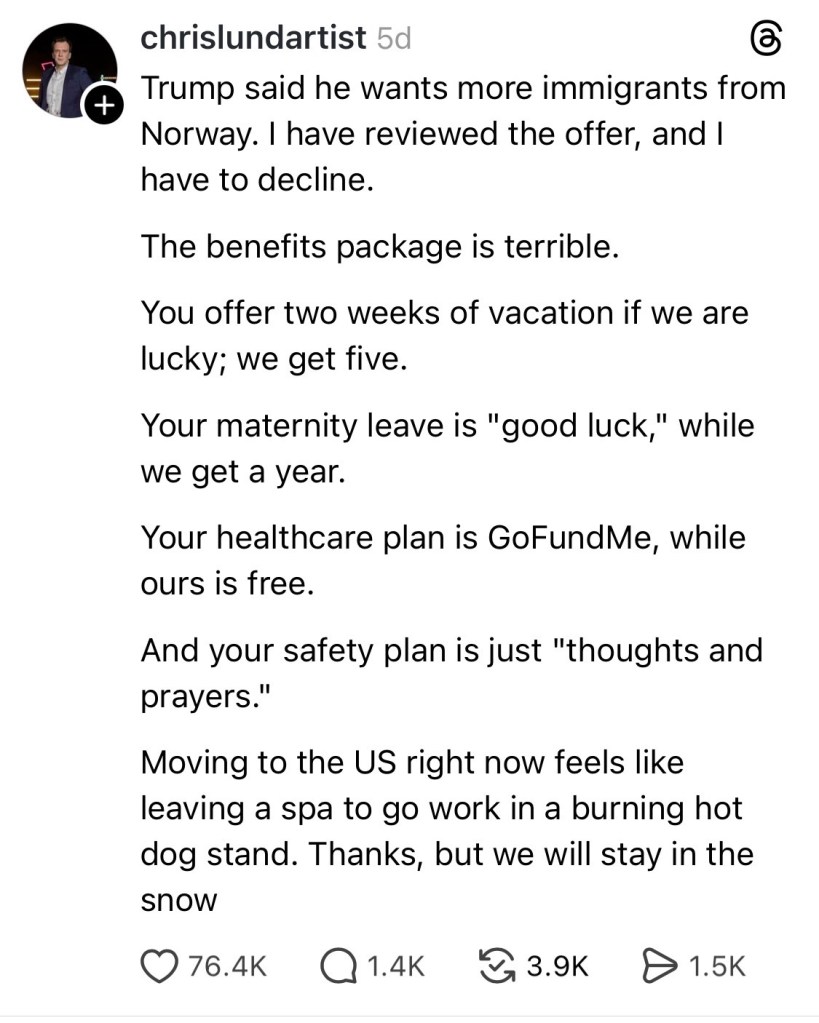
When I read Chris Lund’s social media post publicly declining the idea of moving to the United States, his words landed not as provocation but as clarity. I did not know who he was at the time, but he is an artist living in Norway. His post surfaced in response to Donald Trump’s widely reported comment inviting immigrants from Norway, Sweden, and Denmark to the United States because, in Trump’s words, he did not want people from “sh_thole countries” in Africa. Lund’s refusal was disarmingly simple. Why would anyone leave a spa for a burning hot dog stand?
Lund’s response was blunt, humorous, and devastatingly precise. The benefits package in the United States is terrible. The social contract is threadbare. The risks are high and the protections are low. His now widely shared comparison, that moving to the United States feels like leaving a spa to work in a burning hot dog stand, struck a nerve because it did not exaggerate. It described a reality that millions of Americans quietly recognize and that many non-Americans increasingly refuse to romanticize.
This was not anti American rhetoric. It was comparative reasoning. Lund did not argue that the United States lacks talent, creativity, or ambition. He argued that the tradeoffs no longer make sense. For people living in Northern European countries (e.g. Denmark, Norway, and Sweden) with strong labor protections, universal healthcare, meaningful parental leave, and baseline public safety, the United States now looks less like a destination and more like a risk exposure. That distinction matters. Immigration has always been about tradeoffs. What is new is how lopsided those tradeoffs have become.
The Myth of the American Benefits Package
For decades, the United States sold itself as a place where hard work compensated for weaker public systems. The promise was straightforward. You may not get much from the state, but you will earn more, advance faster, and build wealth. This American Dream story still circulates, but it collapses quickly when compared to lived reality in other countries.
Two weeks of vacation is not a perk in most of the advanced industrialized world. It is a warning sign. In many European countries, five weeks of vacation is standard and protected by law. Time off is not framed as indulgence but as a requirement for long term productivity and health. In the United States, vacation remains discretionary, fragile, and culturally suspect. People do not ask how much time off you get. They ask whether you are allowed to use it.
Parental leave reveals the gap even more starkly. In much of Europe, a year of paid leave is not considered generous. It is considered responsible. In the United States, new parents assemble time off from sick days, unpaid leave, savings, and hope. The message is unmistakable. Family and children are treated as a private inconvenience rather than a shared public good. Chris Lund did not need to dramatize these facts. He simply stated it. The shock is how ordinary it sounds to people outside the United States.
Healthcare as a Moral Divider
Nothing exposes the divergence between the United States and its peers more clearly than healthcare. In most of Europe, healthcare is a right attached to citizenship. It is predictable, bureaucratic, and reliable. You get sick, you receive care, and you do not lose your home or your future in the process.
In the United States, healthcare is a financial product. It is tied to wealth, employment, renegotiated annually (usually not for the better), and shaped by exclusions, deductibles, co-pays, networks, and denials. GoFundMe pleas on social media have become an informal extension of the healthcare system, a crowdsourced safety net that reveals both American generosity and systemic failure. When medical bankruptcy is common, it stops being a personal misfortune and becomes a structural indictment. For a Norwegian like Lund, the calculation is simple. Why accept a system where illness threatens financial ruin when you already live in one where it does not. No salary increase compensates for that level of risk once you have experienced something better and more reliable.
Safety, Guns, and the Cost of Denial
The sharpest line in Chris Lund’s response may also be the simplest: Your safety plan is thoughts and prayers. The sentence lands because it describes a uniquely American ritual of denial. Mass shootings are followed by mourning language instead of policy action. Elected officials offer condolences as substitutes for change. Grief is ritualized, televised, and then folded back into normal life without altering the conditions that produced it.
This pattern has repeated itself for decades. Columbine shattered the illusion that mass shootings were rare anomalies. Sandy Hook destroyed the belief that wealthy elementary children were somehow beyond the reach of gun violence. Each moment was described as a turning point. Each was followed by silence, paralysis, or symbolic gestures that left the underlying system intact. More recently, a shooting at Brown University this past week served as another reminder that no space is exempt. Schools, universities, grocery stores, movie theaters, dance clubs, and places of worship have all been absorbed into the geography of American gun risk.
In the absence of state and national policy, the responsibility to respond is shifted downward. Schools rehearse lockdown drills that double as trauma training. Teachers are asked to think like security personnel. Parents perform daily safety calculations that parents in many other countries never have to consider. Children learn, implicitly and explicitly, that gun vulnerability is part of American citizenship. This is not resilience. It is normalization.
Northern European countries are not violence-free. But they treat public safety as a collective responsibility rather than an individual burden. They regulate access to lethal weapons. They study patterns. They revise laws when evidence demands it. When something breaks, they attempt to fix it. In the United States, gun violence has been reframed as an unavoidable cost of freedom rather than a policy choice that can be revisited.
Choosing not to move into this environment is not cowardice or weakness. It is rational self-preservation. When a society repeatedly refuses to act on what it knows, politicians have to eventually stop arguing and start making decisions about the gun issue.
The Unspoken Caveat: Wealth Changes Everything in America
There is an unspoken qualifier beneath nearly every defense of American exceptionalism. If you are a millionaire or billionaire, many of these problems are manageable or invisible. Private healthcare neutralizes risk. Paid leave can be self funded. Safety becomes a matter of body guards, gated communities, and controlled environments.
For everyone else in America, these are not abstract policy debates. They are daily calculations about illness, childbirth, debt, time off, and physical safety. The United States works remarkably well for people who can insulate themselves from its failures by making it rain money. For the majority, it requires constant improvisation in the absence of a declining American social contract.
Why Americans Are Looking Outward
Americans are increasingly exploring dual citizenship and long-term residency abroad. Europe, Mexico, Costa Rica, and parts of Latin America are not being pursued as romantic escapes or lifestyle experiments. They are being evaluated as risk-management strategies in an era defined by volatility. Citizenship is no longer only about identity or heritage. It has become a form of insurance against instability in healthcare, governance, and economic security.
The irony is difficult to miss. For generations, the United States drew people fleeing uncertainty, corruption, and fragile institutions. It marketed itself as a place where rules held, systems functioned, and opportunity could be planned across a lifetime. Today, Americans themselves are scanning for exit ramps, not because they lack patriotism or ambition, but because the instability and risk they were told to associate with elsewhere has begun to feel internal, structural, and increasingly normalized.
There is a reason so many Americans now live in Costa Rica, Mexico, and many other countries around the world. These movements are not trends or acts of wanderlust. They are responses to lived experience. I am personally exploring Italy and Mexico, not as an act of escapism, but as a sober assessment of healthcare access, long-term affordability, legal stability, and quality of life. For many Americans, daily life in the United States has become more expensive, more precarious, and less humane, even as it demands more labor, more stress, and greater personal risk. Leaving is no longer framed as abandonment. It is framed as relief.
Trump, Norway, and the Geography of Denial
When Donald Trump said he wanted more immigrants from Norway et al., he unintentionally exposed the contradiction at the center of American immigration rhetoric. Countries like Norway do not send large numbers of people abroad because their systems work. People stay because staying makes sense. Economic security is predictable. Healthcare is treated as a public good. Social trust is reinforced by institutions that function with consistency rather than spectacle.
You cannot selectively admire the outcomes of high-functioning social Northern European democracies while rejecting the policies that produce them. The stability, health, and productivity associated with countries like Norway are not accidents of culture or climate. They are the result of deliberate choices about taxation, labor protections, public investment, and the social contract. People are not detachable from the systems that shaped them, even when political narratives pretend otherwise. This is the geography of denial. Leaders praise the people of certain countries while condemning the very ideas that make those countries livable. It allows admiration without accountability and aspiration without imitation. Norway becomes an abstraction, a rhetorical prop, rather than a model that demands honest comparison.
Chris Lund’s refusal to move to the United States cuts through that denial with clarity. His response did not rely on ideology or outrage. It relied on comparison. By naming the gap between what America promises and what it delivers, he exposed an uncomfortable truth: if we truly wanted to build a society that attracts people the way Norway does, they would have to reckon honestly with the systems we continue to reject.
The spa metaphor resonated not because it was cruel, but because it was familiar. It captured exhaustion rather than arrogance. Once you have experienced a society that treats rest, care, and safety as built-in features rather than optional perks, voluntarily trading them for chaos, stress, and precarity feels less like ambition and more like poor decision making. No amount of patriotic branding makes the burning hot dog stand feel acceptable once you have enjoyed the spa.
The United States still has real strengths. It generates ideas at scale. It attracts talent. It rewards risk and reinvention. But power without protection loses its appeal. Innovation without care produces burnout faster than breakthroughs. Freedom without safety becomes a slogan rather than a lived reality, impressive in speeches and hollow in daily life.
For generations, American politicians have relied on a familiar distraction. When systems strain, immigrants are blamed. When wages stagnate, immigrants are blamed. When healthcare collapses, housing becomes unaffordable, or work hours becomes unsustainable, immigrants are blamed. This tactic is as old as American politics itself, and it has always been easier than admitting that their policy choices are enriching a few while leaving many behind.
Under Donald Trump, this strategy is being pushed to a more punitive and cruel levels. Rhetoric hardened into billions for policy, and policy enforced through public displays of cruelty by ICE is meant to signal strength rather than solve economic problems. Immigration enforcement has become a stage for intimidation for all Americans. Recent Supreme Court decisions have empowered racial profiling and aggressive enforcement, blurring the line between noncitizens and citizens in everyday life. The result is a system in which people are being questioned, detained, or brutalized in public spaces by ICE based on appearance, accent, or assumption.
This is not accountability. It is deflection. Immigrants did not dismantle labor protections, hollow out public services, or normalize insecurity as a feature of economic life. They did not design tax codes that reward extraction over contribution or policies that treat burnout as a personal failure rather than a systemic outcome.
But, I truly believe scapegoating will not suffice this time. People are looking around and looking forward to the midterms. They are comparing experiences with friends, colleagues, and family living elsewhere. They are noticing that immigrants did not make the choices currently shaping American life. Blame can travel only so far before reality catches up. It is not a culture war skirmish. It is not a matter of taste, temperament, or ideology. It is about policy. And until those policies change, Northern Europeans and others will keep doing the same quiet math Chris Lund did, looking at the spa, looking at the burning American hot dog stand, and deciding that the heat of the hot dog stand is not the same thing as the warmth of the spa.
Julian Vasquez Heilig is a nationally recognized policy scholar, public intellectual, and civil rights advocate. A trusted voice in public policy, he has testified for state legislatures, the U.S. Congress, the United Nations, and the U.S. Commission on Civil Rights, while also advising presidential and gubernatorial campaigns. His work has been cited by major outlets including The New York Times, The Washington Post, and Los Angeles Times, and he has appeared on networks from MSNBC and PBS to NPR and DemocracyNow!. He is a recipient of more than 30 honors, including the 2025 NAACP Keeper of the Flame Award, Vasquez Heilig brings both scholarly rigor and grassroots commitment to the fight for equity and justice.




 Cloaking Inequity
Leave a comment