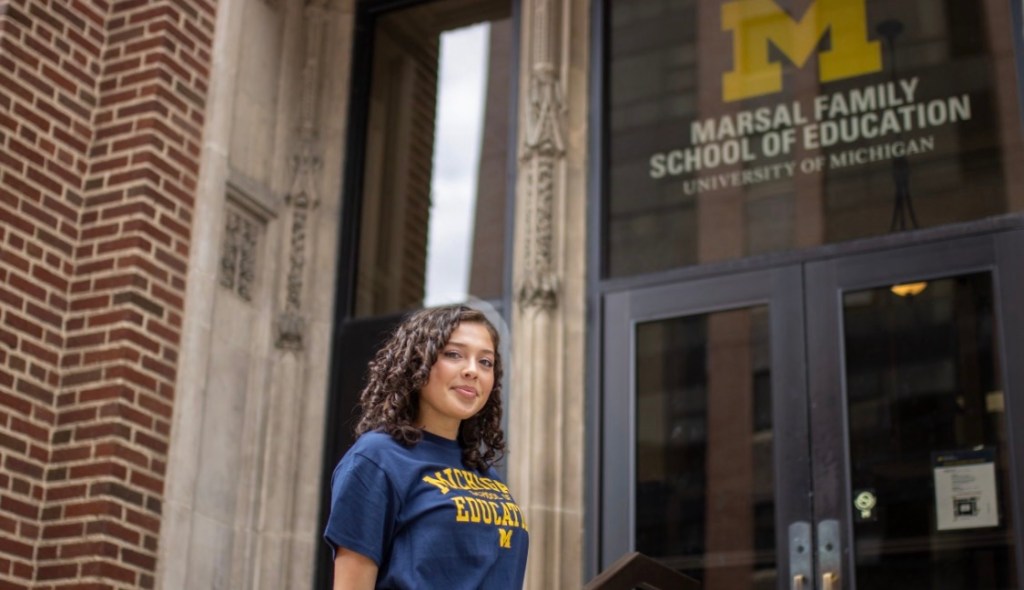
Yesterday, my daughter Lucia was admitted to the University of Michigan, and I cried for hours. I did not expect that kind of reaction, but it came anyway, uninvited and unstoppable. It was not a single wave of emotion. It was layer after layer of memory, relief, fear, pride, and gratitude colliding all at once. I cried in in the afternoon, and again late at night when the house was quiet. I cried because something had closed and something else had opened, and both moments carried weight.
I cried because this was not just an admission letter. It was confirmation that Lucia would become a third-generation Wolverine, and that kind of continuity is never guaranteed. Every generation risks being the one where the line breaks. I cried because I know how fragile opportunity can be, even when people work hard and do everything right. I cried because I could suddenly see her future expanding outward, filled with responsibility as much as possibility. Joy was there, but so was reverence.
What also overwhelmed me was knowing where she was admitted. Lucia was accepted into the Learning, Equity, and Problem Solving for the Public Good program at the Marsal Family School of Education. LEAPS is not a program designed to reward ambition. It is designed to cultivate responsibility. It is built on the idea that learning should serve communities and that leadership should be accountable to the public good. Watching my daughter step into that space cracked something open in me.
Fire, Responsibility, and the Weight of Choice
In Greek mythology, Prometheus steals fire from the gods and gives it to humanity. Fire is not just warmth or light. It is knowledge, creativity, and the ability to shape one’s own future rather than simply endure what is given. Prometheus understands that withholding fire keeps people dependent and vulnerable. He also understands that bringing it down will come at a cost he cannot avoid.
What has always stayed with me about Prometheus is not the theft itself, but the intention behind it. He does not bring fire for glory or recognition. He does not do it to prove he is clever or powerful. He does it because he believes people deserve access to what has been hoarded. His leadership is rooted in belief rather than ambition. That distinction matters more the older I get.
Prometheus knows he will be punished, and he chooses the act anyway. He does not ask whether the gods will approve. He asks whether humanity can thrive without fire. That question sits at the heart of community-centered leadership. Who bears the cost when knowledge is withheld. Who pays the price when comfort is preserved at the expense of dignity. Prometheus answers by stepping forward and accepting the consequences himself.
When Courage Becomes Uncomfortable
For a long time, I carried a simplified version of Martin Luther King Jr. in my head. He was revered, quoted, celebrated, and safely distant. Then I learned in an African American leadership class at the University of Michigan as an undergraduate how unpopular he became later in his life, and it unsettled me deeply. As King spoke out more forcefully against the Vietnam War and economic injustice, his approval ratings collapsed. He lost support not only among white Americans, but among African Americans as well.
This was not because he abandoned his values. It was because he expanded them. He refused to separate racial justice from economic justice. He refused to ignore the moral cost of war. He insisted that dignity could not be compartmentalized. In doing so, he made people uncomfortable, including people who once admired him.
That realization changed how I understand leadership. King was not rejected because he lost clarity. He was rejected because he gained it. He carried fire into places that preferred darkness disguised as stability. He understood that popularity is often the first casualty of honesty. That lesson feels especially relevant now.
Institutions That Choose Courage
I remember learning, while I was faculty at Sacramento State, that our university was one of the few places where King was welcomed to speak during that period. That detail stayed with me, quietly but persistently. It reminded me that courage is not only an individual trait. Institutions choose who they welcome and who they silence. Those choices shape history.
Sacramento State did not have to open its doors to King. Many campuses did not. Some cited safety. Others cited neutrality. Still others simply chose comfort. Sacramento State chose to listen and engaged. That choice mattered then, and it still matters now.
Institutions reveal their values when ideas challenge comfort. Neutrality in moments of injustice is not neutral at all. It is a decision to protect the status quo. Welcoming King required accepting risk and criticism. It required aligning values with action. That lesson has followed me throughout my career in education.
A Sentence That Would Not Let Go
While reading Lucia’s application materials, one sentence stayed with me long after I closed the document. It was a quote she included from King, spoken at Michigan’s Hill Auditorium in 1962. Every person is heir to a legacy of dignity and worthiness. The words are simple, but they carry a radical demand.
Dignity, in that framing, is not something granted by institutions or earned through approval. Worthiness is not conditional on performance or proximity to power. It is inherited by virtue of being human. That idea disrupts systems built on hierarchy and exclusion. It demands that education do more than sort people into winners and losers.
Seeing that quote in Lucia’s application connected past and present in a way that felt overwhelming. It tied Michigan’s history to her future. It reminded me that institutions can be vessels for moral inheritance when they choose to be. That sentence felt like a quiet promise and a heavy responsibility at the same time.
What LEAPS Teaches About Fire
Michigan’s LEAPS is built around the belief that learning should serve the public good. It centers equity not as a talking point, but as a practice that requires discipline, humility, and courage. It asks students to understand systems before trying to fix them. It teaches that problems are rarely technical alone. They are social, historical, and deeply human.
What makes LEAPS different is how it positions students. They are not passive recipients of knowledge. They are co-creators responsible for how knowledge is used. Lived experience matters. Narrative matters. Data matters. History matters. Learning happens in relationship with community rather than in isolation from it.
LEAPS does not promise students intellectual comfort. It promises preparation in a world being dominated by AI. It prepares students to sit with complexity and conflict. It prepares them to face resistance when they challenge systems that benefit from inertia. In that sense, LEAPS is about learning how to carry fire without dropping it or turning away when it burns.
Lucia and the Choice to Carry Fire
This is where Lucia and Prometheus meet. Lucia did not choose the easiest path. She chose a program that asks more of students than performance. She chose a space that insists on accountability to community. She chose learning that comes with responsibility.
As her father, I see in her the willingness to step toward complexity rather than away from it. I see her understanding that education is not about personal advancement. It is about what you do with what you are given. That orientation did not appear overnight. It was shaped by listening, witnessing, and engaging with the world as it is.
Prometheus carries fire knowing it will burn. Lucia is learning how to carry fire knowing it will challenge her. That does not mean seeking suffering. It means accepting responsibility. It means refusing to look away when knowledge demands action. It means understanding that dignity is not abstract, but built through decisions made every day.
At Night the Tears Returned
Late last night, after the messages slowed and the house finally went quiet, the tears returned. These were now not tears of surprise or release. They were steadier, fuller, and shaped by resolve. I thought about the unstable world Lucia is stepping into and the fire she will be asked to carry. I thought about how rare it is to be invited into spaces that demand both courage and care. I felt gratitude for the people and ideas that will surround her and challenge her to grow with integrity. I felt hope that is not blind or naive, but grounded in preparation, purpose, and community.
This kind of hope does not deny difficulty. It looks directly at it and still chooses commitment. It is the hope that understands dignity is not symbolic, but something built through daily decisions. It is the hope that asks young people not simply to succeed, but to serve. It is the hope that believes education can still be a place where moral responsibility is cultivated rather than avoided. That hope is what steadied my tears.
Yesterday was emotional because it marked a crossing. Lucia is stepping into a space that asks her not just to learn, but to lead. Not just to absorb light, but to bring it into places where it is needed. I cried because I could see the fire already in her hands. And I cried because I know that once you accept the responsibility of carrying fire, you are changed forever. There is no return to innocence, only movement forward with purpose.
Carrying It Forward
Prometheus reminds us that progress always carries a cost. King reminds us that moral clarity often brings rejection before recognition. LEAPS reminds us that universities can still prepare people to face those realities with honesty rather than retreat from them. These stories do not compete with one another. They belong to the same moral lineage. Each affirms that dignity is worth defending even when it is inconvenient.
My hope is that Lucia carries fire with courage and humility. That she understands its power without being consumed or overwhelmed by it. That she brings light not for recognition, but for community. That she remembers fire is meant to be shared, not hoarded. And that she empowers others towards their own inheritance of dignity and worthiness.
Yesterday, I cried for hours because I could see all of that coming into focus at once. Pride, fear, responsibility, and hope braided together into something larger than any single moment. Fire does that. It reveals what matters and clarifies what must be done. Once the fire is yours to hold, turning away is no longer an option. The only question left is where you will bring it.
Julian Vasquez Heilig is an educator, scholar, and father committed to community-centered leadership and public purpose education. A third-generation Wolverine family, his work sits at the intersection of equity, policy, and institutional responsibility. He writes about leadership, dignity, and the moral choices that shape schools and communities, often drawing from lived experience, history, and faith in the next generation. He believes education should prepare people not just to succeed, but to serve.




 Cloaking Inequity
Leave a comment