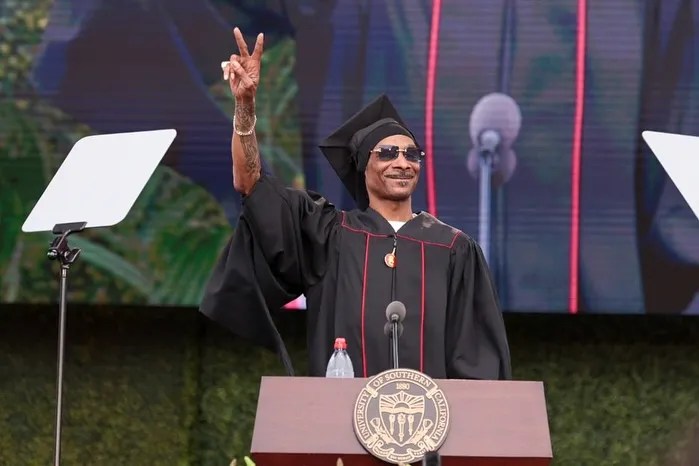
In a University of Southern California graduation address, Snoop Dogg offered a statement that feels increasingly urgent in the age of artificial intelligence. The world does not need more copies. It needs originals. What might sound like cultural commentary is, in fact, strategic advice for navigating a rapidly changing economy and technological age. As AI systems become more capable of reproducing just about everything, the premium shifts away from simple replication and toward originality. The more machines can copy, the more valuable human creativity becomes.
AI excels at pattern recognition and recombination. It draws on existing data, existing language, existing art, and existing assumptions to produce outputs that feel new but are fundamentally derivative. AI can organize, accelerate productivity and scale, but it cannot decide what matters or why something should exist in the first place. Meaning, values, and imagination still originate with humans. In that sense, AI magnifies rather than diminishes the importance of original thinking.
This shift has real consequences for individuals and institutions alike. In an environment saturated with competent, maybe elegant copies, standing out requires more than technical use and proficiency. It requires judgment, synthesis, and the courage to pursue ideas. Originality becomes a form of advantage, not because it is fashionable, but because it is new and different. The future will reward those who can go beyond what can be made that already exists.
Lessons from the Classic Coke Debacle
History offers clear examples of what happens when imitation replaces identity. I remember vividly in the mid-1980s when Coca-Cola made a decision grounded in desire and supposition. Their blind taste tests suggested to them at the time that consumers preferred a sweeter flavor profile closer to that of Pepsi. Acting on this information, Coca-Cola in dramatic fashion reformulated its flagship product and released “New Coke.” From an analytical standpoint, the decision made sense. But from a smart human perspective, it didn’t.
What the data captured was taste in isolation. What it failed to capture was cultural meaning. Consumers did not experience Coca-Cola merely as a beverage; they experienced it as a symbol, a memory, and a human constant. When “New Coke” replaced the original formula, the backlash was immediate and emotional. People were not rejecting optimization. They were reacting to the feeling that the company had abandoned its biting taste.
Coca-Cola’s rapid reversal and the reintroduction of “Classic Coke” restored trust precisely because it reaffirmed who the brand was. A drink that slapped you across the face after every sip. The lesson wasn’t that data is dangerous or that innovation is misguided or never appropriate. It was that analysis cannot simply substitute for clarity of identity. Tools can inform decisions, but they cannot define the origin purpose. AI can organize thoughts and originality, but it always cannot come to the table with ideas that slap you across the face.
Originality Before Recognition: The Enduring Example of Van Gogh
History in the art world offers a poignant illustration of the cost and value of originality. When I was younger, touring Europe with Contiki, I visited the Van Gogh Museum in Amsterdam and stood in front of one of his Sunflowers. It was the moment I fell in love with his work. Just last week, decades later, I trekked to the MoMA in New York, looking at Starry Night. Vincent van Gogh spent his life creating work that defied the artistic norms of his era. His use of color, texture, and emotion unsettled many contemporaries. The work did not fit neatly into prevailing tastes or expectations, and during his lifetime it was largely ignored or dismissed. He sold almost nothing, and recognition did not come quickly or easily. What endured was not difference for its own sake, but his originality.

Van Gogh faced a choice that many creatives confront. He could have softened his style, imitated popular trends, or reshaped his work to gain acceptance. He did not. Instead, he remained committed to his way of seeing the world, even as it isolated him professionally and socially. That commitment came at a profound personal cost, but it preserved the integrity of his work. Standing in those museums years apart, I was struck by a familiar lesson: originality often looks like failure before it looks like legacy.
Today, Van Gogh’s paintings are among the most recognizable and influential in the world. What was once rejected is now foundational. His story reminds us that originality often precedes recognition by years or even generations. AI tools can help organize ideas, sharpen expression, and clarify meaning, but they cannot supply vision. What makes work distinctive still comes directly from the human source. Originality comes first. Recognition follows, if it comes at all.
Early Decision as a Tool for Commitment in a Mass Application Era
The importance of having originality is not limited to art and business. It is increasingly visible in higher education. I remember when I applied to college, applications were filled out by hand on paper forms. Decisions arrived weeks or months later in the mailbox, postcards for rejections and thick envelopes for acceptances. Today, students refresh portals and scan emails for subject lines, sometimes greeted by animated confetti signaling good news. The process has become easier, faster, and more accessible, but it has also changed how students approach the act of applying.
The rise of application platforms like the Common App has fundamentally altered student behavior. Applying to college is now easier, faster, and less costly, in part because many institutions distribute application fee waivers widely to increase application volume. As a result, students apply to more institutions, often submitting highly similar applications with limited differentiation. What was once a deliberate process has become, for many applicants, a numbers exercise.
This increase in volume has created new challenges for higher education. An offer of admission no longer reliably signals a student’s intention to enroll. Yield has become harder to predict, and institutional planning has grown more complex. Early Decision (ED) has emerged as one of the few mechanisms that restores clarity for universities because it requires students to enroll if admitted. Because a student can apply ED in the fall of the application cycle to only one institution and the agreement is binding, it forces prioritization rather than hedging (Note: Although, there are important critiques about how ED negatively impacts student financial aid. This is a topic for another day). For institutions, this signal of intent is critical. For students, it requires reflection and alignment.
Some universities have responded with admissions strategies that reflect institutional identity rather than scale alone. Northeastern University built its approach around experiential learning and cooperative education, reinforcing a clear and coherent mission. Tulane University has adopted a different strategy by using free applications and Early Action broadly and then deferring many applicants while inviting them to apply ED II to gain guarantee yield. This structure creates a deliberate moment of choice for students and greater certainty for the institution. In a system shaped by ease and volume, originality in strategy becomes a meaningful advantage.
Why Original Thinking Is the Only Sustainable Advantage in an AI era
Across these examples, a consistent pattern emerges. Originality, while riskier, creates differentiation that endures. In an AI-driven world, this distinction becomes is important. Machines will continue to improve at replication, optimization, and scale. Competing with AI on those terms is a losing strategy without your own originality. Human advantage lies in asking better questions than AI would or would alone, integrating disparate ideas, and exercising judgment rooted in values. It lies in imagining futures that are not yet predictable and in making choices that existing data alone cannot justify. So original thinking operates upstream of AI, shaping the inputs and purposes that machines can then potentially amplify.
To succeed in this environment, individuals and institutions must resist the pull of sameness while embracing collaboration. Originality can be cultivated through dialogue with peers and through the thoughtful use of technology that helps organize ideas without defining them. Standing in uncertainty is part of the work in our rapidly evolving world, but it is work best done together, with tools that expand capacity rather than replace judgment.
The task before us is to cultivate originality in a world shaped by scale and speed. That means helping people define meaning for themselves, take responsibility for developing and impementing new ideas, and refine those ideas through interaction with others. Technology can accelerate this process by lowering barriers, surfacing connections, and clarifying thought. What it cannot do is decide or bring to the table what matters. That responsibility remains human.
Conclusion
While I respect artistic originality, I have to admit I lost some respect for Snoop Dogg for choosing to perform at the inauguration last January. That reaction is not about politics or nostalgia or purity tests. It is about the expectations that come with identity. When someone long associated with independence, edge, and cultural critique chooses to align himself with a cultish political spectacle, it registers. Originality carries weight, and choices that trade distance for access are hard to unsee.
That discomfort points to the larger lesson. To succeed in this environment, individuals and institutions must resist the pull of red hat sameness and the temptation to simply outsource judgment. We must be willing to sit with our uncertainty long enough to create something genuinely new and meaningful. The world needs originals who can define purpose, take responsibility for ideas, and lead with imagination rather than simply imitation. That commitment to originality is not only a moral stance. It is a strategic one in a world saturated with boring copies.
Please share.
Julian Vasquez Heilig is a nationally recognized policy scholar, public intellectual, and civil rights advocate. A trusted voice in public policy, he has testified for state legislatures, the U.S. Congress, the United Nations, and the U.S. Commission on Civil Rights, while also advising presidential and gubernatorial campaigns. His work has been cited by major outlets including The New York Times, The Washington Post, and Los Angeles Times, and he has appeared on networks from MSNBC and PBS to NPR and DemocracyNow!. He is a recipient of more than 30 honors, including the 2025 NAACP Keeper of the Flame Award, Vasquez Heilig brings both scholarly rigor and grassroots commitment to the fight for equity and justice.




 Cloaking Inequity
Leave a comment