Even if you are not religious or Christian, stay with me for a moment. What follows is less about doctrine and more about ethics, power, and what happens when institutions lose their moral center in a democracy. One of the most jarring scenes in the Gospels is not a miracle of healing or a quiet parable told beside the sea. It is the moment Jesus walks into the sanctuary and turns it upside down.
Tables crash. Coins scatter. Voices rise. Order dissolves.
This is not a story about private faith or personal piety. It is a public moment, set inside an institution, aimed squarely at how power, money, and legitimacy interact. Read this way, the scene functions as a parable about systems. It asks what happens when spaces meant for care and meaning become engines of extraction, and what ethical disruption looks like. This is not the Jesus of stained-glass calm and soft focus. This is a powerful public rupture. A moral interruption.
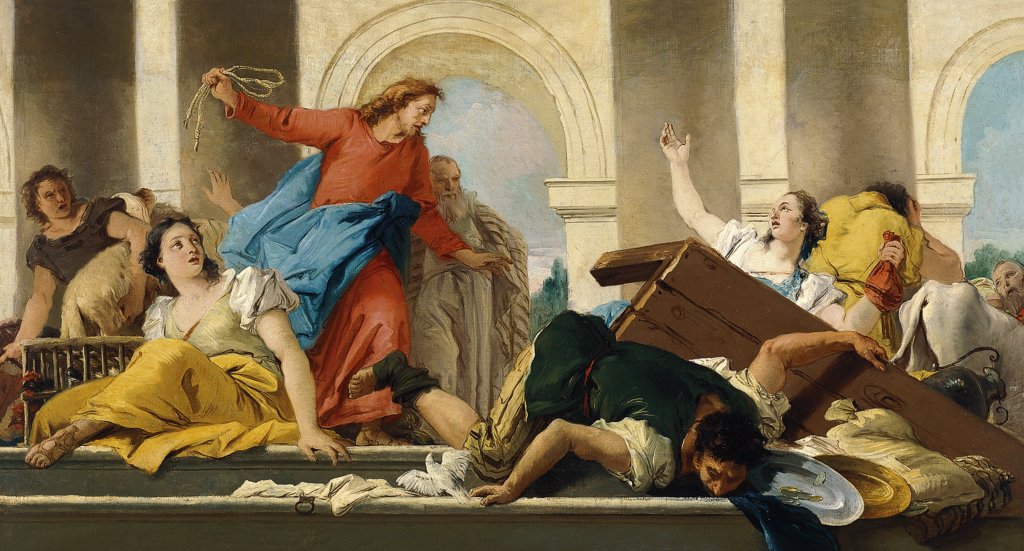
From a theoretical perspective, this moment operates as what might be called an institutional stress test. The temple is revealed not by its rituals but by how it responds when its ethical core is challenged. Jesus does not critique the temple from afar. He enters it. He does not write a treatise. He acts. The protest action is the argument. The episode appears in all four Gospels, which matters. When a story is preserved across multiple accounts, it signals that early communities understood it as essential, not incidental. In the Gospel of Matthew, the scene is described with blunt force. Paraphrased here:
Jesus entered the temple courts and drove out all who were buying and selling there. He overturned the tables of the money changers and the benches of those selling doves. “It is written, My house will be called a house of prayer, but you are making it a den of robbers.”
The language matters. He names exploitation. The sanctuary has become a site where religious obligation is leveraged for profit, where access to worship is mediated by exchange rates, fees, and advantage. From a theoretical standpoint, this is a critique of institutional capture. A system created to serve the people has inverted its purpose and begun serving itself.
Importantly, the text does not suggest that everyone present understood what was happening in that moment. The scene would have been frightening, especially for the vulnerable. Children, pilgrims, the poor, and those already anxious about approaching the sacred likely experienced confusion and fear. Sudden disruption, even when morally justified, is rarely comfortable. Disorder feels like danger before it feels like correction.
This is where later reflection becomes essential. Meaning often lags behind experience. What feels like chaos in the moment can, over time, be recognized as restoration. This dynamic is emphasized in the writings of Ellen G. White, who reflects extensively on this episode in The Desire of Ages. White is careful to note that Jesus’ actions were not driven by uncontrolled anger but by moral clarity. She writes:
“In His anger He was not guilty of sin. His indignation was directed against hypocrisy, injustice, and cruelty.”
This distinction is critical. Theoretically, it separates destructive rage from ethical disruption. Jesus’ actions are not an endorsement of violence or intimidation. They are a form of moral boundary-setting protest enacted in public space. The fear experienced by onlookers is real, but it is not the goal. The goal is exposure and correction. White also emphasizes the effect of Jesus’ presence and speech itself. She describes how authority emanated not from force but from integrity:
“There was a rush for the door, and the money-changers fled from the temple, carrying with them their ill-gotten gains.”
What drives them out is not physical power but moral authority. From a theoretical lens, this suggests that institutions often persist in unethical practices not because they are unchallenged intellectually, but because they are unchallenged ethically. When confronted by integrity that cannot be co-opted, corruption loses its footing. White further notes that after the chaos subsides, a different scene emerges. The marginalized return. The children come back. Healing resumes. She writes:
“The blind and the lame came to Him in the temple; and He healed them.”
This sequencing matters. Disruption is not the end of the story. Restoration is. The clearing of the tables creates space for the sanctuary to become what it was intended to be. From a theoretical perspective, this suggests that ethical reform is not merely subtractive, removing what is wrong, but generative, making room for what was excluded.
Children play a particularly important role in White’s account. She observes that after the merchants flee, children remain and meet with Jesus openly. This detail challenges the assumption that disruption necessarily harms the innocent. While fear may be present in the moment, children often recognize authenticity before adults do. They respond not to decorum but to moral coherence. White writes:
“The children, who had been driven from the temple by the profane traffic, now returned, and waved their palm branches.”
The theoretical implication is subtle but profound. When institutions prioritize order over justice, they often silence the most honest voices. When those institutions are corrected, even abruptly, those voices reemerge.
At no point does Jesus seize control of the temple. He does not install himself as administrator. He does not reorganize the economy occurring in the temple. His intervention is temporary but divisive and decisive. This restraint is essential in his protest. From a rights-respecting perspective, the story does not endorse domination (e.g. Venezuela). It models accountability without authoritarianism.
White underscores this restraint by noting that Jesus withdraws after the act. The confrontation is not sustained by force but by the moral clarity it introduces. Institutions are left to reckon with themselves. Jesus’ protest has important implications for how religious narratives are understood in public life, particularly in moments like the one that unfolded recently at a Minnesota church in St. Paul. The Gospel account does not treat disruption of a sacred space as automatically illegitimate. Instead, it distinguishes between disruption that desecrates and disruption that exposes. Jesus does not interrupt worship to mock faith or silence prayer. He interrupts because the sanctuary itself has been compromised by the quiet normalization of graft and power.
Read this way, the question raised by the St. Paul incident is not simply whether a service was disrupted, but whether moral authority can remain unexamined when religious leadership is entangled with state power and policies that many are experiencing as harmful. The Gospel narrative suggests that faith loses credibility when it demands tranquility at the expense of justice, and that moments of interruption, though uncomfortable, can serve as catalysts for ethical reckoning rather than threats to belief itself. The cleansing of the temple does not justify coercion or exclusion. Instead, it offers a framework for ethical self-critique. Religion, in this reading, is at its most faithful when it interrogates its own power rather than asserting it over others.
The fear present in the moment should not be dismissed. Fear is a real human response to sudden disruption. But fear alone does not determine meaning. Meaning emerges through reflection, context, and outcome. In this story, fear gives way to understanding because the disruption leads to healing, inclusion, and restored purpose.
From a theoretical standpoint, the episode invites a broader question: how do institutions respond when confronted with evidence that they or their leaders have drifted from their ethical foundations? Do they double down on order, or do they allow ethical disruption and protest to do its corrective work? Jesus’ action suggests that reverence without justice is hollow. Ritual without ethics becomes performance. And institutions that mistake stability for righteousness risk confusing silence with peace.
Ellen White’s interpretation reinforces this conclusion. She does not portray Jesus as rejecting the temple, but as reclaiming it. The goal is not destruction, but alignment. Not chaos for its own sake, but clarity. For communities, the stakes of current moment in our nation’s history is real and enduring. This is why moments of disruption, like the one that unfolded at a St. Paul church carry such ethical weight. The protest was unsettling. It interrupted worship. It triggered arrests and fierce federal response. But read alongside the Gospel account, the significance of the moment lies not in the discomfort it caused, but in the questions it forced into the open about power, legitimacy, and moral responsibility.
In this sense, the overturned tables function as both a warning and an invitation. A warning that sacred spaces and public institutions alike are not immune to corruption. And an invitation to examine whether the systems we defend as orderly are, in fact, serving their intended purpose or merely protecting advantage and power behind procedure.
Fear may accompany the moment of reckoning. Children may cry. Adults may recoil. Disruption always feels threatening before it feels clarifying. Yet the aftermath reveals the deeper meaning. When exploitation is removed, space opens for healing. When graft is exposed, trust can be rebuilt. And when institutions are willing to be corrected, they can once again become houses of justice rather than markets of advantage.
This pattern is visible far beyond any single place or situation. Public life is increasingly marked by concern over vast sums of money exchanged for influence, natural resources extracted through coercive arrangements, regulatory frameworks rewritten in ways opaque to the public, and educational institutions criticized for bending under political pressure. The parable does not require certainty about every biblical claim to remain instructive. It asks a more enduring question: at what point does maintaining order become indistinguishable from enabling harm?
The answer is neither quietism nor domination. It is ethical interruption and transparency. Not protest for its own sake, but the courageous refusal to allow graft, abuse of power, or moral compromise to remain invisible. The tables are overturned not because chaos is virtuous, but because injustice cannot be corrected while it is protected by silence, decorum, or fear. In this way, the Gospel scene in the temple aligns not against democratic principles, but alongside them. It affirms the moral logic of peaceful, constitutional protest as a safeguard of the common good, a reminder that accountability is not a threat to order but a condition of it.
The story endures not because it is comfortable, but because it is clarifying. It reminds readers that protest is not measured by calmness, but by faithfulness to justice, compassion, and truth. Democracy itself depends on this distinction. Rights exercised without conscience become hollow, and order preserved without accountability becomes coercive. Ethical protest interrupts not to destabilize society, but to call it back to its founding promises.
In the end, this blog post is not only about a particular parable or situation in the news, but about the communities that a government of the people by the people serves and sustains. Healthy communities are not defined by the absence of disagreement, but by their capacity to confront injustice without abandoning their shared commitments to dignity, participation, and the rule of law. Peaceful protest, ethical disruption, and collective voice are not signs of disorder. They are expressions of civic faith in the possibility of a more just and democratic society. That clarity matters.
Julian Vasquez Heilig is a scholar, public intellectual, and policy analyst who writes about the intersections of education, democracy, and power. He has spent his career examining how systems—whether in higher education, public policy, or politics—use influence, money, and narrative to shape outcomes. His blog Cloaking Inequity and Without Fear or Favor newsletter on Linkedin explores the hidden structures that govern American life, from public education to presidential politics, and challenges readers to see how leadership, integrity, and equity intersect.






 Cloaking Inequity
Leave a comment