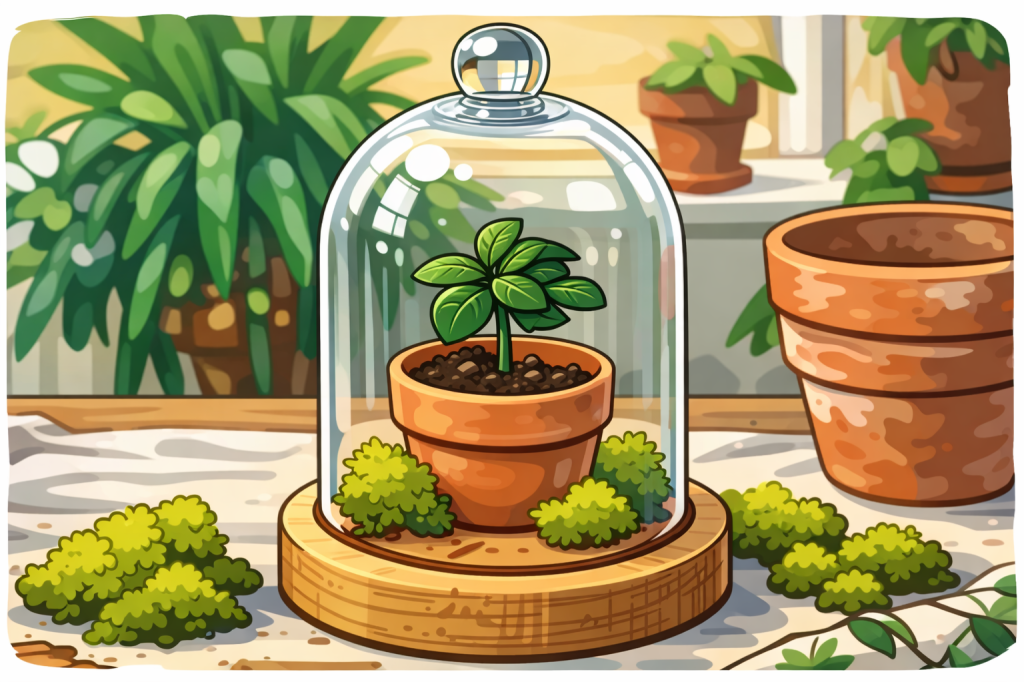
Last year, after I stepped down from executive academic administration, I had a very small plant that was basically dead. It was only about three inches high, sitting in a tiny green pot, delicate in a way that made its decline feel almost predetermined. The leaves were dry, thin, and drained of color, and there was no visible sign of growth or recovery. It did not look dormant or resting. It looked finished… kaput. I kept it out of the garbage more out of habit than belief, already resigned to the idea that it would not ultimately survive.
That season of my life carried the same quiet feeling. Stepping back into my faculty roots did not come with drama or public rupture, but it marked the end of six years of executive leadership life structure that had organized my days for six years as a dean and provost. When a role like that pauses, the calendar is no longer full and the daily scaffolding relaxes. You wake up with fewer demands and fewer external expectations, but also with less clarity about where your energy belongs. The focus is now not loud or visible. It resettles in the corners of places that once held purpose, momentum, and certainty.
The plant reflected that condition more precisely than I understood at the time. Nothing catastrophic had happened to it. It had not been neglected in any obvious way, it was just not living in the right environment. It had simply been exposed for too long in demanding conditions. Being that small and fragile, it had no margin for recovery. Eventually, it stopped responding altogether. I guess I had already accepted that it would not recover and was quietly preparing to let it go.
An Unknowing Gift
During my birthday week, I had a meal with a faculty colleague and her husband. She gave me a small glass plant dome without knowing anything about the plant. She had not seen it and did not know it existed. She simply gave me the dome as a gift, without explanation or narrative attached. It was offered casually, generously, and without any sense that it was meant to solve a problem. At the time, it registered as thoughtful. Then its significance came into focus.
The dome was clear glass with a reclaimed wood base, solid and understated. When I placed it over the plant, the fit felt almost exact, as though the space had been designed for something that small and vulnerable. Light still entered freely, but the sharpness of constant exposure disappeared. Moisture stayed present rather than evaporating immediately. The environment warmed and softened in ways that were difficult to measure but easy to sense. Nothing about the plant itself was altered. Only the conditions around it changed.
Looking back, the timing feels uncanny. It is almost as if she knew, without knowing, that something needed rescuing. It is almost as if she sensed that m passion for leadership did too. She did not offer advice or interpretation. She did not ask questions or suggest next steps. She gave me something that created safety without requiring explanation. The gift worked precisely because it did not try to fix anything directly.
Resurrection Takes Time
For a long while after placing the dome over the plant, nothing happened. Weeks passed without visible change, followed by months where progress could only be imagined rather than seen. I resisted the urge to interfere, partly because I had already tried everything else, and partly because the dome itself felt like a boundary that should not be disturbed. The plant did not need attention. It needed consistency. It needed protection.
Slowly, almost imperceptibly, the plant began to respond. Color returned in places I had assumed were no longer viable. Leaves grew and held their shape rather than collapsing inward. The new growth appeared where there had once been only dryness. This was not a dramatic revival or sudden turnaround. It was a gradual return that required patience and restraint. The dome did not force life back into the plant. It allowed life to reemerge.
It took a full year for the plant to truly recover to normal. Not weeks and not months, but a year of being left alone inside a space that asked nothing of it except to exist. There were long stretches where nothing appeared to be happening at all. The change became obvious only when I looked back and compared what stood there now to what had nearly been discarded. What had looked dead was revealed to be waiting. Time and protection did the work.
Healing Without Performance
That year mirrored my own experience of sabbatical more closely than I expected. After stepping down, I did not need urgency or motivation. I needed shelter from constant evaluation, expectation, and aggressiveness. I needed a respite, an environment where I did not have to explain and justify my commitment to communities or demonstrate resilience or be noticed. Recovery did not arrive through productivity or reinvention. It arrived through steadiness and gifts of love from my family and local, national, and international colleagues.
What surprised me most was how much rejuvination depended on not being watched. There is a particular pressure that comes from being observed during recovery. It turns rest into performance and progress into obligation. The dome offered the opposite. It created a space where nothing had to be proven. That absence of demand was not indulgence. It was essential.
My faculty colleague at Western Michigan University understands this kind of care instinctively. She knows from her professional field that when something is almost spent, encouragement alone is insufficient. You have to change the conditions. Her gift of care, conversation and collaboration was rejuvenating because it did not require gratitude, speed, or results. It trusted the process even when the outcome was uncertain. That trust is rare, and it is powerful.
Who Holds the Conditions for You
This experience leaves me with a question that feels both personal and necessary. Who is the person or community in your life that gives you what you need to thrive when you are spent? Not the ones who urge you to push harder or remind you of who you used to be. The ones who recognize that depletion is not failure. They see that when exposure can be fatal. Their instinct is protection rather than pressure.
These people and communities do not need full information to care well. They act without needing to witness the new leaves firsthand. They are patient with silence and unafraid of long stretches where nothing appears to be happening. Their support does not arrive as spectacle or strategy. It arrives as steadiness. Over time, that steadiness accumulates into something transformative.
We do not always control the climate around us. But we can become a climate for someone else. We can be the steady glass when the winds are harsh. We can be the patient witness when growth is hidden. And when enough of us choose to hold conditions for one another, thriving stops being an exception. It becomes a shared possibility.
Julian Vasquez Heilig is a civil rights advocate, scholar, and internationally recognized keynote speaker. He has served as Education Chair for both the NAACP California State Conference and the NAACP Kentucky State Conference, advancing equity for students and communities. Over the past decade, he has delivered more than 150 talks across eight countries, seeking to inspire audiences from universities to national organizations with research, strategy, and lived experience that move people from comfort to conviction and into action.




 Cloaking Inequity
Leave a comment