At the very moment when many of America’s most powerful universities turned away from responsibility and values, historically Black colleges and universities (HBCUs) stepped forward, despite operating under conditions designed to limit their survival.
During the early 1930s, Jewish intellectuals in Germany experienced rapid and devastating exclusion from academic life. After Adolf Hitler became chancellor in January 1933, the Nazi regime moved swiftly to purge Jewish professors from universities, research institutes, and cultural organizations. These actions were implemented through legal decrees and administrative orders that masked persecution as ordinary governance. Jewish scholars lost their livelihoods, professional standing, and legal protections in a matter of months. Many were stripped of citizenship and barred from publishing or teaching. The speed and formality of these expulsions left little time for escape.
At the same time, Black Americans in the Jim Crow South lived under a regime of racial segregation enforced by law, custom, and violence. Jim Crow laws restricted access to education, housing, employment, and political participation, shaping nearly every aspect of daily life. Lynching and racial terror operated as tools of social control, reinforcing the boundaries imposed by statute. These systems were not accidental or informal but were sustained by courts, legislatures, and local authorities. Scholars have long documented how state sanctioned exclusion structured Black life in the South during this period. That recognition would later inform acts of solidarity grounded in shared historical memory rather than abstraction.
When American Universities Refused Responsibility
Jewish scholars fleeing Germany faced formidable obstacles when they turned toward the United States for refuge. Immigration officials enforced the public charge rule, requiring visa applicants to prove they would not rely on government assistance. Because the Nazi regime confiscated Jewish property and restricted the transfer of assets abroad, many refugees could not meet this requirement. Academic credentials, professional reputation, and international recognition carried little weight in this process. Visa quotas further limited access, transforming escape into a bureaucratic ordeal marked by long waits and repeated denials.
Several private organizations attempted to intervene in response to these barriers. The Emergency Committee in Aid of Displaced Foreign Scholars was established in 1933 with support from the Rockefeller Foundation to assist refugee academics in securing temporary placements. The committee identified qualified scholars, raised funds, and negotiated work visas where possible. However, it lacked authority over university hiring decisions. Many predominantly white institutions declined to participate, citing financial constraints during the Great Depression. Antisemitism and professional gatekeeping further shaped these refusals.
As a result, numerous prestigious universities closed their doors to scholars whose work they later ironically celebrated. Hiring decisions rested with administrators who lacked courage and chose institutional comfort over moral responsibility. These refusals were not neutral acts of caution. They reflected an unwillingness to bear the cost of solidarity during a moment of crisis. For many displaced Jewish scholars, the consequences of these decisions were immense. That reality underscores how institutional inaction can function as a form of harm.
How HBCUs Chose Solidarity
Historically Black colleges and universities responded differently under similarly constrained conditions. Administrators at HBCUs recognized the existential danger Jewish scholars faced and chose to act despite their own institutional vulnerability. Between the 1930s and 1940s, at least fifty three Jewish refugee scholars were hired by HBCUs across the country. These institutions included North Carolina Central University, Howard University, Tougaloo College, and Philander Smith College. Each appointment required navigating political scrutiny, limited budgets, and political resistance. Yet these leaders proceeded because they recognized the stakes and the values at stake.
One of those scholars was Ernst Manasse, who joined North Carolina Central University in 1939 shortly before his visa expired. Manasse had been dismissed from German academia because of Nazi racial laws. He later stated unequivocally that without refuge at NC Central, he would likely have been arrested and killed. James E. Shepard personally approved his appointment, along with the hiring of three additional Jewish refugees. Shepard made these decisions while leading an institution that itself faced discrimination, surveillance, and chronic underfunding. His actions reflected moral clarity rather than institutional advantage.
The interaction between Jewish refugee professors and Black students produced a meaningful intellectual exchange. Many Jewish scholars had never lived among Black Americans due to European and American segregation. Likewise, many students had never studied under Jewish faculty members. Shared experience of exclusion created recognition and empathy. Jewish historian Georg Iggers later reflected that racial segregation in the South reminded him of the conditions he fled in Germany. He emphasized that Black Americans bore the full weight of that system.
Jewish Leadership and the Founding of the NAACP
The solidarity demonstrated by HBCUs did not emerge in isolation or without precedent. Jewish Americans played a documented role in founding the National Association for the Advancement of Colored People in 1909. The organization grew out of a coalition responding to racial violence, lynching, and the systematic dismantling of Reconstruction era gains. Jewish leaders were involved not just as symbolic supporters but as organizational architects. Their participation reflected a recognition that racial injustice threatened democratic life as a whole.
Henry Moskowitz, Rabbi Stephen S. Wise, and Joel Elias Spingarn were among the Jewish leaders who helped build the NAACP during its formative years. Spingarn later served as chairman of the organization and provided financial stability during periods of intense political hostility. His leadership helped sustain the NAACP when its advocacy placed it at risk. In recognition of his contributions, the NAACP named its highest honor the Spingarn Medal. The award remains the organization’s most prestigious distinction.
The Spingarn Medal honors outstanding achievement by an African American whose work advances justice and public service. Over the decades, recipients have included artists, scholars, activists, and public leaders. In 2025, the medal was awarded to Vice President Kamala Harris, marking a continuation of its legacy. The award reflects a belief that moral leadership matters across generations. It also reflects the enduring connection between justice, courage, and institutional responsibility.
Einstein, HBCUs, and Moral Clarity
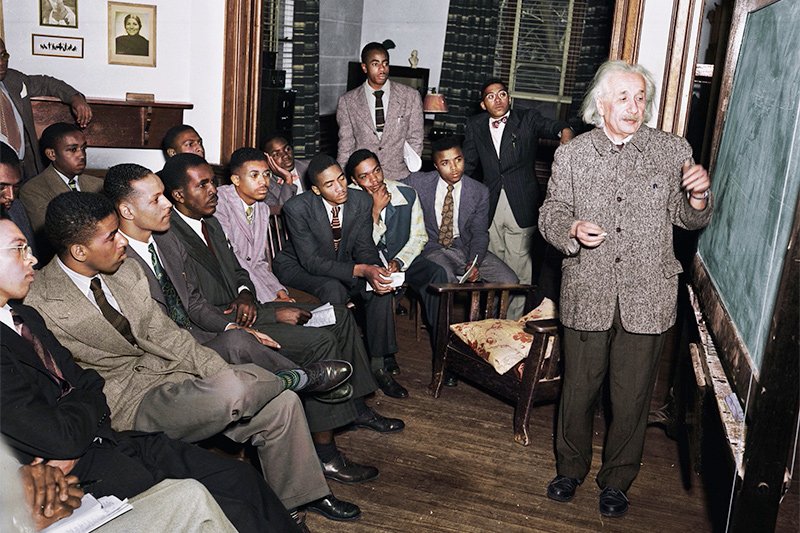
Albert Einstein understood the moral stakes of racial injustice in the United States with unusual clarity. In May 1946, he deliberately chose to deliver an address at Lincoln University in Pennsylvania, one of the nation’s oldest historically Black colleges and universities. At a time when he was already in failing health and rarely accepted honorary degrees or university invitations, Einstein made an explicit exception. He did not choose a more prestigious white institution. He chose a Black university because he believed racism threatened democracy itself.
Speaking before Black students and faculty, Einstein named segregation as a moral failure of white America, declaring that racial separation was not a problem of Black people but “a disease of white people.” This was not a symbolic gesture made in safety. His visit carried real professional and social risk and was largely ignored by mainstream media that otherwise followed his every move.
Einstein’s appearance at Lincoln University was consistent with a lifetime of action. He supported civil rights organizations, collaborated with Paul Robeson on anti-lynching efforts, defended the Scottsboro Boys, and publicly criticized segregation in speeches and writing, including his 1946 essay The Negro Question. He corresponded with W.E.B. Du Bois and offered personal solidarity to figures like Marian Anderson when she was denied lodging due to segregation.
His presence at an HBCU reflected alignment with institutions that had already demonstrated moral courage under constraint. It was not performative. It was deliberate. Einstein understood that leadership is measured not by comfort or acclaim, but by the willingness to speak plainly and act decisively during moments of moral testing.
Why This History Still Matters
What binds these stories together is not coincidence, but choice. Again and again, institutions and individuals with the least margin for error chose responsibility over safety. HBCUs extended refuge when elite universities declined. Jewish leaders stood with Black Americans when doing so invited surveillance and reprisal. Albert Einstein used his global stature not to seek comfort, but to tell an uncomfortable truth in an uncomfortable place. None of these acts were inevitable. All of them were deliberate.
This history reminds us that moral clarity rarely originates from power. It emerges from values and courage. It surfaces when people and institutions recognize that neutrality, in moments of injustice, is itself a decision. The HBCUs that hired refugee scholars are remembered not because they were wealthy or insulated, but because they acted when others hesitated. Einstein’s legacy endures not only because of his intellect, but because he understood that democracy is weakened whenever dignity is conditional.
At Western, while provost, I attempted to translate that conviction into action. In the aftermath of war and the destruction of universities abroad, I proposed to the President an exchange opportunity program to bring displaced students and faculty to our campus—scholars whose institutions had been destroyed by war and conflict, whose laboratories and classrooms had been reduced to rubble. As the Western Herald reported in “Former WMU provost speaks on leadership” (September 10, 2025), I believed this was something squarely within my purview as provost: consistent with our prior global exchanges and aligned with our public mission. It was a tangible way to stand with those whose education and livelihoods had been interrupted by violence. The program was never implemented. After I stepped down, it was quietly placed in the dustbin of abandoned initiatives. But the proposal itself reflected my deeper belief that universities do not merely comment on the world’s crises; they can create refuge within them. If neutrality in the face of injustice is complicity, then institutional imagination in the face of suffering is responsibility.
History is clear on one point. Progress does not arrive through inevitability. It arrives through people and institutions willing to act before consensus forms, willing to speak before safety is assured, and willing to stand with others when standing costs something. That is the lesson HBCUs taught the world. It is the lesson Einstein tried to pass on. And it remains the measure by which leadership, in any era, should be judged.
Julian Vasquez Heilig is a nationally recognized policy scholar, public intellectual, and civil rights advocate. A trusted voice in public policy, he has testified for state legislatures, the U.S. Congress, the United Nations, and the U.S. Commission on Civil Rights, while also advising presidential and gubernatorial campaigns. His work has been cited by major outlets including The New York Times, The Washington Post, and Los Angeles Times, and he has appeared on networks from MSNBC and PBS to NPR and DemocracyNow!. He is a recipient of more than 30 honors, including the 2025 NAACP Keeper of the Flame Award, Vasquez Heilig brings both scholarly rigor and grassroots commitment to the fight for equity and justice.





 Cloaking Inequity
Leave a comment