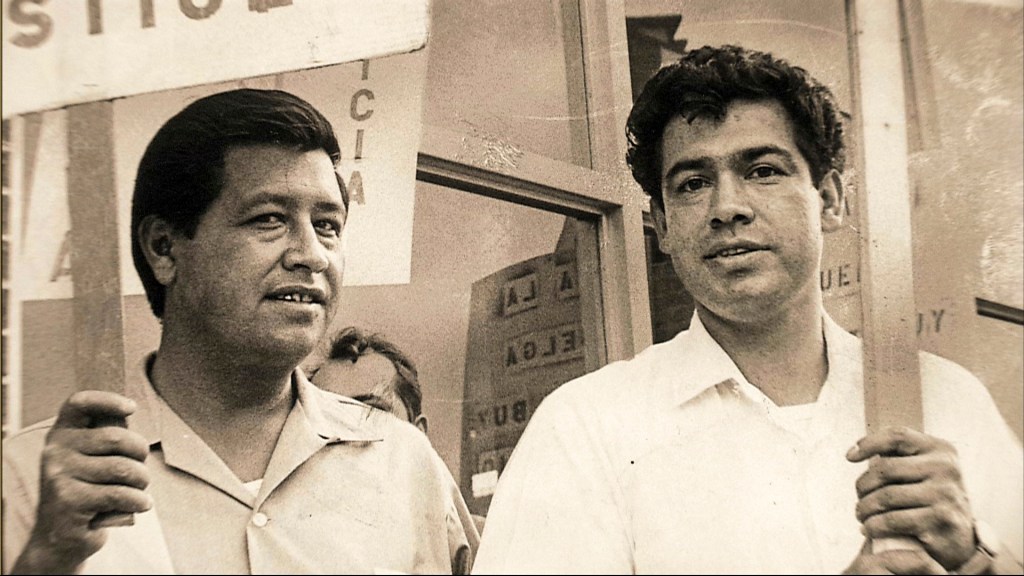
With Cesar Chavez’s birthday approaching, this is a time to reflect, and for many of us, it is not an easy reflection. The recent allegations are painful and difficult to process. For those of us who grew up seeing Chavez as a symbol of justice and sacrifice, it feels unsettling, even unbelievable. But, I believe Dolores Huerta and the others who are speaking out and take seriously the responsibility to listen when people who were there speak their truth.
We often turn people into symbols of a movement because it is easier to understand and easier to teach. That instinct is human, but it can also flatten the truth. The real story of the civil rights movement is far more complex and far more human than any single narrative. It includes courage and contradiction, leadership and tension, progress and even severe imperfection.
There was far more to the struggle for civil rights and justice for Latinos than Cesar Chavez, as important and transformative as the UFW work was. Across the country, organizations, communities, and young people were organizing, resisting, and building in ways that were local, decentralized, and deeply personal. Movements are built by many people. So let’s talk about the people.
The efforts of the people in the movement were not always unified, and they were not always perfect, yet they were grounded in a shared commitment to dignity, self determination, and justice. Our elders tell us that were disagreements about strategy, tensions between groups, and moments when the path forward was not clear. That is what makes the history real rather than symbolic. It reminds us that people within movements were making mistakes, navigating pressure, uncertainty, and political consequences while still choosing to act. To me, that is the central lesson captured in One Battle After Another, Oscar Winner for Best Picture, which portrays activists making difficult decisions in real time without the benefit of hindsight. They were not icons at the time. They were imperfect humans making choices in uncertain conditions, often without knowing how those choices would be judged and experienced later.
That complexity matters because it challenges us to move beyond simplified narratives and to engage more honestly with the past. The work of justice for all is not finished, and that understanding the fullness of history is part of continuing that work. This moment has pushed me to more fully tell a story from my own family’s experience, one that reflects the complexity, tension, and reality of that era .
A Vasquez Family Story Within a National Movement
Some family stories are etched into you because they connect personal memory to the larger currents of history. My uncle Mario Vasquez was part of the generation of young Chicano activists who came of age during the civil rights era, and his story is one of many threads woven into that broader tapestry. For our family, the story begins with a young man who was a student at the University of Michigan during a time when campuses across the country were alive with political debate and social transformation. The Vietnam War, civil rights struggles, and movements for cultural recognition were reshaping American society in ways that demanded engagement and courage.
At some point during his time at Michigan, my uncle made a decision that reflected the intensity of that moment and the pull of something larger than himself. He left the university and traveled west to become involved with the Crusade for Justice, a Denver based Chicano civil rights organization founded by Rodolfo “Corky” Gonzales. That decision was not simply about joining an organization. It was about stepping into a movement that required commitment, risk, and a willingness to challenge existing systems of power. It was also about identity, culture, and the search for a more just society.
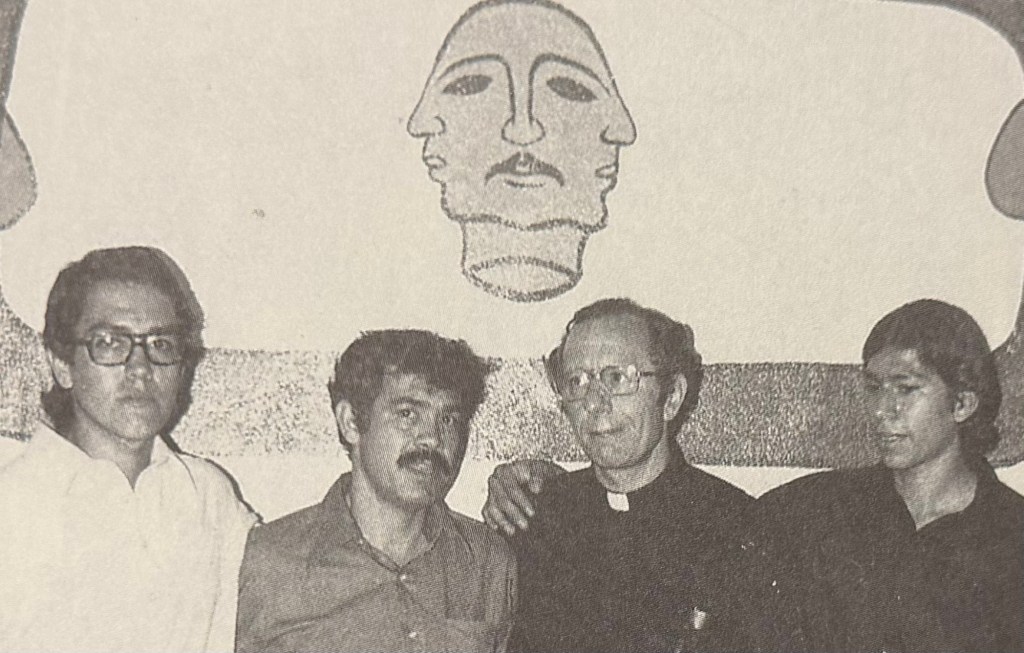
Photo credit: The Crusade for Justice: Chicano Militancy and the Government’s War on Dissent Original Caption: Radical priest James Groppi of Milwaukee, Wisconsin, poses with Ernesto Vigil, Rodolfo Gonzales, and Mario Manuel Vasquez after a June 10, 1973, fund-raiser in support of the Crusade’s legal defense committee. Photograph by Pablo Castro.
The Crusade for Justice was one of the most influential organizations in the Chicano movement and helped define a generation of activism rooted in both political organizing and cultural pride. It combined political advocacy, cultural affirmation, and community-based education to challenge both institutional inequality and internalized marginalization. It created space for young people to see themselves not as subjects of history, but as agents within it. That sense of agency shaped decisions like the one my uncle made, and it is part of what makes his story meaningful beyond our family.
The Context of Struggle and Surveillance
By the early 1970s, the Crusade for Justice had become a focal point for young activists who believed that the Chicano movement could transform American society. It was also a period marked by tension, where civil rights organizations across the country were facing increasing scrutiny, surveillance, and confrontation. Law enforcement agencies were not simply observing these movements, but actively monitoring, infiltrating, and in some cases attempting to bait and disrupt them. That environment shaped how events unfolded and how they were later recorded.
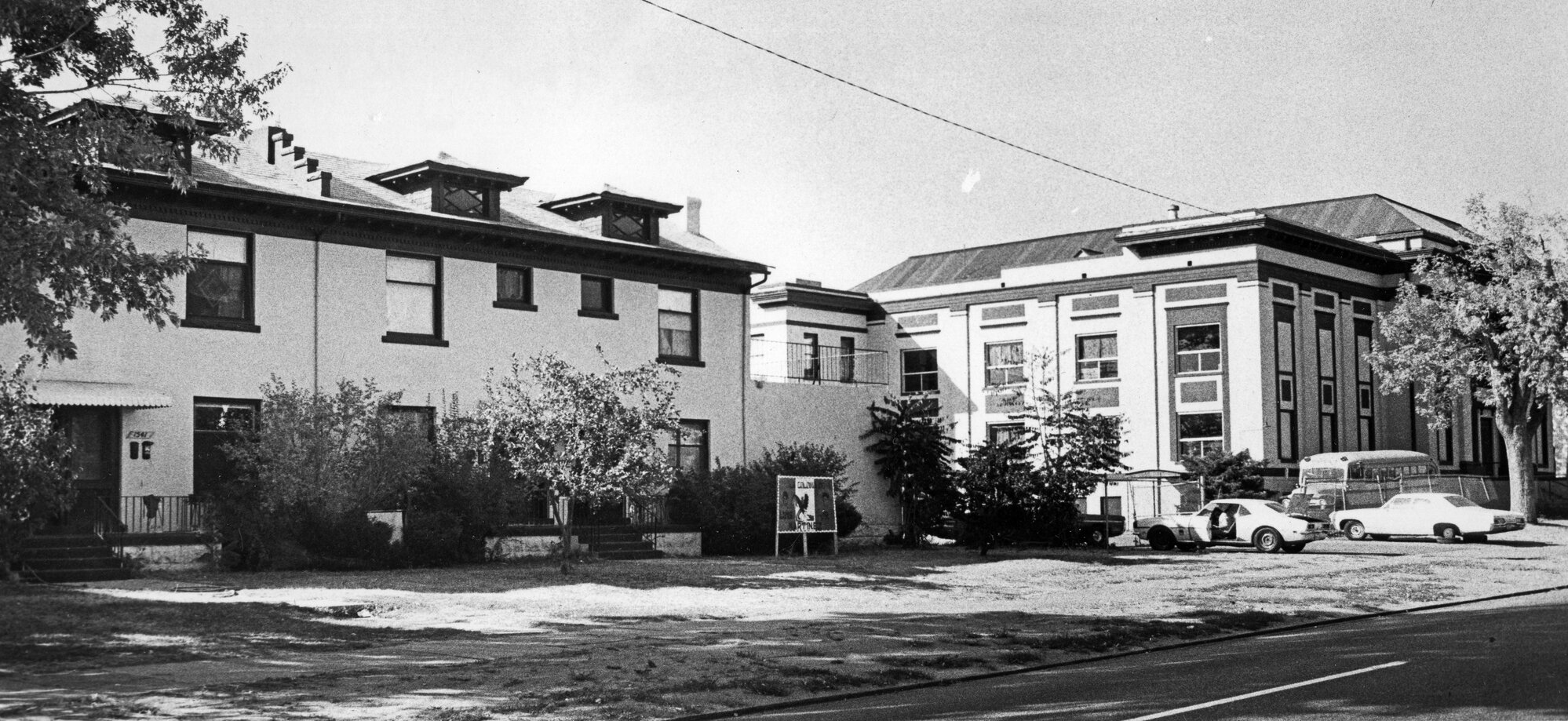
Crusade for Justice buildings on Downing Street in Denver
What we now know through historical documentation is that the Crusade for Justice had been under extensive surveillance for years. Federal agencies tracked meetings, protests, and even individual participants, creating a record that reflected institutional perspectives on activism. These records reveal a broader national strategy aimed at containing civil rights movements that were seen as disruptive to the American status quo. They also show how quickly activism could be framed as threat rather than as an expression of democratic participation .
This context matters because it helps explain the conditions under which events like the St. Patrick’s Day incident occurred. It was not simply a moment of isolated conflict, but part of a broader environment of mistrust and escalation. Activists were navigating a reality where their actions were being closely watched and often interpreted through a lens of suspicion. At the same time, law enforcement was operating within a framework that viewed certain forms of activism as inherently dangerous. That intersection created a volatile space where misunderstandings and confrontations could quickly intensify.
March 17, 1973: A Moment of Volatility
On March 17, 1973, Mario Vasquez, then a 19 year old activist associated with the Crusade for Justice, was arrested following an incident that became known as the St. Patrick’s Day shootout. Contemporary coverage of the event appears in the Colorado Historic Newspapers collection, which documents the events that followed, and additional context is provided in book The Crusade for Justice: Chicano Militancy and the Government’s War on Dissent. Historical accounts describe an exchange of gunfire between activists and police, followed by multiple arrests and intensified scrutiny of the organization. Reports from that day indicate that officers responding to a disturbance were met with gunfire and an apartment explosion. One officer was injured, and a civilian was killed, allegedly by the Denver police. These events were followed by arrests and a continued investigation.
Mario faced charges related to the incident, and the case quickly became a focal point for organizing among supporters who saw his arrest as part of a larger pattern. A “Free Mario Vasquez” campaign calling for his release emerged, and students, community members, and organizers rallied around what they understood to be a broader struggle for justice. The story of that day therefore exists in multiple forms, shaped by official records, media coverage, and the lived experiences of those who were there. It reflects both the volatility of the moment and the larger struggle over how activism, resistance, and justice were being defined during that era. There is much, much more to this story, but I try to keep these blogs to less than 1500 words. When you see me, just ask and I’ll tell you the full story.
Memory, Conversation, and the Weight of History
Like many events of that time, the story is complicated and resists simple conclusions. Historical records indicate that Mario was later cleared or acquitted of the charges. But the legal outcome does not capture the full weight of the experience or its lasting impact on those involved. The significance of the event lies not only in what happened, but in what it represented about the risks of activism during that era. It was a moment shaped by courage, fear, conviction, and consequence, all unfolding within a broader struggle for recognition and equality.
That tension became real for me in a different way last year when I reached out to Ernesto B. Vigil to talk about the incident. He is the author of the aforementioned book The Crusade for Justice: Chicano Militancy and the Government’s War on Dissent, which probably provides the most detailed account of the events over about 60 pages and also carefully traces the historicity of the Crusade over time. We spoke for several hours, and it was not an easy conversation. At times it was tense, and the passage of time had not erased the emotions connected to that moment. He was still angry about what had happened, and at one point he asked me directly if I was CIA or FBI. That question reflects the level of distrust that shaped that period and the lasting imprint of surveillance and confrontation on those who lived through it.
That conversation stayed with me and led me to call my uncle and my cousins to reflect on those days from within our own family. What I heard was not a single narrative, but a set of memories that were layered with pride, pain, and reflection. It became clear that history is not only preserved in archives and official accounts, but also in the stories humans tell and the meanings they carry forward. I also want to acknowledge that I appreciate that an elder like Vigil was willing to speak with me about those times, even when the conversation was difficult, because that willingness reflects a commitment to memory and to telling the story of civil rights for generations that come after.
Conclusion: The Generation That Made the Movements
When people talk about the civil rights era, they often focus on the most visible leaders whose names appear in textbooks and public memory— Corky Gonzales, Delores Huerta, Cesar Chavez, John Trudell, Kwame Ture, Marsha Johnson and so many others. Movements, however, are built by thousands of individuals who decide that the world they inherited is not the world they want to leave behind. Some organize marches, others write, and many work quietly in communities to build institutions and support one another. Some face arrest, trials, and consequences that never fully make it into historical records. My uncle was one of those individuals, and his story reflects the broader reality of a generation that chose action over comfort.
In April of 2025, I traveled to Denver to visit the location where the Crusade for Justice headquarters once stood. Today, the site is marked by a post office and surrounding parking lots, a quiet and unremarkable space in the flow of modern life.
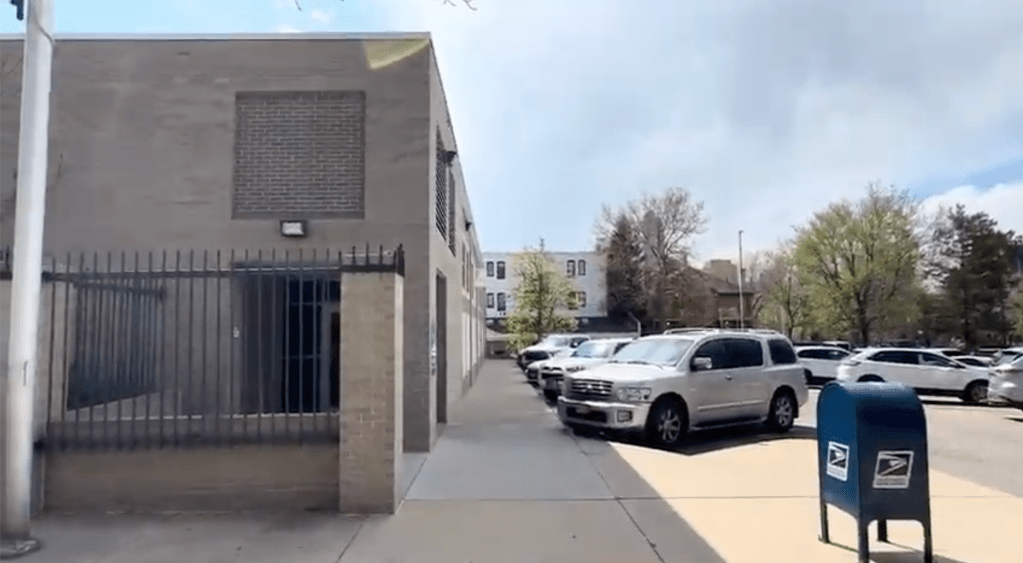
The photo I have from my visit to the Downing Street neighborhood is nondescript, just a view of the neighborhood in present day Denver. It does not show the movement, the people, or the events that once defined that space. But that is part of the point. History does not always leave visible markers. It lives in places that have been repurposed, renamed, and rebuilt, even as the meaning of what happened there continues to resonate. That ordinary landscape now holds an extraordinary past, one that shaped lives and futures in ways that are not immediately visible but are deeply felt when you take the time to stand still and remember.
At first glance, there is little to indicate what once existed there or the significance it held during one of the most intense periods of Chicano activism. But standing there, I felt something different. The echoes of history remained. It was emotion and powerful for me. I could almost hear the voices of young people organizing, debating, and imagining a different future. I could feel the tension of that time in my body, as if it had never fully left the ground beneath me. The sirens were not just imagined in the distance, they felt present, pressing in, carrying urgency and warning all at once.
There was a weight to it, a sense of fear that was not abstract but immediate, the kind that sharpens your awareness because something real is at stake. It made clear that standing for civil rights in that moment is not symbolic. It is dangerous, it is physical, and it carries consequences that can turn violent without warning. As we have seen in more recent moments, including the killing of Alex Jeffrey Pretti in Minneapolis, that reality is not confined to the past. In January 2026, Pretti, a 37-year-old ICU nurse, was shot and killed by federal agents during a protest, an event that sparked national outrage and raised serious questions about accountability and the use of force by ICE. It reminds us that the risks people took then are not distant from the risks that still exist now, and that the courage required to stand for justice has always come with a cost.
As the decades pass, civil rights stories can easily fade into the background, leaving behind simplified versions of complex histories. Memory matters because it reminds us that history was not inevitable, but created through choices, risks, and collective effort. My uncle Mario Vasquez was one of those people, and his story is part of the lived history of the 1960s and 1970s civil rights era. Remembering these stories matters because it shows that the struggle for dignity and equality was not abstract, but deeply personal, shaped by real families, real communities, and real individuals who believed their courage could change the world, and it did. That legacy lives in me, and I intend to carry it forward with you.
Julian Vasquez Heilig is a professor of Educational Leadership, Research, and Technology whose work focuses on strengthening democratic institutions through education, research, and public engagement. His scholarship examines how education policy and leadership shape opportunity for students and communities that have historically been underserved. Beyond the university, he works directly with schools and educators to develop programs that help students evaluate information, examine evidence, and use their public voice responsibly, including serving as a special advisor to the Michigan Hispanic Collaborative. He is the recipient of more than thirty honors for his scholarship and public engagement, including the 2025 NAACP Keeper of the Flame Award.


 Cloaking Inequity
Leave a comment