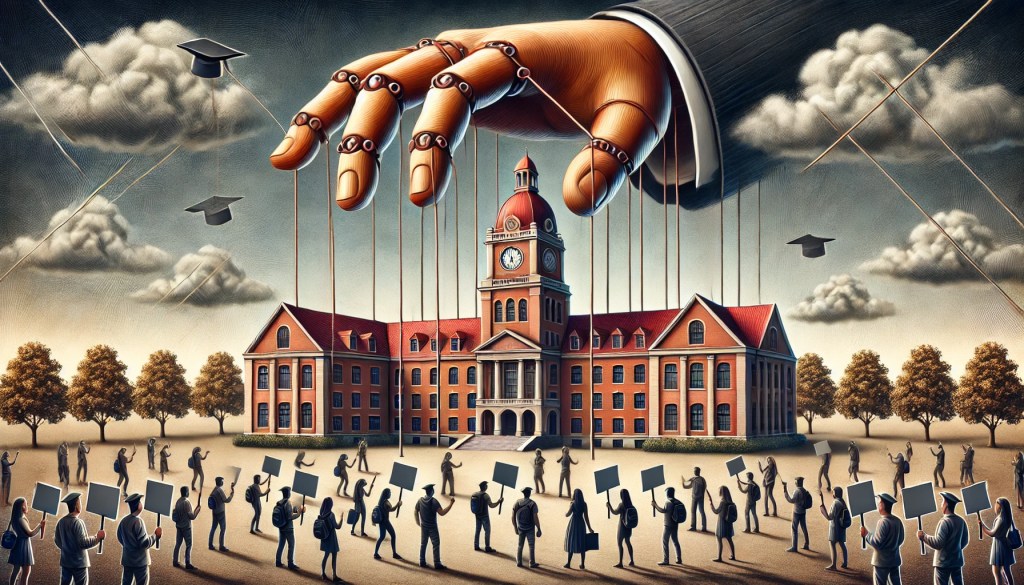
As I discussed on Democracy Now! with Amy Goodman, Donald Trump has made it clear that he will continue adding contingencies to federal funding as a tool for controlling universities, just as authoritarian regimes have done throughout history. He started with DEI, branding it as a political target. Now, his demands have escalated—he is calling for an outright ban on student protests, mask-wearing, and even the deportation of international students who engage in activism. He has also proposed the permanent expulsion of American students for participating in protests, signaling an alarming shift toward suppressing dissent on college campuses.
Trump’s latest statement today, posted on Truth Social this morning, goes even further:
“All federal funding will stop for colleges and schools that allow ‘illegal’ protests, and agitators will be imprisoned or sent back to the country they came from. American students will be permanently expelled or, depending on the crime, arrested.”
This marks a dangerous turning point. As I emphasized on Democracy Now!, once universities go down the road of political patronage and strings attached to federal research funding or student financial aid, there is no clear stopping point. Today, the target is DEI. Tomorrow, it’s student activism, public health policies, faculty speech, and even labor unions on campus—which could easily be framed as “obstacles to efficiency” or “left-wing political forces” that must be suppressed.
Trump’s approach is not an isolated political tactic—it is part of a broader pattern seen in autocratic regimes across the world. Consider the following examples:
1. Russia: Criminalizing Dissent and Controlling Universities
Under Vladimir Putin, the Russian government has systematically cracked down on student activism and faculty speech. Universities that tolerate protests risk losing state funding, and faculty members who criticize the government are frequently fired or even imprisoned under vague “extremism” laws. Putin’s government has forced student organizations to register as “foreign agents”, effectively criminalizing dissent and making it impossible for independent academic discourse to flourish.
2. China: The Politicization of Higher Education
In China, universities are tightly controlled by the state. Faculty and students must adhere to the ideological framework of the Chinese Communist Party (CCP), and those who express dissent—whether through protests or research that challenges state narratives—face repercussions. Institutions must comply with government mandates to receive funding. Students who protest can be blacklisted from employment opportunities, a tactic that discourages activism.
3. Hungary: Government Takeover of Universities
In Hungary, Prime Minister Viktor Orbán has transformed universities into political tools. His government has seized control of independent institutions, replacing their leadership with political allies (Florida and Texas anyone?). The Central European University (CEU)—one of Europe’s most prestigious institutions—was forced to relocate out of Hungary after Orbán’s government made it impossible for the university to operate freely. Orbán’s education policies mirror Trump’s rhetoric, using funding as a weapon to eliminate opposition and force ideological compliance in higher education.
What Happens Next? The Targeting of Unions
If Trump follows the authoritarian playbook, labor unions could become his next target. Throughout history, autocratic leaders have attacked unions because they represent organized resistance to state overreach. Trump’s hostility toward unions is already well-documented—he has repeatedly spoken out against worker protections and collective bargaining. If he successfully ties federal funding to restrictions on student protests and DEI, it is not a stretch to imagine him tying funding to the suppression of labor unions on campus as well.
Imagine a future where universities are pressured to dissolve faculty unions in order to remain eligible for federal research grants. Or where graduate student unions are declared illegal under the guise of preventing “radical activism” on campus. The precedent is already being set. Once funding becomes a political weapon, no institution or advocacy group is safe.
History Is Our Warning—Will We Listen?
This is the politics of coercion, not governance. And history has shown us where it leads. When authoritarian leaders tie public resources to ideological compliance, it is never about just one issue. It starts with DEI, but soon expands to protest bans, restrictions on research, faculty purges, and attacks on organized labor.
Trump and his political allies understand this playbook well. By choking off funding for institutions that refuse to comply, they can reshape the entire landscape of higher education, much like Russia, China, and Hungary have done. The only question is: Will we recognize the pattern in time?



 Cloaking Inequity
Leave a reply to Monty J. Thornburg Cancel reply