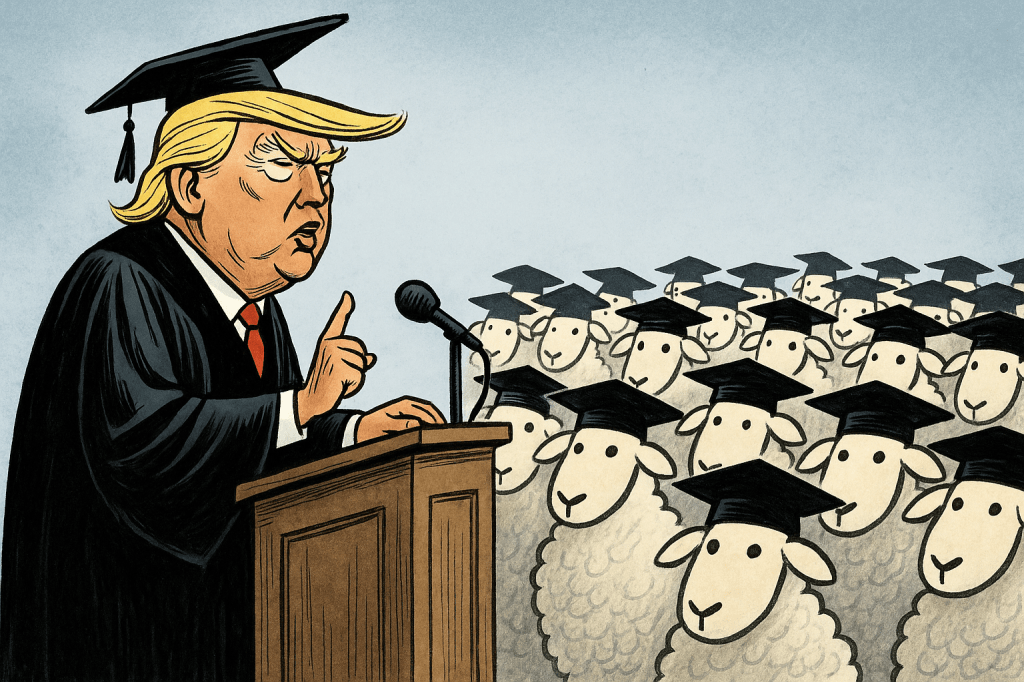
Please don’t yawn. When most Americans hear the word “accreditation,” their eyes glaze over. It’s not flashy. It doesn’t spark headlines like student debt relief or campus protests. But accreditation is one of the quiet, foundational pillars of American higher education. It’s the gatekeeper of federal student aid, the validator of institutional quality, and the primary public safeguard against academic fraud.
And that’s precisely why Donald Trump wants to control it.
On April 23, 2025, Trump signed an executive order that fundamentally reconfigures who controls accreditation—and why. While the language of the order invokes noble goals like “academic freedom,” “quality,” and “student outcomes,” it is, in reality, a political instrument disguised as reform. If implemented, it would weaponize accreditation to enforce ideological loyalty, dismantle standards for equity and inclusion, and open the floodgates to low-quality, politically aligned diploma mills.
Having spent years navigating the accreditation process—as a provost, a faculty leader, and an accreditation reviewer—I’ve seen both its value and its shortcomings. But what Trump proposes is not reform. It is retaliation against institutions that dare to be inclusive, rigorous, or independent.
Accreditation: The Quiet Giant of U.S. Higher Education
Most Americans rarely think about how their colleges and universities are evaluated. Accreditation is a behind-the-scenes process led by independent, nonprofit agencies composed of educators and institutional leaders. These agencies examine academic rigor, student outcomes, faculty qualifications, governance, and financial integrity.
Accreditation ensures that students who enroll in higher education institutions receive meaningful credentials. It also determines eligibility for Title IV federal financial aid, which underwrites much of the U.S. higher ed system.
I’ve participated in this work firsthand—serving on accreditation review teams for Auburn University, Clemson University, and Texas Woman’s University through SACSCOC. I’ve led institutional responses as an academic leader at the University of Kentucky, California State University Sacramento, and the University of Texas at Austin. And as a provost, I’ve fought unfair rulings from accreditors who applied standards inconsistently or arbitrarily. In one case, an accreditor threatened to close one of our programs. Why? Our student-to-faculty ratio exceeded their benchmark by a single student. One. This minor numerical deviation was emblematic of the kind of bureaucratic rigidity that can masquerade as quality assurance. We appealed the decision, presented clear evidence, and ultimately prevailed—thanks to a fair and independent review panel that recognized the arbitrariness of the ruling.
That experience taught me two things: (1) accreditors must be held to high standards of transparency and fairness; and (2) peer review, not political pressure, is the bedrock of accreditation integrity.
Dissecting the Executive Order: A Trojan Horse for Authoritarianism
Trump’s April 2025 executive order begins by citing “student success” and “educational quality.” But it quickly pivots to scapegoating DEI (diversity, equity, and inclusion) efforts, condemning “unlawful discrimination” by accreditors, and asserting federal authority to deregister agencies that promote inclusive practices.
The order contains four primary attacks on the current system:
1. Misleading Focus on Outcomes
The order cites declining graduation rates and growing student debt as evidence that accreditors have failed. But these outcomes stem from broader systemic inequities: underfunded K–12 schools, the rising cost of college due to less state funding, economic insecurity, and low social mobility—not the accrediting process.
Blaming accreditors for national graduation rates is like blaming the weather service for hurricanes. If the Trump administration were serious about improving outcomes, it would invest in financial aid, basic needs support, and student advising—not gut DEI which seeks to create the climate to improve student success.
2. Redefining Equity as “Discrimination”
The most egregious part of the executive order is its claim that DEI standards constitute “unlawful discrimination.” It specifically targets three of the nation’s top professional accreditors:
- The American Bar Association, which encourages diversity in law school faculty and student admissions.
- The Liaison Committee on Medical Education, which promotes recruitment of underrepresented medical students.
- The Accreditation Council for Graduate Medical Education, which advances inclusive medical training environments.
Rather than celebrate these efforts to ensure equitable representation in essential fields, the Trump order seeks to punish them—revoking their recognition unless they abandon these values.
This is not about preventing discrimination. It is about institutionalizing exclusion.
3. Mandating Ideological Hiring
The order demands “intellectual diversity” among faculty—an ambiguous term that, in this context, means forcing institutions to hire more political conservatives. It disregards academic merit, disciplinary expertise, and shared governance. We saw this same problematic attack in the letter to Harvard.
This is not intellectual diversity. It’s ideological enforcement—a loyalty test masquerading as academic balance.
4. Accreditation Shopping Malls
By streamlining the process for institutions to switch accreditors, the order opens the door to a race to the bottom. Politically aligned institutions could select accrediting agencies that overlook quality, ignore student outcomes, and enforce Trumpian ideology.
This could turn accreditation into a marketplace of ideological compliance—where accountability is optional and rigor is irrelevant.
Accreditation Is Not the Enemy—Corruption Is
The greatest irony of all? The man behind this order once launched one of the most egregious academic scams in modern history: Trump University.
Unaccredited. Unregulated. Unqualified.
Trump University was a for-profit real estate seminar business that used high-pressure sales tactics to convince students—many with limited means—to spend up to $35,000 on training packages. It offered no degrees, no credit, no career guarantees. It was forced to shut down amid lawsuits and settled for $25 million in 2016.
Now, the man behind that fraudulent venture wants to rewrite the rules for legitimate accreditation—so that entities like Trump University could operate with federal protection.
Trump University: A Blueprint for Deregulated Abuse
Let’s be clear: under Trump’s executive order, Trump University could have stayed open.
The order allows schools to shop for politically friendly accreditors, shields them from scrutiny, and weakens state authority to hold them accountable. Any enforcement effort—like New York’s lawsuit against Trump University—could be framed as “interference with institutional mission.”
Trump University wasn’t an aberration. It was a prototype. And this order would let it replicate, expand, and receive federal dollars in the process.
A Glimpse Into Trump’s Mindset: Power, Chaos, and Profit
If anyone doubts the intent behind this executive order, just read Trump’s own words.
In his April 2025 interview with The Atlantic, titled “Read The Atlantic’s Interview With Donald Trump,” the former president discusses executive power, chaos, and control with unnerving candor. He brags about breaking institutions to remake them in his own image. He talks about chaos as a strategy—not a side effect. He views disruption not as a problem, but as a tool to force obedience to him.
And he makes it clear that behind every disruption is an opportunity: to extract loyalty, consolidate power, and make money.
This is not conjecture. It’s confession.
Trump is not dismantling accreditation to improve education. He is doing it to bend higher education to his will—and to eliminate the mechanisms that hold fraudulent or ideological institutions accountable.
Global Echoes: Accreditation as an Authoritarian Tool
Trump’s tactics are not unique. Around the world, authoritarian regimes have used accreditation and academic governance to suppress dissent and enforce conformity.
In C_hina, the Ministry of Education censors textbooks, enforces “Xi Jinping Thought,” and ties accreditation to party loyalty.
In Turkey, post-coup purges shuttered over a dozen universities. Accreditation was centralized under Erdoğan’s direct control.
In India, under Modi’s government, accrediting agencies have pressured universities to silence critics of the state and eliminate progressive curricula.
In Brazil, Bolsonaro attacked departments he deemed “leftist,” threatened budgets, and sought to reshape university values through intimidation.
In Poland, gender studies and LGBTQ+ content have been targeted, with government pressure reshaping accreditation practices to conform to nationalist ideology.
The pattern is disturbingly familiar: redefine accreditation as a political tool, weaponize it against equity, and reward institutional obedience with funding and recognition.
Trump’s order follows this exact script.
What We Stand to Lose
Make no mistake: this order is not about accountability or student success. It is about remaking higher education into an arm of political propaganda.
Here’s what’s at stake:
- Accreditor independence: If accreditors must answer to political leaders, peer review is dead.
- Equity in education: Without DEI frameworks, entire populations will be excluded from the best opportunity to succeed in higher education.
- Professional standards: Medical schools, law schools, and public universities may be forced to compromise quality or risk losing federal recognition.
- Student protection: Predatory, low-quality institutions could flood the market—many with federal aid access.
The Call to Action: Defend Accreditation, Defend Democracy
We must not let this stand.
We must fight this executive order:
- In the courts, where it likely violates First Amendment protections and the principle of academic freedom.
- In Congress, where higher education policy belongs—not in the hands of a single authoritarian-minded executive.
- On campuses, where faculty, staff, and students must defend the principles of independent inquiry and inclusion.
- In the public square, where voters must understand what’s really at stake: the soul of American higher education.
If we allow accreditation to become an instrument of political obedience, we lose one of the last lines of defense against educational fraud and ideological indoctrination.
Let’s be clear: this is not about partisan politics. This is about principle.
Because education is not a propaganda project.
It is a public trust.







 Cloaking Inequity
Leave a reply to Steve Ruis Cancel reply