
Preface: A Call to the Courageous
To my fellow educators, researchers, and freedom dreamers:
It is no longer enough to whisper about injustice at conferences. It is no longer enough to bury our critiques in dense academic journals. If you believe—as I do—that education is a liberatory act, then you are already dangerous to those seeking to sanitize history, dismantle diversity, and politicize the classroom through fear.
I was reminded of this just recently, after the conclusion of a high-profile presidential search. A reporter called me afterward, their tone hushed but resolute. “I wanted you to know,” they said, “you didn’t get the job because the trustees decided you were too dangerous—for the status quo.”
They meant it as sympathy. I took it as confirmation. I am a leader rooted in relationships, people, and community. The most fulfilling part of academic leadership is serving others—students, faculty, staff, and the broader public. That said, what they intended as a disqualifier, I wear as a declaration: Yes, I am dangerous. Dangerous to complacency. Dangerous to managed decline. Dangerous to performative inclusion. Dangerous to the Ono-style leadership that prioritizes institutional image over institutional transformation. They said the trustees feared I would empower students, protect faculty voices, and challenge stakeholders to dream bigger—to move beyond maintenance and toward mission.
That call didn’t wound me—it galvanized me.
Because when the gatekeepers say you’re dangerous, it usually means you’re telling the truth too loudly to ignore.
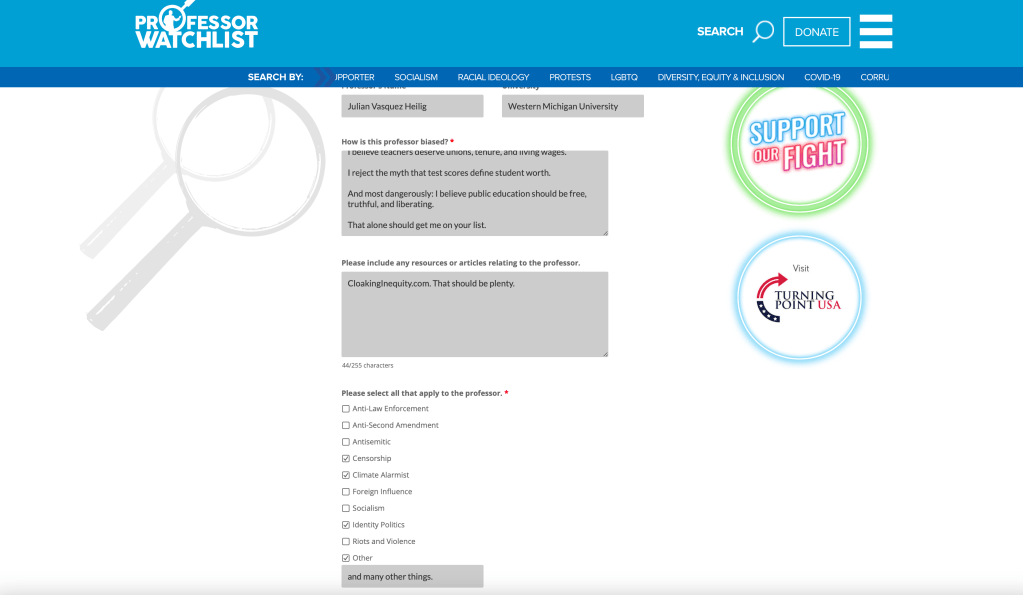
So I invite you to do something bold: apply to be on the Turning Point USA professor watch list.
The Professor Watchlist is a digital blacklist maintained by Turning Point USA (TPUSA)—a conservative political advocacy organization founded by Charlie Kirk. Branded as a tool to “expose and document college professors who discriminate against conservative students and advance leftist propaganda in the classroom,” the site compiles names, photos, and affiliations of faculty from across the country. Their so-called evidence? Often nothing more than public quotes, tweets, syllabi, or research topics that challenge right-wing orthodoxy.
Framed as a defense of “free speech,” the Watchlist functions as a political weapon—one designed to chill academic freedom, intimidate educators, and silence critical perspectives on race, gender, history, and inequality. Scholars are targeted for teaching about systemic racism, LGBTQ+ rights, reproductive justice, decolonization, and even climate change. Some entries are based on unverified student complaints or selectively interpreted media reports from ideologically aligned outlets.
In reality, the Professor Watchlist is less about protecting students and more about punishing professors who refuse to conform. It’s part of a broader campaign to erode trust in higher education, discredit intellectuals, and normalize surveillance of dissent. To be named is not to be disgraced. It is to be marked as a threat—to religious nationalism, to educational privatization, to authoritarian nostalgia. In that sense, the list doesn’t expose misconduct—it reveals who’s doing the work of liberation.
So, let’s flood them with applications. Let’s crowdsource the resistance. If their goal is to track professors, let us give them volume. If they seek to name us, let us name ourselves first—and do so with pride.
Because when they target one of us, they wake the rest of us up.
Now, without further ado, I offer my own application to join this peculiar pantheon of “dangerous” minds.
Dear Turning Point USA: Please Add Me to Your Watchlist An Open Letter from Dr. Julian Vasquez Heilig
Dear Professor Watchlist Committee (Or perhaps the underpaid intern fielding angry emails from Florida,)
It has come to my attention that I am not yet listed on your Professor Watchlist. I must admit, this oversight stings. After all, I’ve spent the better part of two decades building what I assumed was an ironclad case for inclusion.
So, I write today with a single request:
Please add me—Dr. Julian Vasquez Heilig—to your list of professors you find ideologically threatening.
I don’t say this lightly. I understand the risk. Being included on your list has subjected others to harassment, threats, and professional backlash. But I also understand the honor—the unintentional but very real validation of one’s commitment to critical inquiry, to justice-centered scholarship, and to the radical idea that public education should serve the public good, not private agendas.
Allow me to submit my credentials.
1. Academic Credentials That Question Power, Not Protect It
I am a tenured full professor of educational leadership and policy. My academic journey has spanned the nation—from faculty beginnings at the University of Texas at Austin, to Dean at the University of Kentucky, and then Provost and Vice President for Academic Affairs at Western Michigan University.
This fall, I return to the classroom to continue preparing the next generation of scholar-activists. My courses explore equity, justice, accountability, and the ways schools can either reproduce or disrupt inequality. I’ve designed graduate programs for diverse leaders, taught K–12 school equity audits, and likely mentored more doctoral students of color than Turning Point USA has ever platformed at one of its conferences.
I’ve authored numerous peer-reviewed articles on high-stakes testing, segregation, and charter schools, published in Urban Education, Teachers College Record, Educational Policy, and Harvard Educational Review. A law review article I co-authored on school finance has been cited in national policy briefs.
My work is referenced by policymakers, think tanks, and educational justice campaigns—and featured in the New York Times, LA Times, Washington Post, USA Today, AP, Education Week, and more. I’ve appeared on local, national, and international media including Al Jazeera, ABC, FOX, CBS, PBS, NBC, NPR, Univision, Latino USA, Democracy Now!, and MSNBC.
In short: I don’t just theorize about equity—I publish it, teach it, and bring it to the public.
2. Public Scholarship That Won’t Sit Quietly in Ivory Towers
In your worldview, professors should remain apolitical technicians—quietly crunching data, nodding through school board meetings, never questioning who holds power.
That is not who I am.
My blog, Cloaking Inequity, has reached over 1.4 million readers in 200+ countries. Consistently ranked among the top 100 education blogs globally, it dissects everything from Trump’s education policy to the voucher-industrial complex. I’ve exposed how billionaires launder racial supremacy through school privatization and how “parental rights” is often camouflage for cultural warfare.
I speak plainly: Privatization is plunder. Charter expansion is modern segregation. Meritocracy is a myth.
As co-leader of the NAACP National Education Taskforce, I’ve worked to resist Project 2025—Trump’s blueprint for dismantling public education, civil rights enforcement, and DEI programs. As former NAACP Education Chair in both Kentucky and California, I’ve helped develop legal strategies and grassroots coalitions to defend our schools.
I do not fear political pushback. I court it—because truth-telling should make someone uncomfortable.
3. I Stand With Those You’ve Already Targeted
Let’s take a moment to honor the prestigious company I hope to join.
You’ve already listed:
- Bettina Love, whose We Want to Do More Than Survive turned abolitionist teaching into national conversation.
- Wayne Au, who revealed the racist roots of standardized testing.
- Zeus Leonardo, who exposed how whiteness is embedded in pedagogy.
- Dorinda Carter Andrews, a critical race theorist helping teachers dismantle racial injustice.
- Asao Inoue, who critiques standard English supremacy and biased grading systems.
- Rochelle Gutierrez, who dares to question the colonial values encoded in math itself.
These are not radicals. They are scholars pushing our field forward. Many are my friends. Their research fuels dissertations, informs policy, and transforms classrooms.
If they are guilty of “advancing a radical community-centered agenda,” then I confess: I am joyfully complicit.
4. I Commit the Ultimate Sin: Believing in Public Education
Let’s be honest. What you fear isn’t indoctrination—it’s education itself.
You’re not afraid students will be told what to think. You’re terrified they’ll learn how to think. How to analyze power. How to challenge systems. How to read a budget. How to spot a lie wrapped in red, white, and blue.
You target us because we refuse to “both sides” authoritarianism. You call us propagandists because we teach truth: that Columbus didn’t “discover” anything; that slavery built this country’s wealth; and that trans students deserve safety and dignity.
You claim to defend free speech—but silence professors with public shaming. You claim to love liberty—but blacklist those who expand its definition.
Your list doesn’t scare me. It fuels the patriot in me.
5. My Application Is a Love Letter to Democracy
My family’s story reflects the real American dream—not the sanitized tale of bootstraps, but the intergenerational struggle for dignity and education.
My great-grandfather was a coal miner. My grandfathers were union auto workers. My maternal family labored as migrant agricultural workers in Michigan. My parents earned degrees from Michigan State and the University of Michigan.
I was born at U-M Hospital, raised in a working-class Black and brown neighborhood, and educated at some of the whitest institutions in America. I’ve worked in red, blue, and purple states—serving in public universities from regional to flagship, as professor, dean, and provost.
I come from coal and crops, books and blue collars. And that makes me dangerous to those who want to flatten education into obedience.
Everywhere I go, I ask one question:
Whose children get opportunity—and whose are left behind?
If asking that makes me dangerous, then yes—please, add me to your list.
I’ll Even Send a Headshot.
If your processing is delayed, I understand. But just in case you need more reasons:
- I critique charter school corruption.
- I oppose voucher schemes.
- I champion Black history, ethnic studies, and labor rights.
- I advocate for sanctuary schools and restorative justice.
- I believe teachers deserve tenure, unions, and living wages.
- I reject the myth that test scores define student worth.
- And yes—I believe public education should be free, truthful, and liberating.
That alone should earn me a spot.
Closing: Let’s Make the List Unmanageable
To every scholar reading this: If you teach with justice, write with courage, and speak truth in your community, you too deserve to be on this list.
So write your own application to them here. Then publish it. Tag @TPUSA. Use #ProfessorWatchMe.
Let’s make our resistance visible, intentional, and unapologetically public.
After all, if they’re going to build a list of troublemakers, let’s make sure we are the most brilliant, beloved, and unbowed band of educators they’ve ever seen.




 Cloaking Inequity
Leave a comment