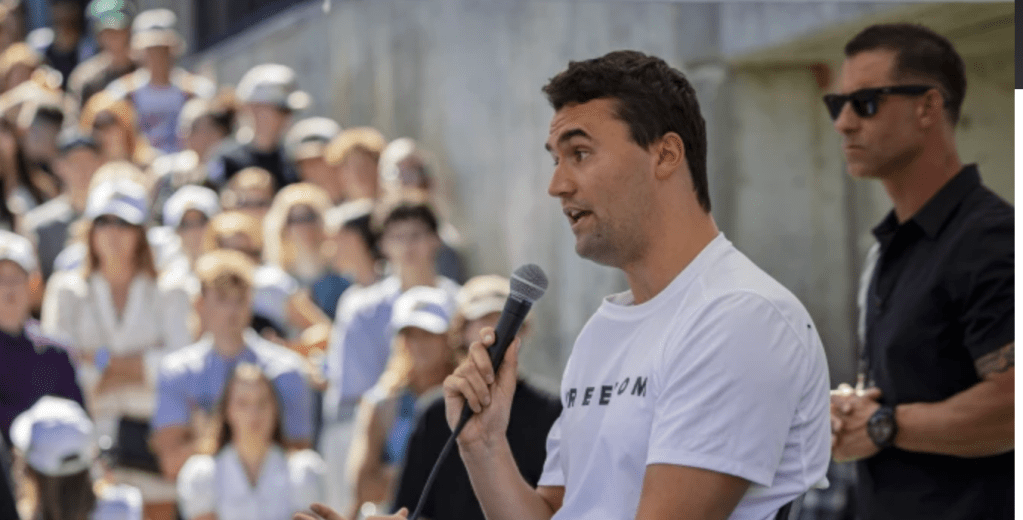
Today, on September 10, 2025, Charlie Kirk, the ultra conservative activist and co-founder of Turning Point USA, was shot in the neck while speaking at an event at Utah Valley University as part of his “American Comeback Tour” an he remains hospitalized, with no further updates yet on his condition. This is not just an attack on one right-wing voice, it’s an assault on the very fabric of free expression and democratic dialogue in our nation.
Gunfire has become the cruel punctuation mark in democracy. We have witnessed it on campaign stages, in schools, in shopping centers, and in neighborhoods where children should be free to play. Whether aimed at silencing political opponents or erupting in the streets of our cities, gun violence is destroying lives and corroding the foundations of our democracy.
The Political Arena: Words, Not Weapons
In a democracy, ideas should clash, not bodies. Campaign rallies, community forums, and legislative debates are supposed to be spaces where disagreements sharpen our understanding, not targets for assassination attempts. When political violence takes root, when bullets fly at elected officials, activists, or public figures, it is not just individuals who are harmed. It is the principle of free speech itself.
From the tragedies that struck leaders like Malcolm X, Robert Kennedy, and Dr. Martin Luther King Jr. to the more recent attacks on Gabby Giffords, Steve Scalise, Donald Trump, and Charlie Kirk, the pattern is devastatingly clear: gun violence is being used to end conversations that should be won or lost in the arena of ideas. Every shot fired is an attempt to silence, not to persuade. That is the death of democracy.
Communities Held Hostage by Gunfire
But this crisis is not confined to politics. It is also lived daily in our neighborhoods. Gun violence has become the leading cause of death for children and teenagers in the United States. Families in Detroit, Chicago, El Paso, Uvalde, Buffalo, and countless other places know the grief of losing loved ones to senseless shootings. The violence is not partisan, not ideological, it is personal. It leaves empty chairs at dinner tables, backpacks that never return from school, and parents burying their children.
When a community must navigate fear of bullets, domestic disputes turned deadly, or suicides fueled by easy access to firearms, the social fabric frays. Safety becomes a privilege instead of a right.
What We Must Say, What We Must Do
We must have the courage to say it plainly: too many guns, too easily accessible, are robbing this country of its future. Common-sense measures, universal background checks, safe storage laws, red flag protections, are not radical. They are the minimum required to honor the lives we’ve already lost and to prevent more blood from staining our schools, streets, and stages.
But laws alone are not enough. We must also change the culture that is glorifying extreme political violence, that mistakes domination for strength, that jokes about resolving political conflict with a trigger pull.
A Call for Courage
Gun violence in politics and in our communities is not two separate tragedies, it is a twin crisis. One strikes at the heart of our democracy, the other at the soul of our daily lives. Both flow from the same failure: a refusal to value human life over firepower and anger. It does not have to be this way. We can choose differently. We can choose life, dignity, and a future where safety is not a privilege but a right.
We should honor those we have lost not with empty words or ritual condolences, but with action, bold, urgent, and unrelenting. Too much blood has already been spilled. Too many leaders, neighbors, children, and friends have been stolen from us. Now is the time to lift our grief into courage. To raise our voices not only in sorrow after the next tragedy, but in a steady chorus that refuses to accept gun violence as normal. A chorus that declares: No more killing. No more excuses. No more silence disguised as thoughts and prayers.
Julian Vasquez Heilig is a nationally recognized public scholar whose work bridges education, policy, and social justice. A consistent advocate for equity and democracy, he writes and speaks widely on the intersection of community, leadership, and the urgent need to confront injustice with courage and collective action.




 Cloaking Inequity
Leave a reply to From Watchlists to Cruelty: The True Legacy Charlie Kirk Left Behind – Cloaking Inequity Cancel reply