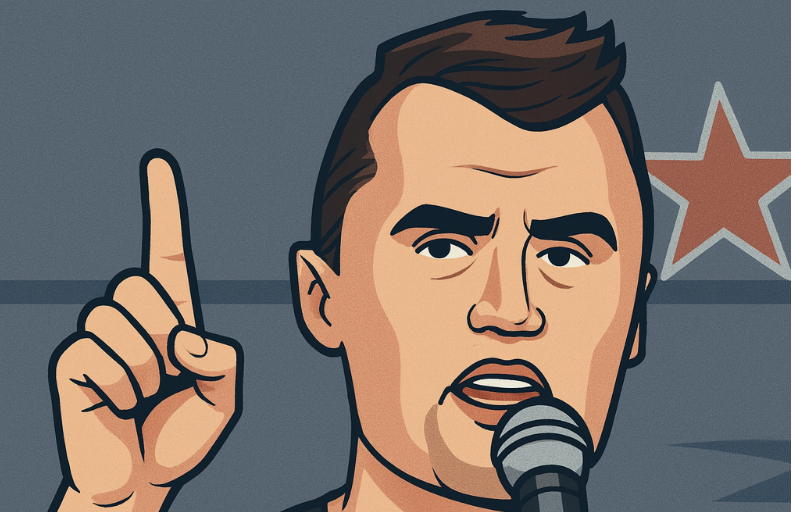
Charlie Kirk once declared, “I can’t stand the word empathy, actually. I think empathy is a made-up, new age term that does a lot of damage.”
It is a stunning line—not just for its cold dismissal of compassion, but for what it reveals about the worldview he helped mainstream. Empathy—the ability to recognize another’s pain, to imagine their humanity, to treat every life with equal worth, is the glue that binds a democratic society. Kirk regarded it as corrosive, a weakness. In his extensive political project, empathy had no place.
After his killing, in the article Charlie Kirk Shot: No More Bullets in Our Politics, No More Blood in Our Communities I held empathy for his family, for the right wing who mourns him, for the fragility of life itself. But empathy is not the same as silence. To mourn without remembering truth is not compassion; it is erasure. And the truth is that Kirk built a career out of normalizing harassment, cultivating division, and mainstreaming ideas that demeaned, scapegoated, and excluded. If we are to learn from his life, we must speak honestly about what he said, what he did, and the culture of intimidation he left behind.
The Professor Watchlist
Kirk’s perhaps most infamous creation was the Professor Watchlist, run through his organization, Turning Point USA. Publicly branded as a transparency tool, it functioned as a digital hit list targeting professors whose research or teaching challenged right wing orthodoxy. The Watchlist normalized political harassment of educators, particularly women, Black faculty, and queer scholars. It showed how Kirk’s movement turned disagreement into intimidation. As Dr. Stacey Patton put it, ” Speak the truth and we will unleash the mob.” Critics have argued, and I agree, that Kirk monetized outrage, weaponized harassment, and turned public discourse into a tool for disciplining dissent.
I talked about this in a May 19, 2025 article, “Apply Here for the Watchlist: Academia’s New Mark of Courage @TPUSA #ProfessorWatchMe.” In that piece, I invited scholars to “apply” for inclusion on Kirk’s list, reframing it as an inadvertent badge of courage. If the Watchlist’s goal was to isolate educators, then our counter-move must be visibility: name ourselves, publish our work boldly, and stand together.
The cost was real. Professors added to the Watchlist have often faced torrents of abuse. Dr. Patton described her inbox filling with racial slurs, misogynist attacks, and violent threats. Universities were deluged with calls demanding firings. Some campuses assigned security escorts to targeted faculty, fearing online threats might turn into physical ones. This was not incidental—it was the point. Fear is a shortcut. So while Kirk famously showed up on college campuses to debate students, you don’t need to win an argument with a professor if you can exhaust them into silence with your internet platform.
My colleague at Western Michigan University, Dr. Melinda McCormick, was also targeted. Her scholarship on inclusiveness, diversity, and LGBTQ+ youth in STEM education was enough to earn her a spot, tagged with labels like “Diversity, Equity & Inclusion, Racial Ideology, Feminism, LGBTQ.” Based on the experience of educators, Kirk’s Watchlist did not engender an exchange of ideas and free speech; it lend itself to intimidation.
As I blogged on May 19th: “When the gatekeepers say you’re dangerous, it usually means you’re telling the truth too loudly to ignore.” The Watchlist tried to define danger as dissent. I redefined danger as courage, the refusal to let harassment silence the work of knowledge creation.
Kirk’s Words: A Career of Division
While the Watchlist was an organizational extension of Kirk’s rhetoric, his words consistently demeaned, scapegoated, and excluded. They often fell into recognizable themes, each targeting communities or values that did not fit his narrow worldview. Here are a few of the words he left behind:
On Guns and Violence
- “Some gun deaths are worth it to preserve the Second Amendment.”
- On his young daughter being impregnated by rape: “The answer is yes, the baby would be delivered.”
These remarks reveal the stark calculus of Kirk’s worldview. Life itself could be treated as expendable, whether the lives lost to gun violence or the body of a raped child, so long as ideology was preserved. Rights for guns, but not for girls. Firepower prioritized over human dignity.
On Black People and Racism
- “If I see a Black pilot, I’m going to be like, ‘Boy, I hope he’s qualified.’”
- Calling George Floyd a “scumbag,” while pushing debunked narratives of his death.
- “Happening all the time in urban America, prowling Blacks go around for fun to go target white people, that’s a fact.”
- “If I’m dealing with somebody in customer service who’s a moronic Black woman… is she there because of her excellence, or … affirmative action?”
- “If we would have said that Joy Reid and Michelle Obama and Sheila Jackson Lee and Ketanji Brown Jackson were affirmative action picks… You had to go steal a white person’s slot.”
These quotes recycle the oldest racial tropes: Black people as dangerous, Black professionals as unqualified, Black women as undeserving. They smear achievement as theft, painting presence itself as illegitimate. By repeating these claims, Kirk gave his permission for suspicion and resentment to flow through workplaces, cockpits, customer counters, and even the Supreme Court.
On Women and Feminism
- On Justice Ketanji Brown Jackson: “She is only there because she’s a Black woman.”
- “Reject feminism. Submit to your husband, Taylor. You’re not in charge.”
For Kirk, feminism was not empowerment but rebellion. Women leaders were reduced to “tokens”; cultural icons like Taylor Swift were scolded into submission. These are not stray barbs, they are consistent with a worldview that sees equality as disorder and patriarchy as natural law.
On LGBTQ+ People and Gender
- “If you’re a WNBA, pot-smoking, Black lesbian, do you get treated better than a United States marine?”
- “We need to have a Nuremberg-style trial for every gender-affirming clinic doctor. We need it immediately.”
LGBTQ+ people were cast as undeserving, their lives and loves reduced to punchlines. Doctors providing gender-affirming care were likened to Nazi war criminals. Kirk’s statements did not merely disagree with policy; they sought to criminalize compassion, stigmatize care, and equate identity with threat.
On Jews and Antisemitism
- “Jews control … not just the colleges; it’s the nonprofits, it’s the movies; it’s Hollywood; it’s all of it.”
- Claiming Jewish donors were “subsidizing your own demise” by funding universities that “breed Anti-Semites.”
These are echoes of the oldest and despicable antisemitic conspiracies: Jews as puppet masters of culture, Jews as complicit in their own destruction. They revive tropes used for centuries to justify exclusion, pogroms, and worse. And in the mouths of men with mass followings, such words ripple outward into dangerous waters.
On Immigration and Replacement Theory
- Arguing Democrats aim to “diminish and decrease white demographics in America.”
- Warning that immigration is designed to “dilute” American culture and values.
Here Kirk parroted the “Great Replacement” conspiracy. This is not a new argument. It descends from the older “white genocide” theory, popularized by neo-Nazi David Lane in his 1995 White Genocide Manifesto, which warned that governments were plotting to make white people an “extinct species.”
French writer Renaud Camus later coined the phrase “Great Replacement” in the 2010s, giving the conspiracy a polished rebranding that allowed it to travel from fringe neo-Nazi forums into mainstream European and American politics. Kirk’s contribution was laundering this theory for a new generation of youth, dressing it not in swastikas but in soundbites.
On Abortion
- Comparing abortion to the Holocaust.
By equating abortion with genocide, Kirk trivialized both. Women making personal medical decisions were cast as perpetrators of atrocity, while historical genocide was reduced to a rhetorical flourish. This framing erases complexity, vilifies women, and severely cheapens historical memory.
On Islam
- “America has freedom of religion… but large dedicated Islamic areas are a threat to America.”
- “Islam is not compatible with Western civilization.”
These words treat millions of Muslims not as fellow citizens but as a civilizational threat. They cast neighborhoods as dangers, faith as incompatibility, identity as disloyalty. This is not defense of liberty; it is permission for suspicion and exclusion.
On Empathy and Human Connection
- “I can’t stand the word empathy … it does a lot of damage.”
Here is the through-line. If empathy is weakness, then cruelty is strength. If compassion is corrosive, then violence is cleansing. Rejecting empathy is the keystone that holds the rest of the worldview together.
Empathy for Transformation
Charlie Kirk built a career on corrosive ideas, racism dressed up as honesty and free speech, cruelty masquerading as strength, harassment repackaged as politics. He dismissed empathy itself as weakness. His rhetoric demeaned Black people, immigrants, women, Jews, Muslims, and LGBTQ+ communities. And yet, while it is still early in the investigation, early indications suggest that none of the communities he constantly vilified were responsible for the attack on him.
At the same time, the hypocrisy of our political culture is on full display. When Senator Hortman, her husband and her dog from Minnesota were assassinated, there was no wall-to-wall coverage, no bipartisan chorus of reverence, no endless commentary from CNN, MSNBC, Fox News, or Republican leaders. Senator Hortman’s death passed with far less national mourning, treated as a political tragedy but not as a civic crisis. Kirk’s, by contrast, has been elevated to a reverent spectacle. That difference in treatment is not only disappointing— it is revealing, exposing the transactional way America dispenses compassion.
The disparity is glaring because it reflects the very culture Kirk helped to shape: one where empathy is dismissed, where compassion is conditional, and where the value of life is measured by partisan loyalty rather than by shared humanity. In such a culture, the deaths of some are magnified into national mourning, while others are minimized, forgotten, or brushed aside.
This is the dangerous irony. Kirk rejected empathy as corrosive, but it is precisely empathy that keeps a society from descending into cruelty. He vilified entire communities, yet those same communities are not implicated in his death. He normalized selective compassion, and now his own passing is being honored in exactly the transactional way he preached: amplified for political capital, stripped of the deeper moral reckoning it requires.
If we are to learn anything from this moment of national shame, it is that empathy must never again be dismissed as weakness. Empathy is strength. It is the moral anchor that exposes hypocrisy, resists cruelty, and insists that every human life has equal worth. Without empathy, mourning devolves into political spectacle. With empathy, mourning becomes transformation—and in that transformation, Kirk’s ideas lose their power.
Julian Vasquez Heilig, Ph.D., is a nationally recognized education scholar, public intellectual, and media voice on issues of equity, democracy, and policy. His work has been featured in the New York Times, Washington Post, Los Angeles Times, USA Today, Education Week, and the Associated Press. He has provided expert commentary on CNN, MSNBC, PBS, NPR, Al Jazeera, Univision, ABC, CBS, FOX. Through his widely read blog Cloaking Inequity and his LinkedIn newsletter Without Fear or Favor, Vasquez Heilig has reached millions of readers in over 200 countries, translating academic research into accessible insights for the public. His media presence consistently challenges misinformation, amplifies marginalized voices, and connects scholarship to urgent debates in education and democracy.




Leave a Reply